Showing posts with label peace. Show all posts

Friday, May 23, 2025

Incessant Thinking and Peace Are Both Within the Mind


Date: Thu, May 22, 2025 at 12:08 PM
Subject: Incessant Thinking and Peace Are Both Within the Mind


Is this email not displaying correctly?
View it in your browser.


May 22, 2025

Thinking, including incessant
thinking, is within the mind. Peace,
too, is within the mind. Understanding
this allows you to watch them both as
objects of the mind, rather than as  
something personal—as "mine."

  
To subscribe to The DailyTejaniya, click here.


To support Sayadaw's freely-
given teachings, click here. 

Sayadaw's website is here. Wisdom's 
Roar
compiles quotes and resources. 

Photography by Tuck Loon Hor 
An archive of The Daily Tejaniya
since 2015 is here.

The editor's website is
www.dougmcgill.com.

Queries: doug@dougmcgill.com

Wednesday, February 12, 2025

Wisdom on finding peace

Why are we all here on Insight Timer or any other meditation platform?

Because we are all seeking peace, a space to slow down, quiet the mind, and reconnect with ourselves, right?

Why do we crave alone time after a long day, whether it’s soaking in a warm bath or standing under a hot shower?

Because in that moment of stillness, we find peace, a break from the noise, a chance to release tension and just breathe.


Why do we get lost in the moment when staring at the ocean or savoring a cup of coffee?

Because it brings a sense of peace, a reminder to be present, to simply exist without overthinking.


And isn’t that why we meditate? To find that same peace, not in the outside world, but within ourselves.


So where is peace found? 


It is always within. Whenever life feels overwhelming, and you need to shut out the outside noise, just go inward. No matter how busy or chaotic life feels, peace is always there, waiting for you to return to it. All you have to do is pause, breathe, and listen. ❤🙏💫

Friday, July 26, 2024

Robert Aitken - Gatha

The Ocean at Sunrise

On the shore of the ocean at sunrise 
I vow with all beings 
to rejoin this enormous power 
that rises and falls in great peace.

~ Robert Aitken, from The Dragon Who Never Sleeps, pg 41

Friday, July 12, 2024

Fwd: The Raft: Peace and Happiness


How can we live a happy and peaceful life in a world filled with suffering?

Inspiration from the International Plum Village Community
May 2024

The Raft

"Our life will be filled with happiness if we can help others around us. But if we spend our whole life building up our name and our fortune, we cannot find happiness. We might have a lot of money, a big house, and a luxurious car, but that's not real happiness. We can only taste real happiness when we can help others."

Thich Nhat Hanh, Peace Is This Moment

Peace and Reconciliation

Brother Phap Dung of Deer Park Monastery gave a Dharma talk at Dartmouth College on peace and reconciliation:


"The topic of peace is is always in our heart; our teacher, that's his whole life: he grew up during wartime with the French occupation, and then the Japanese and then the Americans bringing a lot of violence to our country in Vietnam. So his whole life was dedicated to try to find another option besides resorting to violence. There was a period when he was young, he was tempted to actually leave monastic life and and join the resistance movement to fight against the foreign French and American forces that were bringing in a lot of violence… [But] Thay wanted to find another way of peace so this is why he dedicated his life as a monastic to help people come to a place of nonviolence."

Watch

Can You Live a Happy Life?

In this article on Buddhist ethics, based on a talk given by Thay in 2008/9, we look deeper into the use of Normative Ethics alongside our practice to help us determine what is "right" and how this can lead to a happy life:


"Your way (of seeing) determines whether something is suffering or not.

For example, when we clean the toilet. We can ask: is cleaning the toilet a pain or a pleasure? It depends on the person, right? There are people who don't have a toilet to clean. There are people who have toilets, but don't have soap or toilet cleaner to clean them. There are people who have a toilet, but don't have the time to clean it. And so these people may be very happy to clean the toilet. 'How lucky to have a toilet to clean, to have a clean toilet to use,' so while cleaning the toilet, happiness is possible. But if you think, 'Someone like me, cleaning toilets?' then you would be miserable. So whether suffering or joy, or happiness, depends on us."

Read

Q & A: The Art of Happiness

Watch
 

Guided Meditation: Touching the Buddha Within

This 23-minute guided meditation with Sister Dao Nghiem helps us get in touch with our Buddha nature, arriving one step closer to realizing understanding and compassion. By letting our Buddha nature act for us, we act from compassion and understanding.

Listen

Five Mindfulness Trainings Now in Twelve Languages

The Five Mindfulness Trainings have their root in the Five Precepts offered by the Buddha. They have been expanded and updated so that they represent a way to bring mindfulness into every area of life. Rather than hard and fast rules, they offer us a path to cultivate and develop actions of body, speech and mind that can create a more healthy and compassionate world. With the latest addition of Hindi, they are now available in English, Vietnamese, French, German, Italian, Dutch, Spanish, Greek (Ελληνικά), Bulgarian (български), Chinese (中文), and Turkish (Türkçe).

Read

Retreats & Events

We offer a separate email containing upcoming retreats, events, and community news. Make sure you are signed up by checking your email preference center.


If you can't wait for the next events email, we invite you to take a look at these resources:

Online Events
Retreat Calendar

Thank You

We would like to share with you our heartfelt gratitude for your continued practice and for your support for our beloved monastics and the International Plum Village Community. As we say in the Plum Village tradition, "You are, therefore I am." We wish you and your loved ones safety, health, and ease.

Sunday, January 21, 2024

Foundational Freedom

This talk is about Foundational freedom: the freedom to choose one's attitude. V Frankl

An inner freedom  not limited by external conditions...can be free even if one is in prison.  Nelson Mandela.  Transformed his inner life. to be able to see the humanity in the being of those who were oppressing him and all people of color. 
cultivating his own equanimity and his inner freedom helped move South Africa to a more peaceful society.

Cultivate our own hearts in order to be happy in a world in turmoil.
Ability to meet life's hardships and joys with inner peace. freeing our own hearts. 


Saturday, July 30, 2022

Gathas: How to


How to Do Gatha Practice

By reciting the short verses known as gathas, says Zachiah Murray, we transform any activity into an opportunity to awaken to our true nature. Illustrations by Carole Hénaff.

Illustration of woman walking in garden, "entering the garden, I see my true nature. In it's reflection my heart is at peace."
Gathas are short verses that call us to the present moment. Reciting gathas is a good way to meditate while engaged in any activity, be it sacred or mundane. Joining the breath, the mind, and the activity of the body, the practice invites us into a deep, direct experience of our environment and our self. Dwelling in the present moment in this way, deeply aware of the action we are engaged in, we can develop greater understanding and love.

The word gatha is related to the Sanskrit term for “song” or “verse.” Gathas originated around 1300 BCE as metrical forms of Indo-Iranian religious poetry. Written by the Iranian poet and prophet Zoroaster, a text of hymns called Gathas was placed at the center of Zoroastrian scripture and tradition as a form of reflective spiritual practice. Scholars believe that as Buddhism spread eastward from India, it was influenced by Zoroastrian traditions, and gathas developed in various streams of Buddhism.

Gathas invite us into greater understanding and love through their practice.

The contemporary recitation of gathas has been popularized by Zen teacher Thich Nhat Hanh. In his tradition, a gatha is a verse recited, usually mentally, not aloud, in rhythm with the breath. This is a mindfulness practice we can perform in daily life, or as a part of formal meditation or meditative study. Rich with wordplay and intentional ambiguities, these gathas are intended to awaken the innate inner wisdom of the practitioner, spurring her toward enlightenment.

As a meditative tool, gathas have a close and parallel relative—mantra. A mantra is a sacred word or sound—usually in Sanskrit—that’s repeated, either aloud or in silence, to deepen one’s concentration in meditation. As such, a single mantra may be used while performing many different activities or as a form of meditation itself. Gathas distinguish themselves from mantras in that each gatha is deeply intertwined with a single activity, drawing the practitioner deeply into the flow and feel of the specific action being performed. Ultimately, both gathas and mantras invite us into greater understanding and love through their practice.

If we bring our sincere attention to it, any activity can cultivate awakening to our true nature, our basic goodness. That’s why gathas, which help us bring attention to the present moment, can be used when performing any type of activity—waking up in the morning, brushing our teeth, taking out the garbage, entering the meditation hall, or inviting the bell.

No matter what activity we’re engaging in, or the particular words of the gatha we’re reciting, the practice is always similar. To serve as an example, here’s how we can practice with a gatha for entering a garden—for the moment we cross the threshold from “inside” to “outside.” The crossing of this threshold gives us just enough space to come back to ourselves. We arrive.
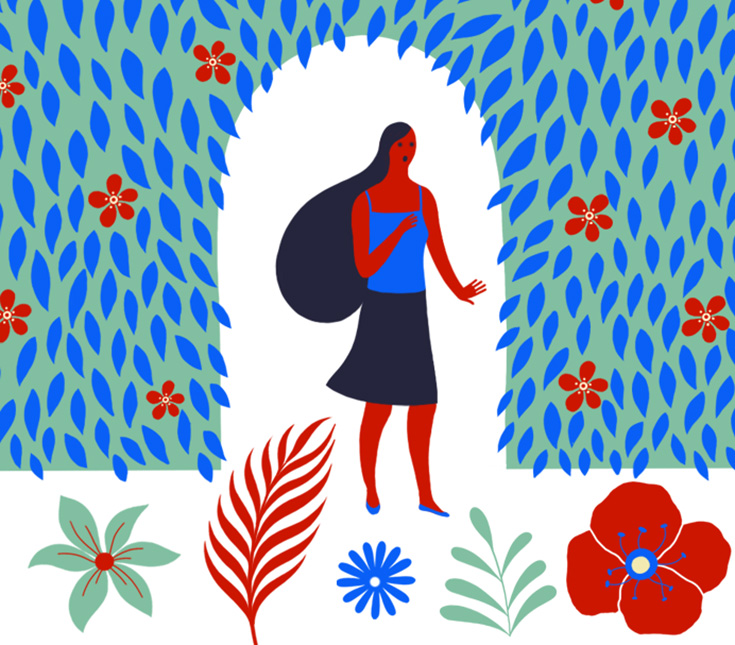
Woman walking in garden

Step One: Recite the Gatha

We stop at the threshold of the garden, becoming aware of the in-breath and the out-breath. We observe the beauty of the environment around us and create an internal pause by reciting—silently or out loud—the entire gatha:

Entering the garden,

I see my true nature.

In its reflection

My heart is at peace.

We allow the meaning to touch our awareness.
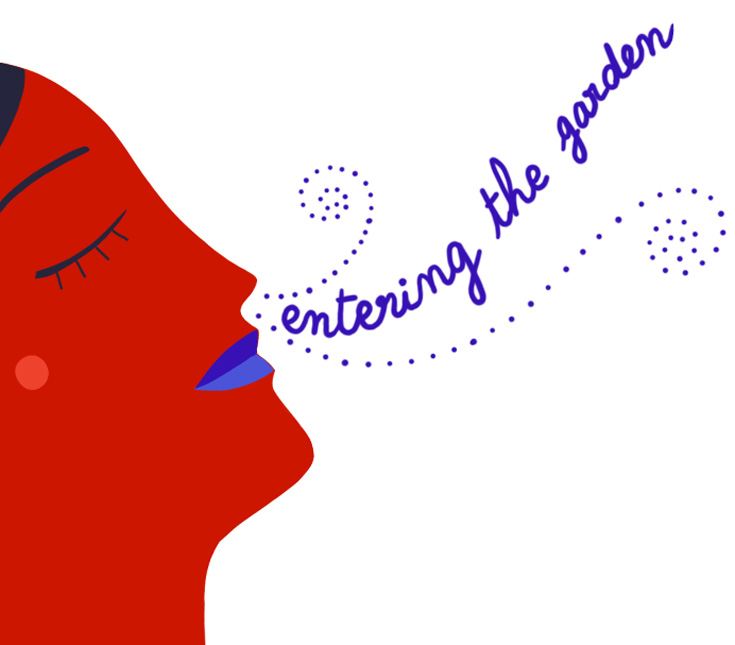
Woman inhaling, "entering the garden"

Step Two: Synchronize with the Breath

A gatha is intended to be practiced in alignment with the breath. Once we have a feel for the gatha, we can correlate each line with an in-breath or an out-breath.

As we say or think, “Entering the garden,” we breathe in, bringing our full awareness to the moment of our arrival.

Next, we say or think, “I see my true nature,” while we breathe out, entering a direct communion with all of nature and inviting a deeper understanding of our true self.

Then we say or think, “In its reflection,” as we breathe in, seeing the beauty and magnificence of nature as a mirror of our own beauty and connection with all of life.

Finally, as we say or think, “My heart is at peace,” we breathe out, peaceful and alive in the present moment.
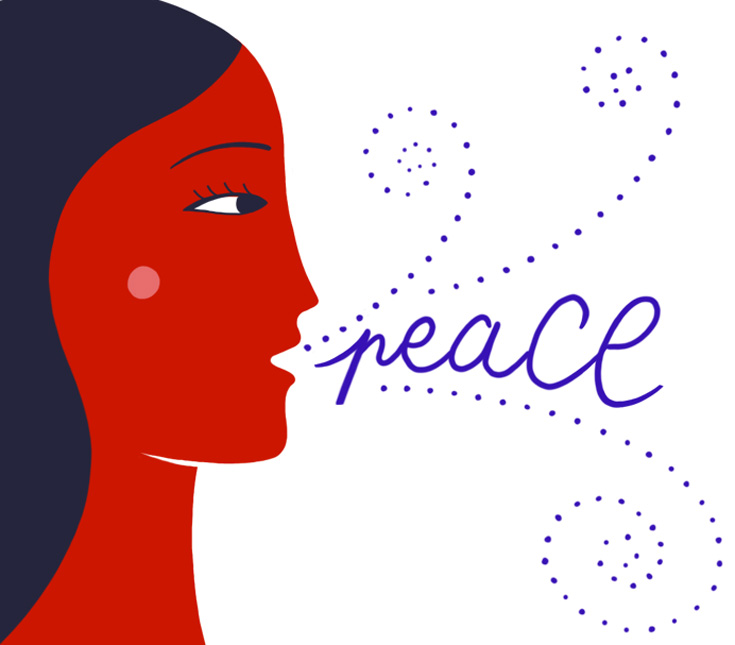
Woman exhaling, "peace"

Step Three: Shorten the Gatha

After we have practiced with the gatha a number of times and have internalized it, we can shorten it. For example, breathing in, we say or think, “Entering.” Breathing out, we say or think, “Nature.” Breathing in, we say or think, “Reflection,” and lastly, breathing out, we say or think, “Peace.” When we have truly internalized a gatha, just a few words will be enough to remind us of the whole.

Many wonderful gathas have been created by Buddhist teachers, and we can benefit from their wisdom. Thich Nhat Hanh’s gatha for greeting someone is “A lotus for you, a Buddha-to-be.” His gatha for washing our hands is “Water flows over these hands. May I use them skillfully to preserve our precious planet.” More gathas by Thich Nhat Hanh can be found in his book Chanting from the Heart: Buddhist Ceremonies and Daily Practices.

Touching what’s real and alive in each moment ultimately returns us to our authentic self.

To personalize our practice with gathas and nourish the expression of our true nature, we can compose our own gathas inspired by our daily experiences and observations. To do this, we choose an activity that we regularly perform, create and memorize a gatha for it, and recite the gatha each time we do that particular activity. The personal nature of gathas created from our own insights deepens our practice and has the potential not only to develop our mindfulness and compassion, but also to water the seeds of compassion and love in those with whom we come into contact.

As meditation in motion, gathas loosen the tangle of our thoughts, opening us to experience the present moment. They help us deepen our understanding of our connection and belonging with all of life as we mindfully engage in the activity before us. When the mind drops into the heart and joins in communion with the breath and our actions, we see life as it is and ourselves as an integral part of it. Touching what’s real and alive in each moment ultimately returns us to our authentic self. Grounded in our essential nature, we can offer our joy, peace, and love to all beings around us. This gift, the gift of our self when expressed in this way, is perhaps the greatest gift ever.

Sunday, March 14, 2021

Mary Oliver's 'When I am among the Trees'


WHEN I AM AMONG THE TREES

by Mary Oliver

When I am among the trees,
especially the willows and the honey locust,
equally the beech, the oaks and the pines,
they give off such hints of gladness.
I would almost say that they save me, and daily.
I am so distant from the hope of myself,
in which I have goodness, and discernment,
and never hurry through the world
but walk slowly, and bow often.
Around me the trees stir in their leaves
and call out, “Stay awhile.”
The light flows from their branches.
And they call again, “It’s simple,” they say,
“and you too have come
into the world to do this, to go easy, to be filled
with light, and to shine.”

Sunday, November 1, 2020

Peace is this moment without judgment


by Dorothy Hunt

Peace is this moment without judgment

Do you think peace requires an end to war? 
Or tigers eating only vegetables? 
Does peace require an absence from 
your boss, your spouse, yourself? 
Do you think peace will come some other place than here? 
Some other time than now? 
In some other heart than yours? 

Peace is this moment without judgment. 
That is all. This moment in the Heart-space 
where everything that is is welcome.
Peace is this moment without thinking 
that it should be some other way, 
that you should feel some other thing, 
that your life should unfold according to your plan.

Peace is this moment without judgment, 
this moment in the heart space where 
everything that is is welcome.


Sunday, October 11, 2020

from Freedom of the Heart through Breathing

 Peace is This Moment Without Judgment

Do you think peace requires an end to war?

Or tigers eating only vegetables?
Does peace require an absence from
your boss, your spouse, yourself?...
Do you think peace will come some other place than here?
Some other time than Now?
In some other heart than yours? 

Peace is this moment without judgment.
That is all. This moment in the Heart-space
where everything that is is welcome.
Peace is this moment without thinking
that it should be some other way,
that you should feel some other thing,
that your life should unfold according to your plans. 

Peace is this moment without judgment,
this moment in the heart-space where
everything that is is welcome.

© Dorothy Hunt

Friday, March 20, 2020

The Peace of Wild Things - Wendell Berry


When despair for the world grows in me

and I wake in the night at the least sound
in fear of what my life and my children's lives may be,


I go and lie down where the wood drake
rests in his beauty on the water, and the great heron feeds.


I come into the peace of wild things
who do not tax their lives with forethought of grief. 


I come into the presence of still water.
And I feel above me the day-blind stars waiting with their light. 


For a time I rest in the grace of the world, and am free.

Tuesday, December 6, 2016

A Stand-down at Standing Rock

While 'showing up' for meditation on a cold, snowy December morning (two days ago, Dec 4th, Sunday)...a meditation dedicated to the ongoing humanitarian effort at Standing Rock, I walked to support 'water protectors'. 

Funny that while walking...frequently 'rationalizing' the good and the bad about the walk, about the cold, about the discomfort, I gradually settled, and noticed how 'showing up' for each moment and each step of the walk brought peace...'Peace is every step'.  Apparently bringing peace elsewhere, too.

And perhaps as a result of committed, interconnected,heart-ful effort, what occurred later this very same day was a decision by the Army Corps of Engineers -- a decision to find another path for the oil pipeline. Hey, hey! 


In Cloister at Cadouin Abbey, La Dordogne, Nov 6 - 2016

Sunday, May 29, 2016

on peace


@Zen_Moments: Violence is unnecessary and costly. Peace is the only way. ~ Julius K. Nyerere m.twitter.com/Zen_Moments
 

Tuesday, January 5, 2016

Peace is always beautiful - Whitman


@Zen_Moments: Peace is always beautiful. ~ Walt Whitman m.twitter.com/Zen_Moments
 

Monday, December 23, 2013

Christmas Light - Mary Sarton

Thank you to Warren for sharing this poem on 12/22/13.


Christmas Light

When everyone had gone
I sat in the library
With the small silent tree,
She and I alone.
How softly she shone!

And for the first time then
For the first time this year,
I felt reborn again,
I knew love's presence near.

Love distant, love detached
And strangely without weight,
Was with me in the night
When everyone had gone
And the garland of pure light
Stayed on, stayed on.
"Christmas Light" by May Sarton from Collected Poems. © W. W. Norton, 1993. Reprinted with permission

Monday, May 6, 2013

Barry Magid on Just Sitting and Lovingkindness

To practice lovingkindness meditation, sit in a comfortable and relaxed manner. Take two or three deep breaths with slow, long, and complete exhalations. Let go of any concerns or preoccupations. For a few minutes, feel or imagine the breath moving through the center of your chest in the area of your heart.

Metta is first practiced toward oneself, since we often have difficulty loving others without first loving ourselves. Sitting quietly, mentally repeat, slowly and steadily, the following or similar phrases: May I be happy. May I be well. May I be safe. May I be peaceful and at ease.

While you say these phrases, allow yourself to sink into the intentions they express. Lovingkindness meditation consists primarily of connecting to the intention of wishing ourselves or others happiness. However, if feelings of warmth, friendliness, or love arise in the body or mind, connect to them, allowing them to grow as you repeat the phrases. As an aid to the meditation, you might hold an image of yourself in your mind’s eye. This helps reinforce the intentions expressed in the phrases.

After a period of directing lovingkindness toward yourself, bring to mind a friend or someone in your life who has deeply cared for you. Then slowly repeat phrases of lovingkindness toward them: May you be happy. May you be well. May you be safe. May you be peaceful and at ease.

As you say these phrases, again sink into their intention or heartfelt meaning. And again, if any feelings of lovingkindness arise, connect the feelings with the phrases so that the feelings may become stronger as you repeat the words.

As you continue the meditation, you can bring to mind other friends, neighbors, acquaintances, strangers, animals, and finally people with whom you have difficulty. You can either use the same phrases, repeating them again and again, or make up phrases that better represent the lovingkindness you feel toward these beings.

Sometimes during lovingkindness meditation, seemingly opposite feelings such as anger, grief, or sadness may arise. Take these to be signs that your heart is softening, revealing what is held there. You can either shift to mindfulness practice or you can—with whatever patience, acceptance, and kindness you can muster for such feelings—direct lovingkindness toward them. Above all, remember that there is no need to judge yourself for having these feelings.

As you become familiar with lovingkindness practice during meditation, you can also begin to use it in your daily life. While in your car, or at work, or in public, privately practice metta toward those around you. There can be a great delight in establishing a heartfelt connection to everyone we encounter, friends and strangers alike.

Sunday, April 21, 2013

Our True Nature is Awareness - Warren Lang

Warren offered this poem tonight.  He said "Our true nature is awareness"....  He wrote this wonderful poem:

Breathe and breathe
Again.
Observe the mind.
Never leave this seat.

And his 'explication de texte', of his own text, is helpful:  Let the thoughts and feelings and other phenomena 's'evanouissent'.  See the ephemerality of phenomena.  This is liberation.

See how the process of 'identifying with suffering' only increases suffering or said differently, it keeps the suffering in the perceived domain of 'permanence', more ego-delusion. 

Identifying with suffering engenders actions that often increase suffering. No thought or condition is permanent. 

Our true seat is the seat of awareness; our true home is the awareness that we always have available.

....

from Verse 1 of Hakuin's Chant in Praise of Zazen: :

From the beginning all beings are buddha
Like water and ice, without water, no ice.
Outside us, no Buddhas.
How near the truth, yet how far we seek.
Like one in water crying 'I thirst',
Like a child of rich birth, wandering poor on this earth,
We endlessly circle the six worlds.
The cause of our sorrow is ego delusion. 
From dark path to dark path, we've wandered in darkness.
How can we be free from this wheel of samsara?

from Verse 2 of Hakuin's Chant in Praise of Zazen: 

The gateway to freedom is zazen samadhi,
Beyond exultation, beyond all our praises,
the Pure Mahayana.
Observing the precepts, repentance and giving,
the countless good deeds and the way of right living
all come from zazen. 
Thus one true samadhi extinguishes evil,
It purifies karma, dissolving obstructions. 
Then where are the dark paths to lead us astray?
The pure lotus land is not far away.
Hearing this truth, heart humble and grateful,
To praise and embrace it, to practice its wisdom,
Brings unending blessings, brings mountains of merit. 

from Verse 3 of Hakuin's Chant in Praise of Zazen:

But if we turn inward and prove our true nature

That True self is No self,
Our own self is no self,
We go beyond ego and past clever words.
The gate to the oneness of cause and effect is thrown open, 
Not two and not three, straight ahead runs the Way.
Our form now being no form,
In coming and going, we never leave home. 
Our thought now being no thought,
Our dancing and songs are the voice of the dharma

A discussion too about being a grumbler, a natural tendency to attempt to problem solve, to not relinquish control;  the ego desperately wants to maintain control of situations.  Desperately wants the world to be a 'certain way'.  But each moment offers a new beginning, a new reality...not one whose conditions will ever be what we can imagine.  "Rest your frontal lobe.'' 

The grumbler will benefit from 'the mindfulness practice' ...that awareness that is always present.  A samadhi can be sourced through Zazen samadhi but also dishwashing samadhi, driving samadhi, etc.

Warren ended with a prayerful meditation from Glimpse After Glimpse, April 17:  

Rest in natural great peace. 
This exhausted mind 
Beaten helpless by karma and neurotic thought,
Like the relentless fury of the pounding waves 
In the infinite ocean of samsara.
Rest in natural great peace. 

NYOSHUL KHEN RINPOCHE


Warren offered how the breath connects inside with outside...two dimensions of the same abiding moment.  One without the other is not possible.