received link on Jan 30, 2022
Showing posts with label poem. Show all posts
Showing posts with label poem. Show all posts
Sunday, January 30, 2022
Friday, April 23, 2021
The Weight Of Our Living: On Hope, Fire Escapes, And Visible Desperation - The Rumpus.net

...
The limits of my language mean the limits of my world, says Wittgenstein. And if we continue to censor our most vital dialogues, our world can only grow smaller. And here, the poem does not necessitate admittance to anyone’s dinner table. It speaks to whomever chooses to listen, whomever needs it. But mostly, it avoids the easy answers, the limited and stunted, convenient closures. And maybe all a poem can really do is remind us that we are not alone—in our feelings. And maybe that’s nothing. And maybe that’s more than enough. Still, there’s no way of knowing if an engagement with poetry would have saved my uncle’s life.
Perhaps. And perhaps not. But I wish I could’ve found a way to share it with him more often, to have the courage to communicate on that urgent and open bandwidth. That we could have trusted each other with our frailties knowing that, as humans, we are, at our best, partially broken. I was never able to explain to him what I really do—with poems and words. My family calls me a scholar because scholars are revered in Vietnam. Having lost so much, they wanted, desperately, for something to be proud of. How can I tell them that I spend hours, months, writing poems very few people will read—and with barely any money to show for it? I hesitate to elucidate on my writing, fearing I will taint any esteemed image they have of me in the process. Other families sacrifice everything for lawyers! my uncle would say at family gatherings, a Heineken in his hand and his face flushed with delight. But we, we did it for a scholar. We might be poor but we’ll live forever in books!
*
There is another world
but it is inside this one.—Eluard
*
I speak of poetry only because it is the medium that I am most intimate with. But what I mean to say is that all art, if willing, can create the space for our most necessary communications. The character in the novel, the brush strokes in the painting, its tactile urgency, the statue of the Madonna made from birdseed, partly devoured and narrowed into a yellowed sliver in the rain. I want to believe there are things we can say without language. And I think this is the space the fire escape occupies, a space unbounded by genre or the physical limitations of the artist’s tools. A space of pure potential, of possibility, where our desires, our strange and myriad ecstasies can, however brief, remain amorphous and resist the decay actualized by the rational world.
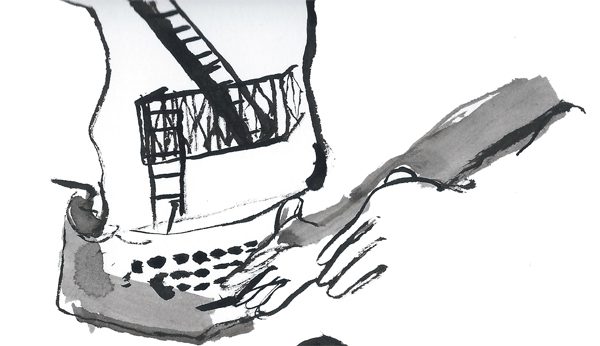
And yet, in a time where the mainstream seems to continually question the power and validity of art, and especially of poetry, its need, its purpose, in a generation obsessed with appearances, of status updates and smiling selfies bathed (corrected?) in the golden light of filters, in which it has become more and more difficult for us to say aloud, to one another: I am hurt. I am scared. What happens now?, the poem, like the fire escape, as feeble and thin as it is, has become my most concentrated architecture of resistance. A place where I can be as honest as I need to—because the fire has already begun in my home, swallowing my most valuable possessions—and even my loved ones. My uncle is gone. I will never know exactly why.
But I still have my body and with it these words, hammered into a structure just wide enough to hold the weight of my living. I want to use it to talk about my obsessions and fears, my odd and idiosyncratic joys. I want to leave the party through the window and find my uncle standing on a piece of iron shaped into visible desperation, which must also be (how can it not?) the beginning of visible hope. I want to stay there until the building burns down. I want to love more than death can harm. And I want to tell you this often: That despite being so human and so terrified, here, standing on this unfinished staircase to nowhere and everywhere, surrounded by the cold and starless night—we can live. And we will.


Wednesday, December 16, 2020
Hafiz on poetry
The Great religions are the ships, Poets the life boats.
Every sane person I know has jumped overboard.
That is good for business,
Isn't it
Hafiz?
- gifted to me by Marion on 14 Dec 2020
Saturday, May 31, 2014
In the Forest of Faded Wisdom
In the Forest of Faded Wisdom
104 Poems by Gendun Chopel
Walking with weary feet to the plains of the sandy south,
Traversing the boundary of a land surrounded by the pit
of dark seas,
Pulling the thread of my life—precious and cherished—
across a sword’s
sharp blade,
Consuming long years and months of hardship, I have
somehow finished
this book.
Traversing the boundary of a land surrounded by the pit
of dark seas,
Pulling the thread of my life—precious and cherished—
across a sword’s
sharp blade,
Consuming long years and months of hardship, I have
somehow finished
this book.
Although there is no one to beseech me
With mandates from on high or mandalas of gold,
I have taken on the burden of hardship alone and written
this,
Concerned that the treasury of knowledge will be lost.
With mandates from on high or mandalas of gold,
I have taken on the burden of hardship alone and written
this,
Concerned that the treasury of knowledge will be lost.
Though terrified by the orange eye of envy
In the burning flame of those bloodthirsty for power,
Accustomed to the habit of gathering what I have learned,
My mind is attached to reasonable talk.
In the burning flame of those bloodthirsty for power,
Accustomed to the habit of gathering what I have learned,
My mind is attached to reasonable talk.
If it somehow enters the door of a wise person, intent of
learning,
Then the fruit of my labor will have been achieved.
For the smiles of stupid and the approval of the rich,
I have never yearned even in my dreams.
learning,
Then the fruit of my labor will have been achieved.
For the smiles of stupid and the approval of the rich,
I have never yearned even in my dreams.
When this ink-stained body’s need for food and drink is
finished,
When this collection of bones—its thread of hope for
gain and honor
snapped—is scattered,
Then may the forms of these letters, a pile of much
learning amassed
through hardship,
Reveal the path of vast benefit in the presence of my
unseen friends.
finished,
When this collection of bones—its thread of hope for
gain and honor
snapped—is scattered,
Then may the forms of these letters, a pile of much
learning amassed
through hardship,
Reveal the path of vast benefit in the presence of my
unseen friends.
University of Chicago Press (2009)
Monday, January 27, 2014
Thursday, July 18, 2013
from blog titled Hun's Wanderings and Wonderings
An apt piece from one of Hun's favorite poets - Tony Hoagland.
“The Word” by Tony Hoagland
Down near the bottom
of the crossed-out list
of things you have to do today,
between “green thread”
and “broccoli,” you find
that you have penciled “sunlight.”
Resting on the page, the word
is beautiful. It touches you
as if you had a friend
and sunlight were a present
he had sent from someplace distant
as this morning—to cheer you up,
and to remind you that,
among your duties, pleasure
is a thing
that also needs accomplishing.
Do you remember?
that time and light are kinds
of love, and love
is no less practical
than a coffee grinder
or a safe spare tire?
Tomorrow you may be utterly
without a clue,
but today you get a telegram
from the heart in exile,
proclaiming that the kingdom
still exists,
the king and queen alive,
still speaking to their children,
—to any one among them
who can find the time
to sit out in the sun and listen.
--with thanks to Hun's Wanderings and Wonderings ( a blog - http://hunwanderings08.blogspot.com)
Below is a rewriting to help with memorization. --CS Lindsay
Down near the bottom of the crossed-out list of things
You have to do today,
Between “green thread” and “broccoli,”
You find that you have penciled “sunlight.”
Resting on the page, the word is beautiful.
It touches you as if you had a friend
And sunlight were a present he had sent
from someplace distant as this morning—to cheer you up,
And to remind you that, among your duties,
Pleasure is a thing that also needs accomplishing.
Do you remember? That time and light are kinds of love,
And love is no less practical than a coffee grinder or a safe spare tire?
Tomorrow you may be utterly
without a clue, but today you get a telegram
From the heart in exile, proclaiming that the kingdom
Still exists, the king and queen alive, still speaking to their children,
—to any one among them who can find the time
To sit out in the sun and listen.
“The Word” by Tony Hoagland
Down near the bottom
of the crossed-out list
of things you have to do today,
between “green thread”
and “broccoli,” you find
that you have penciled “sunlight.”
Resting on the page, the word
is beautiful. It touches you
as if you had a friend
and sunlight were a present
he had sent from someplace distant
as this morning—to cheer you up,
and to remind you that,
among your duties, pleasure
is a thing
that also needs accomplishing.
Do you remember?
that time and light are kinds
of love, and love
is no less practical
than a coffee grinder
or a safe spare tire?
Tomorrow you may be utterly
without a clue,
but today you get a telegram
from the heart in exile,
proclaiming that the kingdom
still exists,
the king and queen alive,
still speaking to their children,
—to any one among them
who can find the time
to sit out in the sun and listen.
--with thanks to Hun's Wanderings and Wonderings ( a blog - http://hunwanderings08.blogspot.com)
Below is a rewriting to help with memorization. --CS Lindsay
Down near the bottom of the crossed-out list of things
You have to do today,
Between “green thread” and “broccoli,”
You find that you have penciled “sunlight.”
Resting on the page, the word is beautiful.
It touches you as if you had a friend
And sunlight were a present he had sent
from someplace distant as this morning—to cheer you up,
And to remind you that, among your duties,
Pleasure is a thing that also needs accomplishing.
Do you remember? That time and light are kinds of love,
And love is no less practical than a coffee grinder or a safe spare tire?
Tomorrow you may be utterly
without a clue, but today you get a telegram
From the heart in exile, proclaiming that the kingdom
Still exists, the king and queen alive, still speaking to their children,
—to any one among them who can find the time
To sit out in the sun and listen.
Monday, May 27, 2013
In the World
Meditation is not just a rest or retreat from the turmoil of the stream or the impurity of the world. It is a way of being the stream, so that one can be at home in both the white water and the eddies. Meditation may take one out of the world, but it also puts one totally into it.
|
- Gary Snyder, "Just One Breath"

IN THIS WORLD of onrushing events the act of meditation—even just a "one-breath" meditation—straightening the back, clearing the mind for a moment—is a refreshing island in the stream. Although the term meditation has mystical and religious connotations for many people, it is a simple and plain activity. Attention: deliberate stillness and silence. As anyone who has practiced sitting knows, the quieted mind has many paths, most of them tedious and ordinary. Then, right in the midst of meditation, totally unexpected images or feelings may sometimes erupt, and there is a way into a vivid transparency. But whatever comes up, sitting is always instructive. There is ample testimony that a practice of meditation pursued over months and years brings some degree of self-understanding, serenity, focus, and self-confidence to the person who stays with it. There is also a deep gratitude that one comes to feel for this world of beings, teachers, and teachings.
No one—guru or roshi or priest—can program for long what a person might think or feel in private reflection. We learn that we cannot in any literal sense control our mind. Meditation cannot serve an ideology. A meditation teacher can only help a student understand the phenomena that rise from his or her own inner world—after the fact—and give tips on directions to go. A meditation teacher can be a check or guide for the wayfarer to measure herself against, and like any experienced guide can give good warning of brushy paths and dead-end canyons from personal experience. The teacher provides questions, not answers. Within a traditional Buddhist framework of ethical values and psychological insight, the mind essentially reveals itself.
Meditation is not just a rest or retreat from the turmoil of the stream or the impurity of the world. It is a way of being the stream, so that one can be at home in both the white water and the eddies. Meditation may take one out of the world, but it also puts one totally into it. Poems are a bit like this too. The experience of a poem gives both distance and involvement: one is closer and farther at the same time.
TRADITIONS OF DELIBERATE ATTENTION to consciousness, and of making poems, are as old as humankind. Meditation looks inward, poetry holds forth. One is private, the other is out in the world. One enters the moment, the other shares it. But in practice it is never entirely clear which is doing which. In any case, we do know that in spite of the contemporary public perception of meditation and poetry as special, exotic, and difficult, they are both as old and as common as grass. The one goes back to essential moments of stillness and deep inwardness, and the other to the fundamental impulse of expression and presentation.
People often confuse meditation with prayer, devotion, or vision. They are not the same. Meditation as a practice does not address itself to a deity or present itself as an opportunity for revelation. This is not to say that people who are meditating do not occasionally think they have received a revelation or experienced visions. They do. But to those for whom meditation is their central practice, a vision or a revelation is seen as just another phenomenon of consciousness and as such is not to be taken as exceptional. The meditator would simply experience the ground of consciousness, and in doing so avoid excluding or excessively elevating any thought or feeling. To do this one must release all sense of the "I" as experiencer, even the "I" that might think it is privileged to communicate with the divine. It is in sensitive areas such as these that a teacher can be a great help. This is mostly a description of the Buddhist meditation tradition, which has hewed consistently to a nontheistic practice over the centuries.
Poetry has also been part of Buddhism from early on. From the 2,500-year-old songs of forest-dwelling monks and nuns of India to the vivid colloquial poems of Kenji Miyazawa in 1930s Japan, there is a continuous thread. Poetry has had a primary place of respect in Chinese literary culture, and many of the best-known poems of the Chinese canon are touched with Ch'an and Taoist insight. Some of the finest poets of China were even acknowledged Ch'an adepts—Bai Juyi and Su Dungpo, to name just two.
Although the Chinese Ch'an masters liked to say "The lowest class of monk is the one who indulges in literature," we have to remember that blame is often praise in the Ch'an world. The Ch'an training halls, with their unconventional dharma discourses and vivid mimed exchanges, and the tradition of the Chinese lyric poems, shih, with their lucid and allusive brevity, were clearly shaping each other by the early Tang dynasty.
Ch'an teachers and students have always written their own sort of in-house poems as well. In formal gung-an(koan) study, a student is often called upon to present a few lines of poetry from the Chinese canon as a proof of the completeness of his or her understanding—an exercise called zho-yu, "capping verses" (jakugo in Japanese). Such exchanges have been described in the book A Zen Forest by Soiku Shigematsu, a Japanese Rinzai Zen priest. Shigematsu Osho has handily translated hundreds of the couplets as borrowed from Chinese poetry and proverb. They are intense:
Words, words, words—fluttering drizzle and snow.
Silence, silence, silence—a roaring thunderbolt.
Bring back the dead!
Kill the living!
This tune, another tune—no one understands.
Rain has passed, leaving the pond brimming in the autumn light.
The fire of catastrophe has burned out all
Millions of miles no mist, not a grain of dust!
One phrase after another
Each moment refreshing.
These bits of poems are not simply bandied about between Zen students as some kind of in-group wisdom or slangy shorthand for larger meanings. They are used sparingly, in interviews with the teacher, as a mode of reaching even deeper than a "personal" answer to a problem, as a way of confirming that one has touched base with a larger Mind. They are valued not for the literary metaphor but for the challenge presented by the exercise of physically actualizing the metaphor in the present. They help the student bring symbols and abstractions back to earth, into the body. Zen exquisitely develops this possibility—yet it's not far from the natural work of poems and proverbs anyway.
The Buddhist world has produced numerous poets and singers of the dharma whose works are still admired and loved. Milarepa, whose songs are known by heart among Tibetans, and Basho, whose haiku are read worldwide, are perhaps the most famous.
I STARTED WRITING POETRY in my adolescence, to give voice to some powerful experiences that I had while doing snowpeak mountaineering in the Pacific Northwest. At first I wrote "directly as I felt." Then I discovered the work of Robinson Jeffers and D.H. Lawrence. Aha, I thought, there is more to poetry. I became aware of poetry as a craft—a matter of working with materials and tools—that has a history, with different applications and strategies all over the world over tens of thousands of years. I came to understand poetry as a furthering of language. (Language is not something you learn in school, it is a world you're born into. It is part of the wildness of Mind. You master your home tongue without conscious effort by the age of five. Language with its sinuous syntax is not unlike the thermal dynamics of weather systems, or energy exchanges in the food chain—completely natural and vital, part of what and who we are. Poetry is the leap off of [or into] that.)
I ran into a poem by Gerard Manley Hopkins with the lines,
O the mind, mind has mountains; cliffs of fall
Frightful, sheer, no-man-fathomed. Hold them cheap
May who ne'er hung there. Nor does long our small
Durance deal with that steep or deep
This helped me realize that literal mountains were not the only place to climb. I was recovering at the time from a little frostbite suffered on a winter ascent of Mt. Hood. (It should be said that mountaineering is not simply some sort of challenging quest. It has that aspect, but for dedicated climbers the strategy, the companionship, and the cooperation is what makes climbing the game it is.) Climbing also opened me up to the impermanence, the total scariness, the literal voidness under my feet, the exposure, as we say, of consciousness itself. What deep and soulful thoughts that witnessing the gulf below can give you.

BEYOND WILD. This can indeed include language. Poetry is how language experiences itself. It's not that the deepest spiritual insights cannot be expressed in words (they can, in fact) but that words cannot be expressed in words. So our poems are full of real presences. "Save a ghost," you might be asked by your teacher—or an owl, or a rainforest, or a demon. Walking that through and then putting a poem to it is a step on the way toward realization. But the path has many switchbacks and a spiritual journey is strewn with almost as many land mines as a poet's path. Let us all be careful (and loose as a goose) together.
MY INTEREST IN WRITING brought me to the twentieth-century modernists and Chinese poetry; and my thoughts on nature and wilderness brought me to Taoism and then to Zen. This growing awareness of Zen was also interwoven with the discovery of Chinese landscape painting. I studied classical Chinese with Peter Boodberg and Shih-hsiang Chen at Berkeley. I learned of the poet Han-shan in seminars with Professor Chen and began a little translating of my own. I came to see that some of the finest of the Chinese poems had a mysteriously plain quality, and I wanted to understand where that came from. I started doing sitting meditation, zazen, by myself at home. These various strands got drawn together in the summer of 1955 when I was a trail-crew worker in the High Sierra of California. I started writing poems out of the labor on the trails that echoed the crispness of classical Chinese poems and also had the flavor of my nightly meditations up on the cliffs.
On those clear nights in the High Sierra I saw the stars as further rocks and trails leading onward and out. Although I had written dozens of poems before, these were the first I could acknowledge as entirely my own. They are in the collection Riprap. I made plans to travel to Japan, to learn more of meditation. A year or so later, in Kyoto, I asked my teacher Oda Sesso Roshi, "Sometimes I write poetry. Is that all right?" He laughed and said, "It's all right as long as it comes out of your true self." He also said "You know, poets have to play a lot, asobi." That seemed an odd thing to say, because the word asobi has an implication of wandering the bars and pleasure quarters, the behavior of a decadent wastrel. I knew he didn't mean that. For many years while doing Zen practice around Kyoto, I virtually quit writing poetry. It didn't bother me. My thought was, Zen is serious, poetry is not serious. In any case, you have to be completely serious when you do Zen practice. So I tried to be serious and I didn't write many poems. I studied with him for six years.
IN 1966, JUST BEFORE ODA ROSHI DIED, I had a talk with him in the hospital. I said, "Roshi! So it's Zen is serious, poetry is not serious." He said "No, no—poetry is serious! Zen is not serious." I had it all wrong! I don't know if it was by accident or it was a gift he gave me, but I started writing more, and maybe I did a little less sitting, too. I think I had come to understand something about play: to be truly serious you have to play. That's on the side of poetry, and of meditation, too. In fact, play is essential to everything we do—working on cars, cooking, raising children, running corporations—and poetry is nothing special. Language is no big deal. Mind is no big deal. Meaning or no-meaning, it's perfectly okay. We take what's given us, with gratitude.
The poet in us can be seen at both the beginning and the end of a life. Everybody knows a child can come up with a rhyme, a song, a poem that will delight us. At the same time, the old priest on his deathbed will write a poem, his last act. The most refined and accomplished people will express their deepest understanding in a poem—and the absolute beginner will not hesitate to try to express a transient transcendent moment. There is no sure way to predict which poem will be better than the other.
Poetry is democratic, Zen is elite. No! Zen is democratic, poetry is elite. Which is it? Everybody can do zazen, but only a few do poetry. Everybody can do poetry but only a few can really do zazen. Poetry (and the literary world) has sometimes been perceived as dangerous to the spirit career, but also poems have been called upon to express the most delicate and profound spiritual understanding.
We can appreciate Ikkyu's probing poem:
Ridiculing LiteratureHumans are endowed with / the stupidity of horses and cattle.
Poetry was originally a / work out of hell.
Self-pride, false pride, / suffering from the passions,
We must sigh for those taking this path / to intimacy with demons.
Ikkyu, a fifteenth-century Japanese Zen master and a fine (and strikingly fearless) poet himself, laughingly ridiculed his fellow poets, knowing as he did the distractions and temptations that might come with literary aspirations. His "intimacy with demons" is not to be seen in the light of the occidental romance with alienation, however. In Japanese art, demons are funny little guys, as solid as horses and cows, who gnash their fangs and cross their eyes. Poetry is a way of celebrating the actuality of a nondual universe in all its facets. Its risk is that it declines to exclude demons. Buddhism offers demons a hand and then tries to teach them to sit. But there are tricky little poetry/ego demons that do come along, tempting us with suffering or with insight, with success or failure. There are demons practicing meditation and writing poetry in the same room with the rest of us, and we are all indeed intimate. It didn't really trouble Ikkyu.
On seeing Ikkyu's poem (and these comments) my friend Doc wrote me from his fish camp:
Ikkyu says, "Humans are endowed with the stupidity of horses and cattle."
I think Ikkyu is full of shit.
Humans are endowed with a stupidity all their own.
Horses and cattle know what to do.
They do it well.
He is right about poetry as a work out of hell.
We ought to know.
Phenomena experience themselves as themselves.
They don't need poetry.
We are looking at a mystery here.
How do these things have such an obstinancy and yet are dependent on my consciousness?
When I practice fishing with two teenagers
poetry never occurs to me.
But later it does.
I can go over the whole day.
Hooray! That's what being human is all about.
It is just as much a weakness as a strength.
You say a language is (a wild system born with us.)
I agree.
It is wilder than wild.
If we were just wild we wouldn't need language.
Maybe we are beyond wild.
That makes me feel better.-Doc Dachtler
Kanaka Creek
SPENDING TIME with your own mind is humbling and broadening. One finds that there's no one in charge, and is reminded that no thought lasts for long. The marks of the Buddhist teachings are impermanence, no-self, the inevitability of suffering, interconnectedness, emptiness, the vastness of mind, and the provision of a Way to realization. An accomplished poem, like an exemplary life, is a brief presentation, a uniqueness in the oneness, a complete expression, and a kind gift exchange in the mind-energy webs. In the No play Basho (Banana Plant) it is said that "all poetry and art are offerings to the Buddha." These various Buddhist ideas in play with the ancient Chinese sense of poetry are part of the weave that produced an elegant plainness, which we name the Zen aesthetic.
Tu Fu said, "The ideas of a poet should be noble and simple." In Ch'an circles it has been said "Unformed people delight in the gaudy and in novelty. Cooked people delight in the ordinary." This plainness, this ordinary actuality, is what Buddhists call thusness, or tathata. There is nothing special about actuality because it is all right here. There's no need to call attention to it, to bring it up vividly and display it. Therefore the ultimate subject matter of a "mystical" Buddhist poetry is profoundly ordinary. This elusive ordinary actuality that is so touching and refreshing, all rolled together in imagination and language, is the work of all the arts. (The really fine poems are maybe the invisible ones, that show no special insight, no remarkable beauty. But no one has ever really written a great poem that had perfectly no insight, instructive unfolding, syntactic deliciousness—it is only a distant ideal.)
So there will never be some one sort of identifiable "meditation poetry." In spite of the elegant and somewhat decadent Plain Zen ideal, gaudiness and novelty and enthusiastic vulgarity are also fully real. Bulging eyeballs, big lolling tongues, stomping feet, cackles and howls— all are there in the tradition of practice. And there will never be—one devoutly hopes—one final and exclusive style of Buddhism. I keep looking for poems that see the moment, that play freely with what's given,
Teasing the demonic
Wrestling the wrathful
Laughing with the lustful
Seducing the shy
Wiping dirty noses and sewing torn shirts
Sending philosophers home to their wives in time for dinner
Dousing bureaucrats in rivers
Taking mothers mountain climbing
Eating the ordinary
appreciating that so much can be done on this precious planet of samsara.
Gary Snyder lives in the northern Sierra Nevada and Practices in the Linji Ch'an (Zen) Buddhist tradition. Pulitzer prize-winning poet and essayist, his most recent book is Practice of the Wild(North Point Press).
Adapted from the Introduction to Beneath a Single Moon: Legacies of Buddhism in Contemporary American Poetry. Edited by Kent Johnson and Craig Paulenich. (Shambhala Publications)
Images © Allen Ginsberg (1) and Mayumi Oda (2 and 3).
Sunday, December 16, 2012
Poem by Gary Snyder offered by Warren
poem by Gary Snyder
http://shlok25.blogspot.com/
http://shlok25.blogspot.com/
My teacher once said to me,
--Become one with the knot itself
Till it dissolves away,
---sweep the garden,
any size.
This poem is offered on the topic of 'sweeping leaves'.
Sunday, March 20, 2011
Noble Truths
Noble Truths
In this heart
suffering and its end.
Cease clinging
to what is not there.
Let go of fear.
Release self to air.
Now eyes open.
Now moon’s light
fills the singing night.
Warren Lang
Monday, December 14, 2009
The Tulips
The Tulips
The tulips at that perfect place
crane their necks with liquid grace
like swans who circling, collide
within the lake this vase provides.
They stood like soldiers, stiff, before
as if they had been called to war.
In two days more, when petals fall,
I will entomb them in the hall
with trash; the morning's coffee grinds,
old newspapers, and lemon rinds.
It's bitter that such loveliness
should come to this,
could come to this.
But now their purpleness ignites
the room with incandescent lights.
Their stamens reach their yellow tongues
to lick the air into their lungs
through stems attached to whitish manes.
The pistil stains.
And even though there are no bees
about the room for them to please,
I take them in like honey dew-
and buzzing now,
I think of you...
I think of you who bought me these,
at least,
I wish you had,
as that might ease the ache
of passing hours.
A love is dying, like these flowers.
crane their necks with liquid grace
like swans who circling, collide
within the lake this vase provides.
They stood like soldiers, stiff, before
as if they had been called to war.
In two days more, when petals fall,
I will entomb them in the hall
with trash; the morning's coffee grinds,
old newspapers, and lemon rinds.
It's bitter that such loveliness
should come to this,
could come to this.
But now their purpleness ignites
the room with incandescent lights.
Their stamens reach their yellow tongues
to lick the air into their lungs
through stems attached to whitish manes.
The pistil stains.
And even though there are no bees
about the room for them to please,
I take them in like honey dew-
and buzzing now,
I think of you...
I think of you who bought me these,
at least,
I wish you had,
as that might ease the ache
of passing hours.
A love is dying, like these flowers.
Thursday, August 9, 2007
Pied Beauty
Glory be to God for dappled things
For skies of couple color as a brinded cow
For rose moles all in stipple upon trout that swim
Fresh firecoal chestnut falls, Finches wings
Landscape plotted and pieced, fold, fallow and plough
And all trades, their gear and tackle and trade.
All things counter, original, spare, strange
Whatever is fickle, freckled, who knows how?
With swift, slow, sweet, sour, adazzle, dim
He fathers forth whose beauty is past change.
Praise him.
For skies of couple color as a brinded cow
For rose moles all in stipple upon trout that swim
Fresh firecoal chestnut falls, Finches wings
Landscape plotted and pieced, fold, fallow and plough
And all trades, their gear and tackle and trade.
All things counter, original, spare, strange
Whatever is fickle, freckled, who knows how?
With swift, slow, sweet, sour, adazzle, dim
He fathers forth whose beauty is past change.
Praise him.
Wednesday, August 1, 2007
Learned Astronomer
When I heard the learned Astronomer
When i heard the learned astronomer,
When the proofs, the figures were ranged in columns before me,
When I was shown the charts and diagrams, to add, divide and measure them,
When I sitting heard the astronomer where he lectured with much applause in the lecture room,
How soon unaccountable I became tired and sick,
Till rising and gliding out I wandered off by myself
In the mystical, moist night air, and from time to time
Looked up in perfect silence at the stars.
When the proofs, the figures were ranged in columns before me,
When I was shown the charts and diagrams, to add, divide and measure them,
When I sitting heard the astronomer where he lectured with much applause in the lecture room,
How soon unaccountable I became tired and sick,
Till rising and gliding out I wandered off by myself
In the mystical, moist night air, and from time to time
Looked up in perfect silence at the stars.
Monday, July 30, 2007
Perhaps
Perhaps
Perhaps these thoughts of ours
will never find an audience
Perhaps the mistaken road
will end in a mistake
Perhaps the lamps we light one at a time
will be blown out, one at a time
Perhaps the candles of our lives will gutter out
without lighting a fire to warm us.
Perhaps when all the tears have been shed
the earth will be more fertile
Perhaps when we sing praises to the sun
the sun will praise us in return
Perhaps these heavy burdens
will strengthen our philosophy
Perhaps when we weep for those in misery
we must be silent about miseries of our own
Perhaps
Because of our irresistible sense of mission
We have no choice
- Shu Ting (translated by Carolyn Kizer)
Perhaps these thoughts of ours
will never find an audience
Perhaps the mistaken road
will end in a mistake
Perhaps the lamps we light one at a time
will be blown out, one at a time
Perhaps the candles of our lives will gutter out
without lighting a fire to warm us.
Perhaps when all the tears have been shed
the earth will be more fertile
Perhaps when we sing praises to the sun
the sun will praise us in return
Perhaps these heavy burdens
will strengthen our philosophy
Perhaps when we weep for those in misery
we must be silent about miseries of our own
Perhaps
Because of our irresistible sense of mission
We have no choice
- Shu Ting (translated by Carolyn Kizer)
Thursday, July 12, 2007
George Herbert. Peace.
Let me once know.
I sought thee in a secret cave,
And ask’d, if Peace were there.
A hollow winde did seem to answer, No :
Go seek elsewhere.
I did ; and going did a rainbow note :
Surely, thought I,
This is the lace of Peaces coat :
I will search out the matter.
But while I lookt, the clouds immediately
Did break and scatter.
Then went I to a garden, and did spy
A gallant flower,
The crown Imperiall : Sure, said I,
Peace at the root must dwell.
But when I digg’d, I saw a worm devoure
What show’d so well.
At length I met a rev’rend good old man :
Whom when of Peace
I did demand, he thus began ;
There was a Prince of old
At Salem dwelt, who liv’d with good increase
Of flock and fold.
He sweetly liv’d ; yet sweetnesse did not save
His life from foes.
But after death out of his grave
There sprang twelve stalks of wheat :
Which many wondring at, got some of those
To plant and set.
It prosper’d strangely, and did soon disperse
Through all the earth :
For they that taste it do rehearse,
That vertue lies therein ;
A secret vertue bringing peace and mirth
By flight of sinne.
Take of this grain, which in my garden grows,
And grows for you ;
Make bread of it : and that repose
And peace, which ev’ry where
With so much earnestnesse you do pursue
Is onely there.
George Herbert - Love bade me welcome
Love bade me welcome
Yet my soul drew back, Guilty of dust and sin.
But Quick-eyed love
observing me grow slack from my first entrance in,
Drew nearer to me
sweetly questioning
if I lacked anything.
A guest, I answered, 'worthy to be here.'
Love said, 'Then you shall be he.'
I, the unkind, ungrateful, ah my dear
I cannot look on thee.'
Love took my hand and smiling did reply,
'Who made the eyes but I?"
Truth, my Lord, but I have marred them.
Let my shame go where it doth deserve.
'And know you not', Love says , 'who bore the blame?'
'My dear, Then I will serve.'
You must sit down, says Love, 'and taste my meat.'
So I did sit and eat.
Yet my soul drew back, Guilty of dust and sin.
But Quick-eyed love
observing me grow slack from my first entrance in,
Drew nearer to me
sweetly questioning
if I lacked anything.
A guest, I answered, 'worthy to be here.'
Love said, 'Then you shall be he.'
I, the unkind, ungrateful, ah my dear
I cannot look on thee.'
Love took my hand and smiling did reply,
'Who made the eyes but I?"
Truth, my Lord, but I have marred them.
Let my shame go where it doth deserve.
'And know you not', Love says , 'who bore the blame?'
'My dear, Then I will serve.'
You must sit down, says Love, 'and taste my meat.'
So I did sit and eat.
Rehearsal -- A noiseless, patient spider
A noiseless patient spider
I marked whereon a little promintory it stood isolated
Marked how to explore the vacant, vast surrounding.
It launched forth filament, filament, filament, out of itself
Ever unreeling them, ever tirelessly speeding them.
And you O my soul from where you stand,
Surrounded, detached in measureless oceans of space,
Ceaselessly musing, venturing, throwing, seeking the spheres to connect them,
Till the bridge you will need be form'd, till the ductile anchor hold,
Until the gossamer thread you fling catch somewhere O my soul.
Rehearsal - A noiseless patient spider
A noiseless patient spider
I marked whereon a little promontory it stood isolated
Marked how to explore the vacant vast surrounding
It launched forth filament, filament, filament out of itself
Every reeling them, ever tirelessly speeding them.
And you oh my soul from where you stand
surrounded, detached in measureless oceans of space
Ceaselessly musing, venturing, throwing, seeking the spheres to connect them
I marked whereon a little promontory it stood isolated
Marked how to explore the vacant vast surrounding
It launched forth filament, filament, filament out of itself
Every reeling them, ever tirelessly speeding them.
And you oh my soul from where you stand
surrounded, detached in measureless oceans of space
Ceaselessly musing, venturing, throwing, seeking the spheres to connect them
Subscribe to:
Posts (Atom)