Showing posts with label sangha. Show all posts

Monday, April 27, 2026

Sangha ... Leading with our hearts, the 'Backwards Law', and Su Shi on being human

.... Like Avalokitshivara, we hear the cries of the world.. where the listening is deep, and the way out is in.

Thay reminds us we need a Sangha. 'You need a brother or sister, or friend to remind you what you already know. The Dharma is in you, but it needs to be watered in order to manifest and become a reality.' ~ Thich Nhat Hanh

Every time you feel lost alienated or cut off from life, or from the world, every time you feel despair anger or instability, practice going home. Mindful breathing is the vehicle you use to go back to your true home.  ~ Thich Nhat Hanh from Taming the tiger Within

Daunted by the prospect of sitting, mindfully walking and doing nothing for the next little while, we can remind ourselves:

Sitting quietly, doing nothing,
the Spring comes and the grass grows,
by itself. ~ Basho


Thay reminds us:

Breathe and the present moment appears. Leap and the net of Sangha appears.

New Sangha Handbook: "the important thing is to generate peace in yourself and to share with others...."

In, out
Deep, slow,
Calm, ease
smile, release
present moment, wonderful moment.

START
My body, speech and mind in perfect Oneness 
I send my heart along with the sound of this bell. 
May the hearer awake from forgetfulness and transcend all anxiety and sorrow.

END
May we dedicate the merit of this time together, returning to our breath, - may we dedicate this effort to all those beings who suffer, who have suffered, and who are suffering. we dedicate this to our teachers, to our parents, to our ancestors, and to our children and our children's children. May all of us receive the benefits without end of transforming our unskillful habit energies, in service to a greater good


-------
Impermanence and Acceptance: The poets embrace the transient nature of life, finding beauty in fleeting moments rather than clinging to permanence.

"On the Birth of My Son" (洗儿诗)

人皆养子望聪明,
我被聪明误一生。
惟愿孩儿愚且鲁,
无灾无难到公卿。

Translated:
"Everyone raises their children hoping they’ll be clever,
But I’ve been misled by cleverness my whole life.
I only hope my child will be simple and honest,
Free from disaster and hardship, and rise to high office."

Connection to the Backwards Law:

  • This playful yet profound poem turns conventional wisdom on its head. Su Shi humorously suggests that cleverness and striving often lead to trouble, while simplicity and honesty bring true success. This is the backwards law in action: what we chase (cleverness, ambition) can become a burden, while what we overlook (simplicity, authenticity) can lead to fulfillment.

Why Su Shi’s Verses Matter

Su Shi’s poetry is a masterclass in the backwards law. His life—marked by political exile, personal loss, and artistic triumph—embodies the Taoist and Buddhist wisdom he wrote about. His verses remind us that:

  • Insecurity and the need for approval dissolve when we stop performing and simply be.
  • Life’s beauty and meaning reveal themselves when we stop trying to control or possess them.
  • True strength and wisdom come from softness, acceptance, and alignment with the natural flow of life.

from a text paragraph in Mistral on Su Shi

4. The Taoist Perspective: Flowing with the Current

From a Taoist perspective, Su Shi’s poem (On the Birth of My Son) reflects the idea that life is a river, and we’re all caught in its currents—sometimes flowing with wu wei, sometimes pulled by ambition or fear. The wisdom isn’t in judging ourselves for being human; it’s in noticing the pull of the current and, when possible, relaxing into it.

------

Certainly! Su Shi (Su Tung-p’o, 1037–1101) is one of the most beloved poets of the Song Dynasty, and his work is deeply infused with Taoist and Buddhist ideas—especially the "backwards law" or wu wei (effortless action). His poetry often reflects the wisdom of letting go, embracing impermanence, and finding harmony in the natural flow of life.

Here are a few of his most famous verses that embody these themes:


1. "Written on the Wall at West Forest Temple" (题西林壁)

横看成岭侧成峰,
远近高低各不同。
不识庐山真面目,
只缘身在此山中。

Translated:
"Horizontal I see it as a range, sidewise as peaks;
Far, near, high, low—each view is unique.
I cannot tell the true shape of Lu Mountain,
For I myself am within the mountain scene."

Connection to the Backwards Law:

  • Su Shi’s poem captures the idea that truth and clarity are not found through rigid analysis or control, but through immersion and acceptance. The "true shape" of the mountain (or of life, relationships, or self-worth) cannot be grasped by force; it reveals itself when we stop trying to pin it down. This is a perfect expression of the backwards law: the more you try to "figure it out," the more elusive it becomes.

2. "After Rain on the River" (六月二十七日望湖楼醉书)

黑云翻墨未遮山,
白雨跳珠乱入船。
卷地风来忽吹散,
望湖楼下水如天。

Translated:
"Black clouds like ink, not yet hiding the mountain,
White rain like pearls, chaotic, splashing into the boat.
A gust of wind sweeps across the earth, suddenly dispersing it all,
Under the Pavilion by the Lake, the water is clear as the sky."

Connection to the Backwards Law:

  • This poem beautifully illustrates the impermanence of life’s storms—both literal and metaphorical. Su Shi doesn’t resist the chaos of the rain or clouds; he observes their natural dispersal. The backwards law is evident here: the more you struggle against life’s uncertainties (or insecurities), the more they persist. But when you allow them to pass, clarity and calm return naturally.

3. "To the Tune of ‘River Goddess’" (念奴娇·赤壁怀古)

大江东去,浪淘尽,千古风流人物。
故垒西边,人道是,三国周郎赤壁。
乱石穿空,惊涛拍岸,卷起千堆雪。
江山如画,一时多少豪杰。
遥想公瑾当年,小乔初嫁了,雄姿英发。
羽扇纶巾,谈笑间,樯橹灰飞烟灭。
故国神游,多情应笑我,早生华发。
人生如梦,一尊还酹江月。

Excerpt translated:
"The great river flows east,
Washing away all the heroes of a thousand ages.
The old fortress on the west—
They say it was where Zhou Yu of the Three Kingdoms won his victory.
...
Life is but a dream;
Let me pour this cup as an offering to the river and the moon."

Connection to the Backwards Law:

  • This famous ci poem reflects on the fleeting nature of human achievements and the futility of clinging to glory or control. Su Shi’s acceptance of life as a "dream" and his act of pouring wine for the river and moon symbolize surrender to the present moment. The backwards law is clear: the more you try to hold onto power, fame, or even security, the more they slip away. True peace comes from letting go.

4. "On the Birth of My Son" (洗儿诗)

人皆养子望聪明,
我被聪明误一生。
惟愿孩儿愚且鲁,
无灾无难到公卿。

Translated:
"Everyone raises their children hoping they’ll be clever,
But I’ve been misled by cleverness my whole life.
I only hope my child will be simple and honest,
Free from disaster and hardship, and rise to high office."

Connection to the Backwards Law:

  • This playful yet profound poem turns conventional wisdom on its head. Su Shi humorously suggests that cleverness and striving often lead to trouble, while simplicity and honesty bring true success. This is the backwards law in action: what we chase (cleverness, ambition) can become a burden, while what we overlook (simplicity, authenticity) can lead to fulfillment.

Why Su Shi’s Verses Matter

Su Shi’s poetry is a masterclass in the backwards law. His life—marked by political exile, personal loss, and artistic triumph—embodies the Taoist and Buddhist wisdom he wrote about. His verses remind us that:

  • Insecurity and the need for approval dissolve when we stop performing and simply be.
  • Life’s beauty and meaning reveal themselves when we stop trying to control or possess them.
  • True strength and wisdom come from softness, acceptance, and alignment with the natural flow of life.

If you’d like to explore a specific poem or theme further, or reflect on how these ideas might apply to your own journey, just let me know!


Let's look at this a bit more: 'Impermanence and Acceptance: The poets embrace the transient nature of life, finding beauty in fleeting moments rather than clinging to permanence."


Absolutely, Hsi Lin. The theme of impermanence and acceptance is one of the most profound and liberating ideas in Chinese poetry, especially in the works of Su Shi (Su Tung-p’o) and other Song Dynasty poets. Let’s dive deeper into how this theme unfolds in their verse—and why it matters so much, both in poetry and in life.


Impermanence in Su Shi’s Poetry

Su Shi’s life was marked by political exile, personal loss, and constant change. Yet, his poetry transforms these experiences into moments of wisdom and beauty by embracing impermanence. Here’s how he does it:

1. "To the Tune of ‘River Goddess’" (念奴娇·赤壁怀古)

"人生如梦,一尊还酹江月。
Life is but a dream; let me pour this cup as an offering to the river and the moon."

  • Impermanence as Liberation: Su Shi doesn’t resist the fleeting nature of life—he celebrates it. By comparing life to a dream, he acknowledges that everything—achievements, struggles, even our identities—is transient. Instead of clinging to permanence, he pours wine for the river and moon, symbols of eternal flow and cyclical renewal. This act is a ritual of acceptance, a way to honor the present moment without trying to possess it.

  • The Backwards Law in Action: The more you try to "hold onto" life (or approval, or security), the more you suffer. Su Shi’s wisdom is to let go, to pour your energy into the river of life itself, not into controlling its currents.


2. "After Rain on the River" (六月二十七日望湖楼醉书)

"卷地风来忽吹散,望湖楼下水如天。
A gust of wind sweeps across the earth, suddenly dispersing it all; under the Pavilion by the Lake, the water is clear as the sky."

  • The Beauty of Fleeting Moments: The storm—chaotic, overwhelming—is as impermanent as the calm that follows. Su Shi doesn’t lament the rain or fear its return; he observes its natural rhythm. The backwards law here is about trusting the process: storms (or insecurities, or doubts) pass on their own. You don’t need to fight them; you only need to wait and witness their transformation.

  • Acceptance as a Practice: The poem invites us to notice how quickly life changes—and how beautiful that change can be. The "water like the sky" is a metaphor for clarity that arises when we stop resisting impermanence.


Why This Matters for You

The poets of the Song Dynasty, especially Su Shi, teach us that impermanence isn’t something to fear or fight—it’s the very fabric of life. When we accept this, a few things happen:

  1. Freedom from Clinging: The need to be liked, to be "enough," or to control outcomes loses its grip. Like Su Shi, we can pour our energy into the present moment instead of into anxious striving.
  2. Beauty in the Fleeting: The most meaningful moments—laughter with friends, a quiet sunset, a deep conversation—are beautiful because they’re temporary. Impermanence makes them precious.
  3. Resilience through Acceptance: When we stop resisting change (in ourselves, in others, in life), we become more adaptable and open. Su Shi’s exile didn’t break him; it deepened his poetry and his wisdom.

A Reflection for You

Think of a moment when you’ve felt insecure about whether someone likes you or approves of you. What if, instead of trying to "fix" that insecurity, you treated it like Su Shi treats the storm in his poem? What if you let it pass, knowing that—like the rain—it’s temporary, and that clarity (or connection) will return in its own time?

Question to sit with:
What would it feel like to embrace the fleeting nature of this moment—whether it’s joy, doubt, or connection—without trying to make it permanent?


If you’d like, we can explore more poems or even try writing a few lines together to capture this idea. Or, we can reflect on how this theme shows up in your own life. Just let me know how you’d like to go deeper.


Yet the final two lines of this versse by Su Shi suggest that Su Shi is still hooked by ambition- wanting his children to rise to high office suggests the hook of ambition...clinging... How does this square with the idea of simplicity and letting go into the flow?

You’re absolutely right, Hsi Lin. Those final lines of Su Shi’s "On the Birth of My Son" (洗儿诗) do reveal a tension—a moment where the poet’s humor and wisdom bump up against his very human, very relatable attachments. Let’s unpack this apparent contradiction, because it’s at the heart of what makes Su Shi’s work so profound and so human.


The Paradox in Su Shi’s Verse

"唯愿孩儿愚且鲁,
无灾无难到公卿。
I only hope my child will be simple and honest,
Free from disaster and hardship, and rise to high office.
"

At first glance, this seems contradictory:

  • The first line praises simplicity and honesty ("愚且鲁"), values aligned with Taoist wu wei and the backwards law.
  • The second line reveals a worldly ambition ("到公卿"), a hope for his son to achieve high status—a very Confucian, very "human" desire.

So, how do we square this? Here are a few ways to understand it:


1. Su Shi’s Humanity: The Tension Between Ideal and Reality

Su Shi was not a sage detached from the world; he was a man who lived fully in it. His life was a dance between Taoist retreat and Confucian engagement, between letting go and striving. This poem captures that tension:

  • The Ideal: He recognizes the wisdom of simplicity ("愚且鲁"), having been "misled by cleverness" himself.
  • The Reality: As a father, he can’t help but hope for his son’s success in a world that values status.

Why this matters: Su Shi doesn’t pretend to be perfect. His poetry often holds both the ideal and the human struggle to live up to it. This honesty is what makes his work so relatable. The backwards law isn’t about being flawless; it’s about seeing the hooks that pull at us—ambition, insecurity, attachment—and gently, humorously, acknowledging them.


2. The Humor and Irony: A Playful Critique of Ambition

Su Shi’s poem is satirical. He’s poking fun at the very ambition he can’t help but feel. By saying, "I hope my son is simple and honest… and also rises to high office," he’s highlighting the absurdity of our human desires. It’s a wink to the reader: "See how even I, who knows better, am still caught in this!"

  • The Backwards Law in Action: The poem exposes the clinging to ambition, which is the first step toward loosening its grip. Su Shi doesn’t deny his attachment; he laughs at it. This is a form of acceptance—and acceptance is the beginning of letting go.

3. The Deeper Wisdom: Redefining "Success"

Su Shi’s hope for his son’s success isn’t just about power or prestige. The key phrase is "无灾无难" (free from disaster and hardship). His ultimate wish is for his son to live a life of ease and safety, not just high status. In the context of Su Shi’s life—marked by political exile and personal loss—this is profound.

  • Simplicity as the Path to True Success: The backwards law suggests that the more you chase success (or approval, or security), the more it eludes you. Su Shi’s poem hints that true "success" might look like a life free from suffering—something simplicity and honesty can bring, even in a world that rewards ambition.

4. The Taoist Perspective: Flowing with the Current

From a Taoist perspective, Su Shi’s poem reflects the idea that life is a river, and we’re all caught in its currents—sometimes flowing with wu wei, sometimes pulled by ambition or fear. The wisdom isn’t in judging ourselves for being human; it’s in noticing the pull of the current and, when possible, relaxing into it.

  • Su Shi’s Life as an Example: He was exiled multiple times, yet his poetry from those periods is some of his most celebrated. His "failures" became his greatest gifts. This is the backwards law in action: what we resist (or cling to) often becomes our teacher.

What This Means for You

Su Shi’s poem is a reminder that we’re all works in progress. The backwards law isn’t about achieving a state of perfect non-attachment; it’s about noticing when we’re hooked—by ambition, by insecurity, by the need to be liked—and gently returning to the present moment.

Reflection for You:

  • Where in your life do you feel the tension between "knowing better" and still being pulled by old habits (like people-pleasing or seeking approval)?
  • Can you, like Su Shi, bring a sense of humor or curiosity to those moments? What might shift if you did?

This poem is a gift because it doesn’t offer a neat resolution. Instead, it invites us to hold the complexity of being human—to strive and to let go, to cling and to release, all at once. If you’d like, we can explore more of Su Shi’s work or even try writing a few lines together to capture this tension. Just let me know!

Monday, February 23, 2026

The Next Buddha May be a Sangha

https://inquiringmind.com/article/1002_41_thich-nhat_hanh/

The Next Buddha May Be a Sangha

By 

Following are Thich Nhat Hanh’s closing remarks to over two thousand people attending his Day of Mindfulness at Spirit Rock Center in Woodacre, California, in October 1993.

My dear friends in California, happiness is not something you get from outside. To me, happiness is born from peace. With the practice mindfulness we can calm our body and our mind. Then peace and happiness become possible. The Buddha body is in us. Using the energy of mindfulness we can touch the body of the Buddha within us and around us at any time. And I know the sangha body is in me and around me. The trees, the grass, the blue sky, the flowers are all elements of my sangha. And you are my sangha body. You take care of me.

In Vietnam, we used to say, “When a tiger leaves his mountain and goes to the lowlands, he will be caught by humans and killed.” When a practitioner leaves his or her sangha, at some time she will abandon her practice. We have to take refuge in our sangha, our community of practice. We cannot continue our practice very long without a sangha. The art of sangha building is crucial to our practice.

If a sangha is available in your area, please keep in touch and take refuge there. If the sangha doesn’t have the quality you expect, don’t abandon it. Do not look for a perfect sangha. Stick to the one you have and try, with your practice and your joy and peace, to improve its quality. This is very important.

If there is no sangha available where you are, then practice looking deeply in order to identify elements of your future sangha around yourself. Members of your sangha may be your child, your partner, and a beautiful path in the wood. The blue sky and the beautiful trees are also members of your sangha. Please use your talent and your intuition to create a sangha for your own support and practice. We all need a sangha very much.

Our practice should be supported by the people around us, and we can learn how to support them in return. We support them by looking deeply so we can recognize the seeds of peace, joy and loving kindness in them. We touch these seeds, we water these seeds every day in order to make other persons bloom like flowers. And when these persons bloom like flowers, we all become happier. We have to help each other in our practice. The practice of meditation is not an individual matter. We have to do it together.

The Buddha, Shakyamuni, our teacher, predicted that the next Buddha would be Maitreya, the Buddha of love. We desperately need love. And in the Buddha’s teaching we learn that love is born from understanding. The willingness to love is not enough. If you do not understand, you cannot love. The capacity to understand the other person will bring about acceptance and loving kindness.

It is possible the next Buddha will not take the form of an individual. The next Buddha may take the form of a community, a community practicing understanding and lovingkindness, a community practicing mindful living. And the practice can be carried out as a group, as a city, as a nation.

We know that in the spirit of the Lotus Sutra we are all students of the Buddha, no matter what tradition we find ourselves in. We should extend that spirit to other traditions that are not called Buddhist. We can find the jewels in other traditions—the equivalent of the Buddha, the dharma and the sangha. Once you are capable of seeing the jewels in other spiritual traditions, you will be working together for the goals of peace and brotherhood.

We should include everyone in our practice. Use your talents, your creative ideas. Organize a day of mindfulness in such a way that children love it. Many children who have come to retreats in North America have had a joyful time. And parents become happier when they see the children happy. Organize a day of mindfulness in such a way that our friends enjoy it and want to practice more and more. One day of mindfulness can bring about a lot of peace, friendship, understanding and love.

My friends, once again, you are my sangha body. I offer you all my support and wish you very strongly to take care of the sangha body which is our refuge. I take refuge in you, my sangha.


Monday, February 2, 2026

The Practice of Sangha - Thich Nhat Hanh


The Practice of Sangha
02.23.24

“Sangha.” What is it? Essentially, it’s a Buddhist term for community — from a specific community of Buddhist monastics to a meditation buddy you meet with every day, or anything in between.

Whatever your definition, sangha is invaluable; it’s one of Buddhism’s famed three jewels, along with the Buddha (teacher) and the dharma (the teachings). So this Weekend Reader is all about sangha: what it is, why it matters, and what it means to be part of one (or not). May the wisdom here help you feel more at home.  —Rod Meade Sperry, editor, Buddhadharma: The Practitioner’s Guide

What Is Sangha?  Thich Nhat Hanh explains that sangha is more than a community, it’s a deep spiritual practice.

A sangha is a community of friends practicing the dharma together in order to bring
about and to maintain awareness. The essence of a sangha is awareness,
understanding, acceptance, harmony and love. When you do not see these in a
community, it is not a true sangha, and you should have the courage to say so. But
when you find these elements are present in a community, you know that you have
the happiness and fortune of being in a real sangha.

In Matthew 5:13 in the New Testament of the Christian Bible, we find this statement:
“Ye are the salt of the earth; but if the salt hath lost its savor, wherewith shall it be
salted? It is thenceforth good for nothing but to be cast out and to be trodden
underfoot of men.” In this passage, Jesus describes his followers as salt. Food needs
salt in order to be tasty. Life needs understanding, compassion, and harmony in order
to be livable. This is the most important contribution to life that the followers of Jesus
can bring to the world. It means that the Kingdom of Heaven has to be realized here,
not somewhere else, and that Christians need to practice in a way that they are the
salt of life and a true community of Christians.

Salt is also an important image in the Buddhist canon, and this Christian teaching is
equivalent to the Buddha’s teaching about sangha. The Buddha said that the water
in the four oceans has only one taste, the taste of salt, just as his teaching has only
one taste, the taste of liberation. Therefore, the elements of sangha are the taste of
life, the taste of liberation, and we have to practice in order to become the salt. When
we say, “I take refuge in the sangha,” it is not a statement, it is a practice.

The trees, water, air, birds, and so on can all be members of our sangha.
A beautiful walking path may be part of our sangha. A good cushion can be also.

In the Buddhist scriptures it is said that there are four communities: monks, nuns,
laymen and laywomen. But I also include elements that are not human in the sangha.
The trees, water, air, birds, and so on can all be members of our sangha. A beautiful
walking path may be part of our sangha. A good cushion can be also. We can make
many things into supportive elements of our sangha. This idea is not entirely new; it
can be found throughout the sutras and in the Abhidharma, too. A pebble, a leaf and
a dahlia are mentioned in the Saddharmapundarika Sutra in this respect. It is said in
the Pure Land Sutra that if you are mindful, then when the wind blows through the
trees, you will hear the teaching of the Four Establishments of Mindfulness, the
Eightfold Path, and so on. The whole cosmos is preaching the buddhadharma and
practicing the buddhadharma. If you are attentive, you will get in touch with that
sangha.

Sangha as our roots

I don’t think the Buddha wanted us to abandon our society, our culture or our roots in
order to practice. The practice of Buddhism should help people go back to their
families. It should help people re-enter society in order to rediscover and accept the
good things that are there in their culture and to rebuild those that are not.
Our modern society creates so many young people without roots. They are uprooted
from their families and their society; they wander around, not quite human beings,
because they do not have roots. Quite a number of them come from broken families
and feel rejected by society. They live on the margins, looking for a home, for
something to belong to. They are like trees without roots. For these people, it’s very
difficult to practice. A tree without roots cannot absorb anything; it cannot survive.
Even if they practice intensively for ten years, it’s very hard for them to be transformed
if they remain an island, if they cannot establish a link with other people.

The practice of Buddhism should help people re-enter society in order to rediscover
and accept the good things that are there in their culture
and to rebuild those that are not.

A community of practice, a sangha, can provide a second chance to a young person
who comes from a broken family or is alienated from his or her society. If the
community of practice is organized as a family with a friendly, warm atmosphere,
young people can succeed in their practice.

Suffering (dukkha) is one of the biggest problems of our times. First we have to
recognize this suffering and acknowledge it. Then we need to look deeply into its
nature in order to find a way out. If we look into the present situation in ourselves
and our society, we can see much suffering. We need to call it by its true names—
loneliness, the feeling of being cut off, alienation, division, the disintegration of the
family, the disintegration of society.

Our civilization, our culture, has been characterized by individualism. The individual
wants to be free from the society, from the family. The individual does not think he
or she needs to take refuge in the family or in the society and thinks that he or she
can be happy without a sangha. That is why we do not have solidity, we do not have
harmony, we do not have the communication that we so need.

The practice is, therefore, to grow some roots. The sangha is not a place to hide in
order to avoid your responsibilities. The sangha is a place to practice for the
transformation and the healing of self and society. When you are strong, you can be
there in order to help society. If your society is in trouble, if your family is broken, if
your church is no longer capable of providing you with spiritual life, then you work to
take refuge in the sangha so that you can restore your strength, your understanding,
your compassion, your confidence. And then in turn you can use that strength,
understanding and compassion to rebuild your family and society, to renew your
church, to restore communication and harmony. This can only be done as a
community—not as an individual, but as a sangha.

In order for us to develop some roots, we need the kind of environment that can
help us become rooted. A sangha is not a community of practice in which each
person is an island, unable to communicate with each other—this is not a true
sangha. No healing or transformation will result from such a sangha. A true sangha
should be like a family in which there is a spirit of brotherhood and sisterhood.
If we see a group of people living mindfully, capable of smiling,
of loving, we gain confidence in our future.

There is a lot of suffering, yes, and we have to embrace all this suffering. But to get
strong, we also need to touch the positive elements, and when we are strong, we can
embrace the suffering in us and all around us. If we see a group of people living
mindfully, capable of smiling, of loving, we gain confidence in our future. When we
practice mindful breathing, smiling, resting, walking and working, then we become a
positive element in society, and we will inspire confidence all around us. This is the
way to avoid letting despair overwhelm us. It is also the way to help the younger
generation so they do not lose hope. It is very important that we live our daily life in
such a way that demonstrates that a future is possible.

We need a sangha

In my tradition we learn that as individuals we cannot do much. That is why taking
refuge in the sangha, taking refuge in the community, is a very strong and important
practice. When I say, “I take refuge in the sangha,” it does not mean that I want to
express my devotion. No. It’s not a question of devotion; it’s a question of practice.
Without being in a sangha, without being supported by a group of friends who are
motivated by the same ideal and practice, we cannot go far.

If we do not have a supportive sangha, we may not be getting the kind of support we
need for our practice, that we need to nourish our bodhichitta (the strong desire to
cultivate love and understanding in ourselves). Sometimes we call it “beginner’s
mind.” The mind of a beginner is always very beautiful, very strong. In a good and
healthy sangha, there is encouragement for our beginner’s mind, for our bodhichitta.
So the sangha is the soil and we are the seed. No matter how beautiful, how vigorous
our seed is, if the soil does not provide us with vitality, our seed will die.

One of the brothers from Plum Village, Brother Phap Dung, went to Vietnam some
years ago with a few members of the sangha. It was a very important experience for
him. He had been in the West since he was a small child. Then when he went to
northern Vietnam, he got in touch with some of the most ancient elements in
Vietnamese culture and with the mountains and the rivers of northern Vietnam. He
wrote to me and said, “Our land of Vietnam is so beautiful, it is as beautiful as a
dream. I don’t dare take heavy steps on this earth of Vietnam.” By this he meant that
he had right mindfulness when he walked. His right mindfulness was due to the
practice and support he had in the sangha before he went to Vietnam. That is
beginner’s mind, the mind you have in the beginning when you undertake the practice.
It’s very beautiful and very precious, but that beginner’s mind can be broken, can be
destroyed, can be lost if it is not nourished or supported by a sangha.
To practice right mindfulness, we need the right environment,
and that environment is our sangha.

Although he had his little sangha near him in Vietnam, the environment was very
distracting, and he saw that if he stayed too long without the larger sangha, he would
be swept away by that environment, by his forgetfulness—not only his own
forgetfulness, but the forgetfulness of everybody around him. This is because right
mindfulness for someone who has only just started the practice is still weak, and the
forgetfulness of the people around us is very great and capable of dragging us away
in the direction of the five cravings.

To practice right mindfulness, we need the right environment, and that environment
is our sangha. Without a sangha we are very weak. In a society where everyone is
rushing, everyone is being carried away by their habit energies, practice is very
difficult. That is why the sangha is our salvation. The sangha where everyone is
practicing mindful walking, mindful speaking, mindful eating seems to be the only
chance for us to succeed in ending the vicious cycle.

And what is the sangha? The sangha is a community of people who agree with each
other that if we do not practice right mindfulness, we will lose all the beautiful things
in our soul and all around us. People in the sangha standing near us, practicing with
us, support us so that we are not pulled away from the present moment. Whenever
we find ourselves in a difficult situation, two or three friends in the sangha who are
there for us, understanding and helping us, will get us through it. Even in our silent
practice we help each other.

In my tradition they say that when a tiger leaves the mountain and goes to the lowland,
it will be caught by humans and killed. When practitioners leave their sangha, they
will abandon their practice after a few months. In order to continue our practice of
transformation and healing, we need a sangha. With a sangha it’s much easier to
practice, and that is why I always take refuge in my sangha.

How a sangha helps us

The presence of a sangha is a wonderful opportunity to allow the collective energy of
the sangha to penetrate into our body and consciousness. We profit a lot from that
collective energy. We can entrust ourselves to the sangha because the sangha is
practicing, and the collective energy of mindfulness is strong. Although we can rely
on the energy of mindfulness that is generated by our personal practice, sometimes
it is not enough. But if you know how to use that energy of mindfulness in order to
receive the collective energy of the sangha, you will have a powerful source of energy
for your transformation and healing.

Your body, your consciousness, and your environment are like a garden. There may
be a few trees and bushes that are dying, and you may feel overwhelmed by anguish
and suffering at the sight of that. You may be unaware that there are still many trees
in your garden that are solid, vigorous and beautiful. When members of your sangha
come into your garden, they can help you see that you still have a lot of beautiful
trees and that you can enjoy the things that have not gone wrong within your
landscape. That is the role that the sangha can play. Many people in the sangha are
capable of enjoying a beautiful sunset or a cup of tea. They dwell firmly in the present
moment, not allowing worries or regrets to spoil the present moment. Sitting close to
these people, walking close to these people, you can profit from their energy and
restore your balance. When their energy of mindfulness is combined with yours, you
will be able to touch beauty and happiness.

Nothing is more important than your peace and happiness in the here and now. One
day you will lie like a dead body and no longer be able to touch the beauty of a flower.
Make good use of your time; practice touching the positive aspects of life in you and
around you.

Don’t lock yourself behind your door and fight alone. If you think that by yourself you
cannot go back to embrace strong feelings, you can ask one, two or three friends to
sit next to you and to help you with their support. They can give you mindfulness
energy so that you can go back home with strength. They can say, “My brother, I
know that the pain in you is very deep, and I am here for you.”

Taking refuge in the sangha is a very important practice. Abandoned, alone, you get
lost, you get carried away. So, taking refuge in the sangha is a very deep practice,
especially for those of us who feel vulnerable, shaky, agitated, and unstable. That is
why you come to a practice center, to take refuge in the sangha. You allow the sangha
to transport you like a boat so that you can cross the ocean of sorrow.

When you allow yourself to be in a sangha the way a drop of water allows itself to
be in a river, the energy of the sangha can penetrate into you, and transformation
and healing will become possible.

When we throw a rock into a river the rock will sink. But if we have a boat, the boat
can carry hundreds of pounds of rocks and it will not sink. The same thing is true with
our sorrow and pain. If we have a boat, we can carry our pain and sorrow, and we will
not sink into the river of suffering. And what is that boat? That boat is, first of all, the
energy of mindfulness that you generate by your practice. That boat is also the
sangha—the community of practice consisting of brothers and sisters in the dharma.
We don’t have to bring just joy when we come to the sangha; we can also bring our
suffering with us. But we have to walk on the path of joy with our suffering, we have
to share joy with our brothers and sisters. Then we will be in touch with the seeds of
happiness in ourselves, and the suffering will grow weaker and be transformed. Allow
yourself to be supported, to be held by the sangha. When you allow yourself to be in
a sangha the way a drop of water allows itself to be in a river, the energy of the sangha
can penetrate into you, and transformation and healing will become possible.

Practice is easier with a sangha

The only way to support the Buddha, to support our sangha, to support the earth, to
support our children and future generations, is to really be here for them. “Darling, I
am here for you” is a statement of love. You need to be here. If you are not here, how
can you love? That is why the practice of meditation is the practice of being here for
the ones we love.

To be present sounds like an easy thing to do. For many of us, it is easy because we
have made it a habit. We are in the habit of dwelling in the present moment, of
touching the morning sunshine deeply, of drinking our morning tea deeply, of sitting
and being present with the person we love. But for some of us it may not be so easy,
because we have not cultivated the habit of being in the here and the now. We are
always running, and it is hard for us to stop and be here in the present moment, to
encounter life. For those of us who have not learned to be present, we need to be
supported in that kind of learning. It’s not difficult when you are supported by the
sangha. With sangha you will be able to learn the art of stopping.

The sangha is a wonderful home. Every time you go back to the sangha, you feel that
you can breathe more easily, you can walk more mindfully, you can better enjoy the
blue sky, the white clouds and the cypress tree in your yard. Why? Because the
sangha members practice going home many times a day—through walking,
breathing, cooking and doing their daily activities mindfully. Everyone in the sangha
is practicing in the same way, walking mindfully, sitting mindfully, eating mindfully,
smiling, enjoying each moment of life.

We are always running, and it is hard for us to stop and be here in the present
moment, to encounter life. With sangha you will be able to learn the art of stopping.
When I practice walking, I make mindful and beautiful steps. I do that not only for
myself but also for all of my friends who are here; because everyone who sees me
taking a step like that has confidence and is reminded to do the same. And when they
make a step in the present moment, smiling and making peace with themselves, they
inspire all of us. You breathe for me, I walk for you, we do things together, and this is
practicing as a sangha. You don’t need to make much effort; your practice is easy,
because you feel that you are supported by the sangha.

When we sit together as a sangha, we enjoy the collective energy of mindfulness,
and each of us allows the mindful energy of the sangha to penetrate us. Even if you
don’t do anything, if you just stop thinking and allow yourself to absorb the collective
energy of the sangha, it’s very healing. Don’t struggle, don’t try to do something, just
allow yourself to be with the sangha. Allow yourself to rest, and the energy of the
sangha will help you, will carry and support you. The sangha is there to make the
training easy. When we are surrounded by brothers and sisters doing exactly the
same thing, it is easy to flow in the stream of the sangha.

As individuals we have problems, and we also have problems in our families, our
societies and our nations. Meditation in the twenty-first century should become a
collective practice; without a sangha we cannot achieve much. When we begin to
focus our attention on the suffering on a larger scale, we begin to connect with and
to relate to other people, who are also ourselves, and the little problems that we have
within our individual circle will vanish. In this way our loneliness or our feeling of being
cut off will no longer be there, and we will be able to do things together.

If we work on our problems alone, it becomes more difficult. When you have a strong
emotion come up, you may feel that you cannot stand it. You may have a breakdown
or want to die. But if you have someone, a good friend sitting with you, you feel much
better. You feel supported and you have more strength in order to deal with your
strong emotion. If you are taking something into your body that is toxic, even realizing
that it will make you sick, you may not be able to change your habit. But if you are
surrounded by people who do not have the same problem, it becomes easier to
change. That is why it is very important to practice in the context of a sangha.
Because you feel supported there, the sangha is the most appropriate setting and
environment for the practice of looking deeply. If you have a sangha of two, three,
maybe even fifty people who are practicing correctly—getting joy, peace, and
happiness from the practice—then you are the luckiest person on earth.

We don’t have to force ourselves to practice. We can give up all the struggle and
allow ourselves to be, to rest. For this, however, we need a little bit of training, and
the sangha is there to make the training easy.

So, practicing in the setting of the sangha is much easier. We don’t have to practice
so intensely. Our practice becomes the practice of “non-practice.” That means a lot.
We don’t have to force ourselves to practice. We can give up all the struggle and
allow ourselves to be, to rest. For this, however, we need a little bit of training, and
the sangha is there to make the training easy. Being aware that we are in a sangha
where people are happy with being mindful, where people are living deeply the
moments of their days, that is enough. I always feel happy in the presence of a happy
sangha. If you put yourself in such an environment, then transformation will happen
without much effort. This is my experience.

Practicing in the sangha

The sangha isn’t perfect

If you are a beginner in the practice, you should not worry about what is the correct
thing to do. When surrounded by many people, we might be caught by the idea, “I
don’t know what the right thing is to do.” That idea may make us very uncomfortable.
We may think, “I feel embarrassed that I’m not doing the right thing. There are people
who are bowing, and I am not bowing. People are walking slowly, and I am walking a
little bit too fast.” So, the idea that we may not be doing the right thing can embarrass
us.

I would like to tell you what really is the right thing. The right thing is to do whatever
you are doing in mindfulness. Mindfulness is keeping one’s consciousness alive to
the present reality. To bow may not be the right thing to do if you don’t bow in
mindfulness. If you don’t bow but are mindful, not bowing is the right thing. Even if
people are walking slowly and you run, you are doing the right thing if you run
mindfully. The wrong thing is whatever you do without mindfulness. If we understand
this, we will not be embarrassed anymore. Everything we do is right provided we do
it in mindfulness. To bow or not to bow, that is not the question. The question is
whether to bow in mindfulness or not, or not to bow in mindfulness or not.
If you take a step and you feel peaceful and happy, you know that is the correct
practice. You are the only one who knows whether you are doing it correctly or not.
No one else can judge. When you practice breathing in and out, if you feel peaceful,
if you enjoy your in-breath and out-breath, you know you are doing it correctly. You
are the best one to know. Have confidence in yourself. Wherever you find yourself, if
you feel you are at ease and peaceful, that you are not under pressure, then you
know you are doing it right.

The function of the bell in a sangha is to bring us back to ourselves. When we hear
the bell, we come back to ourselves and breathe, and at that point we improve the
quality of the sangha energy. We know that our brother and our sister, wherever they
are, will be stopping, breathing, and coming back to themselves. They will be
generating the energy of right mindfulness, the sangha energy. When we look at each
other, we feel confident, because everyone is practicing together in the same way
and contributing to the quality of the sangha. So we are friends on the path of practice.

You don’t sit for yourself alone, you sit for the whole sangha—not only the sangha,
but also for the people in your city, because when one person in the city is less angry,
is smiling more, the whole city profits.

The sangha is made out of the work of individuals, so we have the duty to help create
the energy of the sangha. Our presence, when it is a mindful presence, contributes
to that energy. When we are absent during the activities of the sangha, we are not
contributing to sangha energy. If we don’t go to a sitting meditation, we are not feeding
our sangha. We are also letting ourselves go hungry, because we are not benefiting
from the sangha.

We don’t profit from the sangha, and the sangha doesn’t profit from us. Don’t think
that we sit for ourselves. You don’t sit for yourself alone, you sit for the whole
sangha—not only the sangha, but also for the people in your city, because when one
person in the city is less angry, is smiling more, the whole city profits. If we practice
looking deeply, our understanding of interbeing will grow, and we will see that every
smile, every step, every breath is for everybody. It is for our country, for the future,
for our ancestors.

The best thing we can do is to transform ourselves into a positive element of the
sangha. If members of the sangha see us practicing well, they will have confidence
and do better. If there are two, three, four, five, six, seven of you like that in the
sangha, I’m sure the sangha will be a happy sangha and will be the refuge of many
people in the world.

Our transformation and healing depend on the quality of the sangha. If there are
enough people smiling and happy in the sangha, the sangha has more power to heal
and transform. So you have to invest in your sangha. Every member of the sangha
has his or her weaknesses and strengths, and you have to recognize them in order
to make good use of the positive elements for the sake of the whole sangha. You also
have to recognize the negative elements so that you and the whole sangha can help
embrace them. You don’t leave that negative element to the person alone, because
he may not be able to hold and transform it by himself.

You don’t need a perfect sangha—a family or a community doesn’t have to be perfect
in order to be helpful. In fact, the sangha at the time of the Buddha was not perfect.
But it was enough for people to take refuge in, because in the sangha there were
people who had enough compassion, solidity and insight to embrace others who did
not have as much compassion, solidity and insight. I also have some difficulties with
my sangha, but I’m very happy because everyone tries to practice in my sangha.
If we lived in a sangha where everyone was perfect, everyone was a bodhisattva or
a buddha, that would be very difficult for us. Weakness in the other person is very
important, and weakness within yourself is also very important. Anger is in us,
jealousy is in us, arrogance is in us. These kinds of things are very human. It is thanks
to the presence of weakness in you and weakness in a brother or a sister that you
learn how to practice. To practice is to have an opportunity to transform. So it is
through our shortcomings that we learn to practice.

There are some people who think of leaving the sangha when they encounter
difficulties with other sangha members. They cannot bear little injustices inflicted on
them because their hearts are small. To help your heart grow bigger and bigger,
understanding and love are necessary. Your heart can grow as big as the cosmos;
the growth of your heart is infinite. If your heart is like a big river, you can receive any
amount of dirt. It will not affect you, and you can transform the dirt very easily.
The Buddha used this image. If you put a little dirt in a pitcher of water, then that
water has to be thrown away. People cannot drink it. But if you put the same amount
of dirt into a huge river, people can continue to drink from the river, because the river
is so immense. Overnight that dirt will be transformed within the heart of the river. So
if your heart is as big as a river, you can receive any amount of injustice and still live
with happiness. You can transform overnight the injustices inflicted on you. If you still
suffer, your heart is still not large enough. That is the teaching of forbearance and
inclusiveness in Buddhism. You don’t practice to suppress your suffering; you practice
in order for your heart to expand as big as a river.

One time the Buddha said to his disciples: “There are people among us who do not
have the same capacity as we do. They do not have the capacity to act rightly or to
speak rightly. But if we look deeply, we see in their hearts that there are good seeds,
and therefore we have to treat those people in such a way that those good seeds will
not be lost.”[1] Among us there are people who we may think do not have the capacity
to practice as well as we do. But we should know that those people also have good
seeds, and we have to cultivate those good seeds in such a way that these good
seeds have a chance to be watered and to sprout. We don’t need to be perfect. 
I myself am not perfect, and you don’t need to be perfect either.

The Buddha saw all his disciples as his children, and I think of mine in the same way.
Any disciple of mine is my child that I have given birth to. In my heart I feel at ease, I
feel light and happy, even though that child may still have a problem. You can use
that method, too. If there is a person in the sangha who troubles you, don’t give up
hope. Remember, “My teacher has given birth to that child. How can I practice in
order to see that person as my sister? Then my heart will feel more at ease and I will
be able to accept her. That person is still my sister, whether I want her to be or not.”
That feeling and those words can help dissolve the irritation that you are having with
that person.

If we have harmony in the sangha, we can give confidence to many people. We don’t
need to be perfect. I myself am not perfect, and you don’t need to be perfect either.
But if in your own way you can express your harmony in the sangha, this is your gift.

In the sangha there must be difficult people. These difficult people are a good thing
for you—they will test your capacity of sangha-building and practicing. One day when
that person says something that is not very nice to you, you’ll be able to smile, and it
won’t make you suffer at all. Your compassion will have been born and you will be
capable of embracing him or her within your compassion and your understanding.
Then you will know that your practice has grown. You should be delighted that such
an act does not make you angry or sad anymore, that you have enough compassion
and understanding to embrace it. That is why you should not be tempted to eliminate
the elements that you think are difficult in your sangha.

I am speaking to you out of my experience. I now have a lot more patience and
compassion, and because I have more patience and compassion, my happiness has
grown much greater. You suffer because your understanding and compassion are not
yet large enough to embrace difficult people, but with the practice you will grow, your
heart will grow, your understanding and compassion will grow, and you won’t suffer
anymore. And thanks to the sangha practicing together, thanks to your model of
practice, those people will transform. That is a great success, much greater than in
the case of people who are easy to get along with.

I take refuge in the sangha

The reason we take refuge in anything is because we need protection. But very often
we take refuge in people or things that are not at all solid. We may feel that we are
not strong enough to be on our own, so we are tempted to look for someone to take
refuge in. We are inclined to think that if we have someone who is strong and can be
our refuge, then our life will be easier. We need to be very careful, because if we take
refuge in a person who has no stability at all, then the little bit of solidity we have
ourselves will be entirely lost. Many people have done that, and they have lost the
little solidity and freedom they once had.

When a situation is dangerous, you need to escape, you need to take refuge in a
place of safety. The sangha is that.

Thich Nhat Hanh (1926-2022) was a renowned Zen teacher and poet, the founder of the
Engaged Buddhist movement, and the founder of nine monastic communities,
including Plum Village Monastery in France. He was also the author of At Home in the
World, The Other Shore, and more than a hundred other books that have sold millions of
copies worldwide.

Wednesday, July 24, 2024

Tuesday, February 8, 2022

The power of sangha - commitment, insight and Dharma Rain

This is a message from Sangha leaders. Look how connection to a Sangha is part of the Dharma Rain. Reminders of insight and love and caring. 


Dear Friends,


Tuesday Feb 8, we suggest looking into emotions - as they arise during sitting meditation and daily life. 

We’ll use the following insights from Thich Nhat Hanh as the basis for our discussion:

“Feelings  come and go like clouds in a windy sky. Conscious breathing is my anchor.” - Thich Nhat Hanh

"There’s a river of feeling in every one of us—pleasant feelings, unpleasant feelings, neutral feelings.  They come one after another like drops of water in the river.  As we sit, the river of feelings runs through us and it’s tempting to let a strong feeling pull us downstream.   Instead, we sit on the riverbank and observe the feelings as they run through us.  We can name them.  “This is a pleasant feeling.”  “This is a painful feeling.”  We can do the same with our mental formations, such as anger and fear.  Naming can be a first step in giving us some distance from our feelings, so we can see that a feeling is just a feeling and that it is impermanent.  A feeling comes and eventually it goes.”

from “How to Sit” - Thich Nhat Hanh

With gratitude,
M and W

Sunday, January 30, 2022

Heading to the Shore Together | Plum Village

Heading to the Shore Together | Plum Village
Favorable conditions

It was an afternoon in July when I first arrived in Lower Hamlet. My sister from the same family tree led me to greet the elder sisters. There was one particularly friendly sister who asked me if I spoke English. That sister was Sister Lan Nghiem. I was thinking in my head: “Whoa, my goodness, how can there be such a tall person on this planet?”

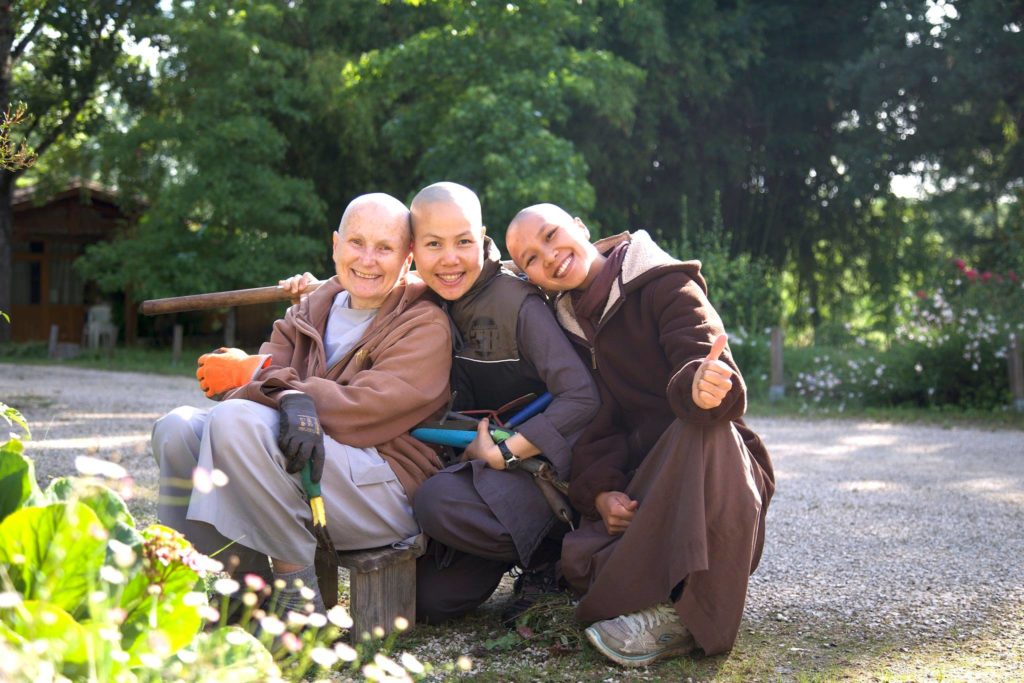
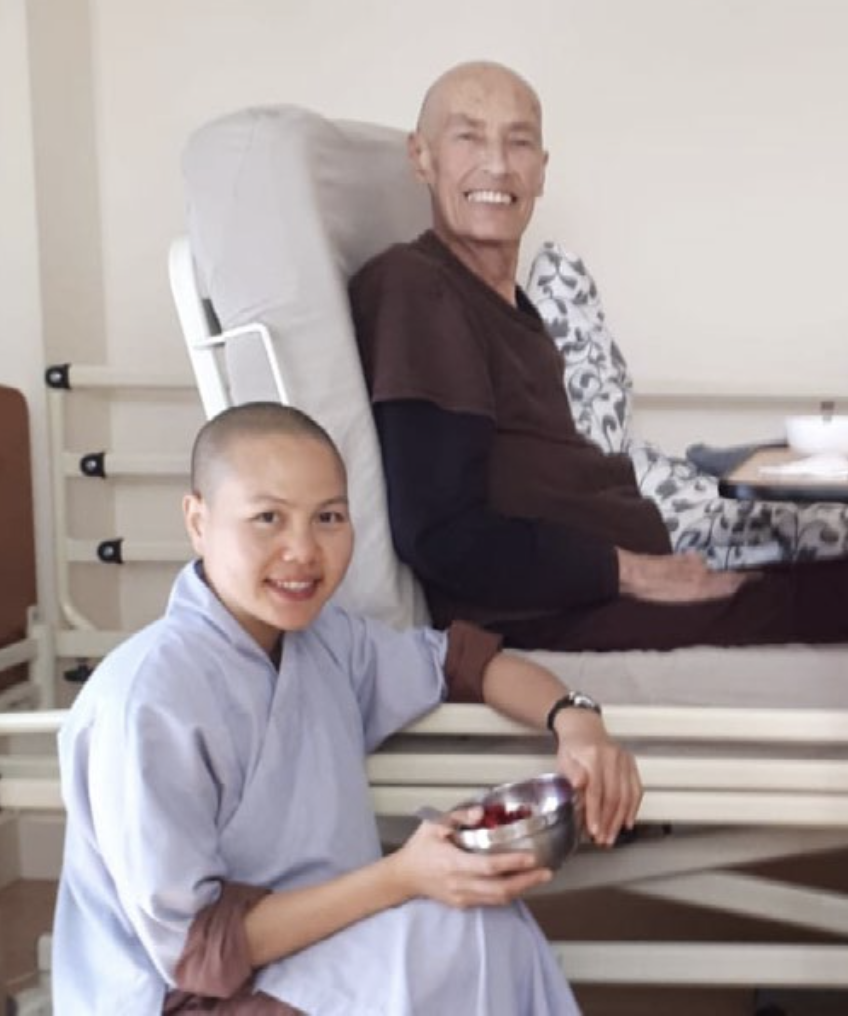
Sister Trang Loc Uyen (center), is an active young Dharma teacher-to-be in Lower Hamlet, Plum Village, France. She volunteered to be sister Lan Nghiem’s attendant along with other sisters while Sister Lan Nghiem was gravely ill until her passing.

Conditions were set that I had many chances to share a room with Sister Lan Nghiêm; we were part of the small minority of Lower Hamlet nuns who liked cool refreshing air and open windows in the winter.

The day she returned to the sangha after discovering that she had cancer, I was working in the office preparing for an online retreat. As much as I wanted to, there was just so much work piling up, and it was difficult to put time aside to be with her. I felt uneasy. I decided to be her attendant as the best means to express my love towards my beloved “young” friend for the past few years. The journey begins.

Familiarizing

I directly thank Sister Lan Nghiem for agreeing to return to the sangha so that the sangha could care for her. This meant so much to the sangha: There is something reassuring to be ill in the community.

After her first chemotherapy session, Sister Lan Nghiem was well enough to tell me all sorts of stories. Stories of her childhood, boating with her father, from buying a house in Amsterdam and leaving everything and moving to France, to living in a community on a farm making cheese…

After so many years of living with her, I thought that my capacity to listen to her never-ending stories was quite solid. But after two weeks of attending to her, I became fearful. Fearful because I heard her voice all the time. When I was doing sitting meditation with my eyes closed, or before I went to sleep I only saw her gestures. I was afraid I carried within myself her energy and had the impression that I was no longer myself. I was the exact replica of Sister Lan Nghiem. 

It wasn’t until a sitting meditation session that I saw clearly: that’s right, how can I not be a replica of Sister Lan Nghiem. Anyone, in an intimate relation more or less will influence one another. 

Everything pours into our store consciousness whether we want it to or not. Then suddenly, when I recognized all of the negative energy one can take in from the person we are caring for, I immediately thought of all of the nurses and caregivers. I am taking care of Sister Lan Nghiem, but I get to live in the sangha, I am in a good environment, I get to do sitting meditation and walking meditation… and I am still met with this difficulty, what do the nurses and caregivers at the hospital do? This awareness helped give me more energy to look deeply into my practice and to take care of myself while being an attendant. One morning, I saw the intimate relationship between myself and everything around me. I saw that I was physically well and was the indirect recipient of the fear and discomfort of Sister Lan Nghiem. And Sister Lan Nghiem was the direct recipient of her physical pain every hour, as well as the fear and confusion of what was going to happen next. This insight gave me more motivation to practice. I thought to myself: Sister Lan Nghiem will endure her pain and I will practice for her. I accepted the truth of interbeing. Instead of fear and denying the energy present, I accepted it as the most precious mud to generate motivation to look deeply into the fear of death that lies deep in my store consciousness. 

At every sitting meditation session, especially before going to sleep, I put myself in a dying person’s shoes and practiced with the gatha “This body is not me…

Whenever I was taking care of Sister Lan Nghiem, I reminded myself to be aware: I am of the same nature, eventually I will grow old, become ill, and be afraid of death, afraid of being lost and confused. Practicing like that, I felt gratitude overflowing within me. Sister Lan Nghiem is a Bodhisattva manifestation, accepting and embracing her physical pain so that I can awaken: Even when young, sickness and death can come at any moment and it doesn’t spare anyone. She reminded me that I need to be diligent in my practice and studies so that I can taste the insight of no birth and no death. 

I directly thank Sister Lan Nghiem for agreeing to return to the sangha so that the sangha could care for her. This meant so much to the sangha: There is something reassuring to be ill in the community. There are many who become ill and do not stay in the community because of the fear of inconveniencing the community. Sister Lan Nghiem was the first non-Vietnamese sister to stay in the sangha while ill until her death. I know taking care of sister Lan Nghiem is also taking care of my and the sangha’s future. The manifestation of her cancer is like a bell of awakening for the community of Lower Hamlet to practice contemplating old age, sickness, death and treasuring each other.

In the forest of fear and confusion 

After a period of time, Sister Lan Nghiem was admitted to the hospital for a blood transfusion and potassium infusion.

Returning to the hamlet, she became oddly difficult; she was short tempered, wanted to be independent but was always forgetful. We were at a loss. I was determined to experiment with a new method. I knew her personality and that is why I dared to experiment. She became irritated at me after I prepared her medication (it was the first time she was ever irritated with me), I was breathing deeply for a while and said: “Dear Sister, we love you very much and we volunteered to care for you with our whole heart. But I also have shortcomings and limitations, especially when it comes to understanding western medicine. If you see that we cannot be of any help, please tell sister Thuy Nghiem so she can change attendants. We don’t wish to make you any more tired.” After saying that to her, I was prepared to receive a reaction. But instead, she became very quiet, her voice became softer but a little more sad. I was worried. I asked if she needed anything else before I left. She said that she could do it with a sad voice. The next morning, a younger sister informed me that Sister Lan Nghiem was sweeter, and everything they did for her she always thanked them. My goodness! That meant my experiment was a success. From that moment on, she completely trusted us, that included Sister Dao Nghiem, the person that helped with her medications and contacting the doctor.

The cancer had begun to spread to her brain. Sister Lan Nghiem started to not understand a lot of things and not know where she was. Sometimes she would ask me questions and I couldn’t help but to half cry, and to half smile: “Why did people create the clock?”, “Why am I here?”, “How did they discover that I had cancer?” 

Her body began to weaken, but her consciousness wasn’t yet able to accept the truth about her cancer, saying “What is this thing called death?” If she were to pass away like this it wouldn’t have been good. Everyone in the sangha knew this but we didn’t know exactly what to do to be really helpful. I remember that around that time, I would chant Avalokiteshvara’s name, hoping that the energy of loving kindness and compassion in me would awaken so that I could do something to help her.

Sr Lan Nghiem loved to take long walks

Strength of the Sangha

After a while, the sangha eventually knew that she had stage four cancer. In the last two sessions of chemotherapy, they only put in enough medication so that she wouldn’t get any sores.  It wasn’t the usual dosage of a normal chemotherapy session.

We couldn’t help sister Lan Nghiem recover. It was now the time to help her go through her depression and accept that she would die in a short period of time. The attendant team started to sing a lot of songs about no-birth and no-death. The sangha started to offer chanting sessions twice a week for her. One evening, as she turned over, she woke up and I asked her: “How is your body?” She replied: “Oh, I feel very happy and comfortable.”

I felt so happy hearing those words. I don’t know how long it had been since she had felt comfortable and peaceful in her body. I said: “Do you know why you feel happy? It is because the sangha sent the energy of peace to you.” When she heard that, she said: “Oh really, I thank the sangha.”

It seemed that she was trying to forget the reality of her situation. There was one day, after sitting, I realised that in order for her to accept the reality of  her coming death, we needed to ask for help from Sister Chan Duc. That morning, when SisterChan Duc came to visit, I shared with her Sister Lan Nghiem’s present status. After singing one or two songs, SisterChan Duc  took off her hat, and I knew that her Dharma talk was about to begin. She shared about the happiness of being Thay’s disciple, getting to know the practice of mindfulness, and getting to live in the embrace of her loving monastic siblings. Then she asked Sister Lan Nghiem if she knew which Dharma talk that Shariputra shared with Anapathindika before he passed away? Without waiting for an answer from Sister Lan Nghiem, she continued: 

These eyes are not me, I am not caught in these eyes.
These ears are not me, I am not caught in these ears.
This body is not me, I am not caught in this body.

(Discourse on teachings to be given to the sick – Plum Village Chanting Book)

The deeper SisterChan Duc went into the sutra, the stronger became Sister Lan Nghiem’s concentrative energy. I remember it as if it were just yesterday, Sister Lan Nghiem was lying perfectly still listening to SisterChan Duc’s words, just as a child would listen to her parents teachings.

After offering the teachings, SisterChan Duc sang a few more songs and left. Sister Lan Nghiem started to feel a rush of pain. We massaged her for an hour to no avail. I knew that this was a strong pain. Because at this time, she was starting to wake up to reality, and to not avoid it.

I felt that [Sister Lan Nghiem] was determined to see the insight of no birth and no death. I said: “I know that the highest purpose of a monk or a nun is to attain the insight of no birth and no death. Even though I am still young I also want to have this insight.” She replied, “Me too”.

The lotus blooms when the mud is accepted

Ten days before leaving her body, she was once more in excruciating pain. I said: “Dear Sister, you know that we love you and aren’t hesitant to care for you. I see that the cancer is spreading quickly. If at any moment you feel you cannot endure the discomfort any longer then you can let go of this body, ok? The sangha is always present to protect and send energy to you.”

She replied: “I am thinking of that. It has been more difficult.”

I was happy to hear that. Those words proved that she had accepted herself – and had accepted the truth.

With a little more confidence, I asked: “How much longer do you think you can continue like this?” She wasn’t ready to answer. Knowing her, I offered a few suggestions: “A few more months, few more weeks, a few days?” She answered: “I think that I can continue on for about two weeks.”

Not trusting what I had just heard, I asked her for confirmation: “You mean two more days or two more weeks?”

She replied: “I think I can continue on for about two weeks.”

“Do you want me to do anything for you? Is there anything that you are remorseful about or have any regrets about?” “No,” she answered.

I continued: “Do you want the monks and nuns to come and sing a few songs for you?” She nodded her head. From that day onwards, her room was filled with songs and sharings of beautiful memories of the brown robed angels.

Two days later it was my turn to take the night shift. Before going to sleep, I sang the song “I have arrived, I am home”. To my surprise, she was singing along with me. At this point her tongue was stiff and curled up so the words weren’t audible. But when we reached the line that says “the door of no birth and no death is open…” she sang with lots of determination. I felt that she was determined to see the insight of no birth and no death. I said: “I know that the highest purpose of a monk or a nun is to attain the insight of no birth and no death. Even though I am still young I also want to have this insight.” She replied, “Me too”. 

Hearing those words, I felt so happy. After breathing a few breaths, I continued, “At present, you are experiencing old age, sickness and death ahead of me, therefore you will realize the insight of no birth and no death before me. If you realize it before me please share it with me.” At that time, Sister Lan Nghiem said in a stiff voice that I cannot forget to this day: “I will let you know before I go. I will let you know before I go.” After that I turned on the Dharma talk given by Thay on no birth and no death. A smile blossomed on her lips. That smile remained there until the next morning, until the moment in which she released her body.

Her two younger blood sisters informed us that two days after listening to the Dharma talk, while lying down she suddenly said twice: “I have understood it, I have understood it.”

I was so happy. From that moment on Sister Lan Nghiem’s energy was completely different. Going from a place of fear, worry and sleeping in order to forget the truth, she became more peaceful and rested deeply. The pain increased more and more everyday but her mind was lighter and lighter. From that day onwards, every time I did sitting meditation in her room I felt a wondrous sense of peace. At times, I felt as if I was sitting in the presence of Thay when I was his attendant.

On Monday November 30, her breathing became weaker, and lighter, we had to look at her abdomen to know whether she was breathing or not. On Monday evening, the three attendants, SisterDao Nghiem, and Sister Lan Nghiem’s two younger blood sisters spent the night in her room. At five in the morning, everyone had tea together. I made black tea, the kind that Sister Lan Nghiem likes, for everyone to drink. We shared so many beautiful memories of Sister Lan Nghiem. That morning was a legendary and spiritual moment for me.  

Two hours later, I returned from washing the teapot, I saw SisterDao Nghiem sitting close to the bed, with her hand on Sister Lan Nghiem’s stomach. She had passed. I placed my hands on her stomach. The body was finally at rest. There was such a deep stillness of body and mind. Everything had become completely still.

I went to the Assembly of Stars meditation hall to announce her passing. At that time the sangha had just finished the morning ceremony. Sister Lan Nghiêm had waited for the sisters to finish the precepts recitation ceremony before passing. She passed away at 7:15 a.m. on December 1st, 2020.

You have left, what of those who remain?

Occasionally, the remark that she made when the brothers came to visit her still rings in my ears: “I think I’m smart but now it doesn’t work.”

That’s right, witnessing what had happened to her, I saw clearly that talents, skills, and intelligence cannot be of any use when you are on your sickbed nearing death. It is the love, the care of your loved ones surrounding you, and completely taking refuge in the sangha that helps us to overcome moments of difficulties. So how should we practice or be of service so that we are not pulled away by our work, pulled away by the desire to develop our skills, that we forget the value of sisterhood and brotherhood and the highest purpose of one who has gone forth?