Showing posts with label mind-body. Show all posts

Monday, January 26, 2026

Regulating - Chibs Okereke & 'Stop' - Thich Nhat Hanh


From CHIBS OKEREKE - Transcribed from Insighttimer on Jan 25, 2026


In this short [descriptive] practice [and guide]we'll be noticing when the mind runs ahead of reality. 
And then we're going to gently invite ourselves back to what's true right now. 
Let's allow the body to arrive before the mind tries to sprint off
into the rest of the day. 


You can close your eyes if that feels comfortable.
Or simply soften your gaze with the eyes open.
And let's begin by feeling the support beneath you.
The chair. The bed, the floor. Holding you safely. 

See if you can allow the shoulders to drop a little. Maybe unclenching the jaw.
Softening the belly. And now let's take a slow comfortable breath in
through the nose. And a soft, easy breath out, through the nose or the mouth.
Breathing in through the nose. And out through the nose or the mouth.
One last breath in. And a slow breath out. And now allowing the breath
to return to its natural rhythm. 


And now I invite you to bring your attention to the simple reality of this moment. Perhaps you can feel the feet on the ground, body breathing.

Maybe you can hear some sounds in the room. Just taking a moment to notice that you're here.

Now, the mind will want to run ahead into what ifs. Worst case scenarios. Conversations that haven't happened yet. problems that haven't arrived. That's just your nervous system, trying to prepare and protect you.

Today we're practicing something different. We're noticing the moment that our thoughts start to sprint into the future. And we're choosing not to feed the frenzy. So as we breathe in, Feeling the breath moving low into the belly. And as we breathe out. Letting the exhale be just a little longer than the inhale. A slightly longer out breath, tells the nervous system. "You're safe."

--> And if a thought pops up about something we said or something we're worried might happen. Just seeing if we can notice it. In the same way that we'd notice a cloud passing across the sky. A thought like to predict. But the body knows what's real. Presence is where clarity lives.

Saturday, January 17, 2026

5 Self Caring Practices


The Joy of Self-Caring

We’ve been sold on the idea that self-care means chocolates and bubble baths, but Cyndi Lee says real self-caring is a practice, not a treat.

Cyndi Lee
5 November 2021
Before everybody started talking about self-care, they talked about detoxing. Cleanses were the trend and many (if not most foods) were vilified. Daily emails arrived letting me know the many ways that I was toxic—food, air, relationships, inner dialogue. The programming director for a huge yoga conference told me that if I wanted my classes to sell out, I just had to put the word “detox” in the title.

This consumeristic approach to ancient yogic practices was accurate in some ways: a need had been identified and a solution proposed. We feel incomplete, unloved, inadequate, and definitely not fit enough. Being toxic might be our own making, but fortunately, we could easily purify ourselves by purchasing a juice cleanse. We could even purify ourselves this way daily, which was really good because it meant we could then continue our toxic ways. So as long as we kept detoxing, we could also keep toxing.

It seems to me that the purification trend has faded and evolved into the latest health directive —self-care. Now the daily emails tell me that I need to get more sleep, do restorative yoga, take time out to get together with a friend, do more barefoot walking on the grass, keep a gratitude journal. Actually, I think these are all really good ideas. But none of them is going to satisfy our dissatisfaction, reduce our craving, or relieve our suffering.

You might be right that your life is super stressful and you deserve a special treat now and then. But applying a materialistic approach to our pain, boredom, need for attention, or aching back is just a band-aid. The discomfort will cycle back up and then we will “do” another self-care activity, and then another when we feel bad again. The momentary relief of a pedicure is like a painkiller that works so well it discourages us from trying to remove the thorn in our foot that is causing our suffering. Besides, it’s our suffering that makes us feel deserving of the yummy self-care goodies.

What our suffering really deserves is compassion. This is what initially inspired me to take the bodhisattva vow. When my teacher, the late Gelek Rimpoche, introduced this concept to me, I was inspired by the idea that my life, my good efforts in practice, and my caring and compassion could be dedicated to the benefits of others.

Actually, Rimpoche didn’t say that. But that’s what I heard. For about twenty years. Then I finally woke up to what he really said, which is that a bodhisattva dedicates their practice for the benefit of all beings, and that includes me.
That was against the stream of what I grew up thinking, which was that good and nice people don’t put themselves first because it’s selfish. So when I first heard about self-care, I kind of thought, “Eewww.” It seemed icky. Like taking yourselves out for a date or something. Sad and lonely.
But sometimes, I am sad and lonely. And it’s nothing a bubble bath can fix because applying a band-aid is not the same as having a caring heart. As Reb Anderson writes in Being Upright, “All suffering is worthy of compassion.” That means that our own suffering too is worthy of our own compassion. Self-care might be a one-off event, but self-caring is a living practice that allows our innate capacity for caring to emerge and, even more, to ripen and increase.

As a yoga and Buddhist meditation teacher, when I talk about practice I’m usually referring to yoga asana or meditation or breath work. When we engage in these practices, we don’t say that we’re doing “self-yoga,” “self-meditation,” or “self-pranayama.” So when we think of “self-caring” as just “caring,” we are already moving toward a larger view of this practice, one that is for benefit of all beings, including ourselves.
How can we shift from the band-aid approach to a practice of self-caring? Even asking the question is a good start. The Tibetan word for practice is gom, which means “getting familiar.” The practice of self-caring is about getting familiar with the part of us that is naturally caring and getting familiar with what it feels like to apply that tenderness to ourselves.
Sometimes I think about how much I suffered when I was a dancer in my twenties. I saw myself in the mirror every day and I was never, ever good enough, thin enough, special enough. I was grumpy a lot of the time and all those drugs I did didn’t make me like myself better. Now that I am in my sixties, my heart breaks when I remember that young woman, and I vow to be kinder to myself. I don’t want to be that way to myself anymore because I don’t deserve it. I also know that when I am not caring to myself, I am more difficult to be around.

This is motivation. It is how we start all spiritual practices. You can say to yourself anytime, “I am going to cultivate my innate ability to be caring, for the benefit of all beings, including myself.” Or you can say, “I am going to get familiar with when I am uncaring toward myself and vow not to go there. I vow to grow my capacity for being a caring person.” If you like, you can place your hands over your chest and feel your heartbeat, as you say this.

Even if you don’t think you can do it or you label it as “magical thinking,” you can still say it because you’re getting familiar with opening to your own potential
.
This is how you begin to move into tend and befriend. “Tending” is when you engage in nurturing activities and attitudes that help you feel safe and calm. “Befriending” means spending time with community and family—experiences that also support “tending.” By attending to yourself with kindness and being willing to take responsibility for your own caring, you are tending and befriending yourself. “Tend and befriend” increases the anti-stress hormone oxytocin, which lowers cortisol, blood pressure, and other stress responses. In other words, self-caring feels good.

“Tend and befriend” sets the ground for you to engage in the practices of self-caring, which are all ways of getting familiar with the two aspects of your nervous system, the sympathetic and parasympathetic.

When a stressful situation arises, the sympathetic nervous system, which is connected to the spine, will respond by telling you to move now, via the fight or flight instruction. This response sends blood to the muscles, speeds up the heart, and slows down other functions that are not needed for running or fighting, such as digestion. Conversely, the parasympathetic nervous system is close to the inner organs and tells each of them when to relax and quietly do their jobs. This is known as rest and digest.

We need both of these systems to be toned so that our nervous system can be nimble and go fast or slow, depending on the need. Unfortunately, most of us are already hyped up to a certain degree. So, I offer some short, simple, and powerful practices below that will stimulate the rest and digest response. Think of this as toggling between the active requirements of your life and the receptive moments that you choose—together they help you become more resilient through the gateway of your body.
The number one thing to remember is to do them. Like all such practices, it might be boring at first and you don’t always feel results right away. Without results, it’s hard to have faith in the process and you can lose your motivation. This is where you just have to trust the practice and look to the wisdom of great teachers. Like Gelek Rimpoche always said, “Drip, drip, drip, the bucket fills.” Being patient is also a way to practice self-caring.

5 Self-Caring Practices

As With any practice, begin by reviewing your motivation. This is a reminder that practice is not just about what you do, but also about how you do it, and that makes the difference.


These practices help you touch into your capacity for caring and develop a sense of genuine closeness with yourself.

Savasana
In the yogic tradition, savasana is a way to let your body and mind rest at the end of a strong, active practice. Savasana is a Sanskrit word that means “corpse pose.” This practice is for letting go of our physical bodies. It is a good opportunity for generating thoughts of gratitude for one’s precious life.

Recently my ayurvedic doctor prescribed a daily savasana to me as a way to recover my energy after the stress of two surgeries. It made me happy to be reminded that something so easy was also so good for me. It nourishes and revives me, both mentally and physically. Savasana will also calm the brain, reduce fatigue, lower blood pressure, and relax your body.

Lie down on your back on your bed or on the floor. Place a small pillow or folded blanket under your head and neck, but not under your shoulders. Your legs are straight, feet as wide apart as your hips. Position your arms about twelve inches out from your sides, palms up. You can also place a pillow or blanket on top of your thighs. Close your eyes and rest for five to ten minutes. If your legs are especially tired, do savasana with your calves up on a stack of two or three large pillows. Or you can lie on the floor with your lower legs and feet on the couch or a chair. This variation also helps invigorate stagnant lymph fluid.

width=
Grounding Touch

In this exercise, you are using your own hands to weight your body, which helps reduce anxiety and create a sense of calmness and stability.

Standing up or sitting in a chair, begin to gently rock side to side. Eventually let your weight settle firmly and evenly on your two feet. Place your right hand on your belly and left hand on the center of your chest. Tune in to the feeling of your breath, the sensation of warmth from your hand, and the strength and softness of your body. Take a few breaths between each of the following movements: place your right hand on your forehead, your left hand on your belly, then both hands on the center of your chest.

Finally, place your palms together and rub them, making some heat. Cup your warm hands over your face and let their warmth melt the tension in your face, eyes, and jaw.
Slide your hands down your face and all the way to the tops of your legs. Press gently on your thighs to enhance the downward-moving energy in the body called apana. Apana supports the immune system by promoting elimination of all that is not needed: physical waste, confusion, doubt, fear, or feeling lost.

Loving-kindness

Sit comfortably. Place your palms on the center of your chest. Close your eyes. Take a few moments to feel your natural breathing and the feeling of your hands on your body.
Then say each of these expressions of loving-kindness toward yourself:

May I be happy.
May I be healthy.
May I be safe.
May I live with ease.

After you recite each of these, notice what comes up in your mind. Whatever you notice is fine and interesting. This is another way of getting familiar with yourself, but it doesn’t mean every thought is true. If you get way off-track, repeat the phrase.
After noticing what comes up, take a big breath in, and as you exhale, let go of that phrase. Go on to the next one.

Gathering and Grounding Breath

This is a way to get out of your head and into your body. You can also do this during a challenging conversation or meeting or even while you are walking down the street.
Sitting or standing, find an upright posture. Close your eyes and tune into the feeling of your natural breath coming in and out. Slowly begin to lengthen your inhalation and extend your exhalation, just a little bit at a time. When you breathe in, imagine all the scattered parts of your mind collecting together in one spot at the edge of your nostrils. As you exhale, let that soft ball of energy drop down into your body, giving you a feeling of earthiness and stability. Repeat slowly as many times as you like.

Bedtime Foot Massage

Sit on your bed with some oil or lotion nearby. My favorite is arnica oil with lavender, as the arnica helps heal bruises and tender spots, and the lavender helps you relax. Put a little oil in your hand and start to rub circles around your ankle. Take your time moving down your Achilles tendon and around your heel. Use one hand to gently flex your toes back and, with the other hand, pull your heel away, stretching the sole of the foot. Interlace your fingers with your toes, as if you were holding hands with them, and slowly circle your foot in both directions, like winding up a toy. Finally, place your other hand over the top of the toe-holding hand and lightly squeeze.

Gently release your hands and place your feet together. You will see that one foot looks fresh and pink, flush with circulation. Time to do the other foot and then tuck yourself in for a nice sleep.

Each of these practices I’ve suggested is easy to do—they don’t require any equipment or expertise and can be done in less than five minutes. All of them integrate body, breath, and mind; they feel good while you are doing them; and when you finish, you will feel better than when you started.

Know that if you forget to practice, you can always make a fresh start. One January, I made a New Year’s resolution to do a daily restorative yoga pose for one month. I did it for two days, but on the third day I completely forgot. I didn’t remember it for the entire year, until the following January. Once I realized, I had a good laugh and then re-upped for the last year’s resolution. Anytime is a good time to cultivate a light heart and generosity toward oneself.

I also want to encourage you not to make a job out of this practice of self-caring. The idea is not that you must do one or more of these practices every day in order to succeed with self-caring. The idea is that these are all methods for helping you get close to yourself. When you pay kind attention to yourself, noticing when your breathing is too tight or your posture is too loose, you develop a thread of awareness around your own energetic habits. As you naturally become more familiar with what is actually nourishing for you, because it’s easy and it feels good, your self-caring practice will grow.

Cyndi Lee

Founder of the world-renowned OM yoga Center in NYC (1998-2012), Cyndi is known for her contemplative classes and soulful teachings. She is the author of 5 books, including Yoga Body, Buddha Mind: A Complete Manual for Physical and Spiritual Well-Being, and the New York Times critically acclaimed May I Be Happy: A Memoir of Love, Yoga, and Changing My Mind. In 2019, she launched a new online course, “Taking Refuge In Your Body,” available from Lion’s Roar.


Sunday, November 16, 2025

Hugh Byrne: the Body keeps the Score


I really disconnected from ourselves. You know, we're often, you know, we might it might have a lot of consequences. You know, we may eat more than we need to do because we're kind of disconnected from our bodies. We're not really aware of our listening to or paying attention to what our body is telling us, our mind may be telling us, oh, I really like this ice cream, you know, or we might eat less than is healthy, because we have a mental image of how, oh, I want to look like this, you know? And so we're caught up in our heads and our thoughts and our stories. Our body has a wealth of information about our well being and about the world, and it's a great, you know, it's a great source of awareness for how we're doing. If we just pay attention, if we turn towards our bodies, in the Buddhist, you know, teachings in the Buddhist tradition, the body is at the very heart of our practice.. It's a place, you know, it's the what's called the first Foundation of Mindfulness. And our bodies really bear the imprint of everything that happens to us in our lives. You know, difficult experiences and traumas and pain are held in the body. And if we're aware of our body and our feelings, then the body can be a.. a doorway, really, to the deepest freedom, to great happiness, to great well being. But as I said, that we're often disconnected, you' probably heard of, you, well known books. one by Bessel V Cog, the Trauma specialist who had a bestseller for many, many company years, I think, on New York Times best seller list called The B Body Keeps the score. The Body keeps the score. The. kind of remembers. traumas and painful experiences, get kind of lodged in the body and this can play out in ways that are quite painful and, you know, difficult for us if we don't find a way of coming back to the body and working with, you know, our bodily experiences. Another one was another book had a title, "The Body Bears, the Birdden, The Body Bears the Birdden. Bessel Vander Cock said, "Oce you start approaching your body with curiosity rather than with fear, everything shifts. So the invitation. The invitation is to really bring an attitude as, you know, I was encouraging you in the meditation, to open fully, to what we're experiencing in the body, to not, you know, go off into not to not do that, but be aware of when we do go off and to choose to come back, choose to come back into awareness of our bodily experience. In one of the most important teachings in in the Buddhist tradition. The Buddha is, you know, quoted as really emphasizing the importance of the body. He says, "Within this fathom long body is found all of the teachings, is found suffering, the cause of suffering, the end of suffering, and the path to the end of suffering. What he's saying is that all of the that awareness of the body will allow us to kind of know the four noble truths, to know how to find freedom from suffering, to be aware of suffering, so to feel, okay, I'm noticing the tension in my body, because I'm I'm not wanting to experience something, or I'm angry about something, and we can, you, if we're angry about something, you know, rather than being lost in that story, in the mind of being pulled along by our anger, we can be aware of the anger and be aware of the tightness in the chest and the heat around our face. There was a very tragic story in the news yesterday here in the US. about an 11 year old boy, I think, a child who was killed in the back seat of a car because of a road rage incident, you know parent, father, and another driver, you, got into, you know angry, conflict about, you know, who was going to be first and it kind of it ramped up into this, you know, what ended in violence and the shooting. And it's so sad to hear that story. I mean, the stories like that, about the suffering that can come when we get kind of swept up in our minds, swept up in the story of our minds. This person did this to me, and I've got to do this to them, you know, rather than what we can do with this practice, this awareness practice, this practice of mindfulness, is to simply come back, you know, we're feeling angry about something, if we just have that moment of awareness to pause, in, pause between the stimulus and the response. If we can pause, then we can just come back and say, "Okay, feeling this tightness, tension, heat in my body, you know, feels, might even feel really explosive, but if we can stay with it, breathe into it, then what might otherwise be an angry action or angry words that create a lot of further conflict, we can just simply ride the waves of that difficult experience. We can we can feel the feelings. We can still say something, but if we can ground ourselves in our direct experience, whatever we say and whatever we do can come from a more grounded place. You know, it may be to say something. It may be to say something in a quite forceful way, but that's very different than just being kind of swept up in anger. You know, it could be the same with you, very similar with other emotions as well, the way we get caught up in stress. You know, and there we're caught up in this kind of psychological fear, which is about the future. You know, and it's not really, it's not say never, but it's very rarely about what's happening right now. I mean, you know, what's happening right now is obviously a factor, but what we're doing, when we're stressed out, is we're taking the present moment, where extrapolating into the future and something of, oh, I've got too much to do, I'll never be able to do this." All the stories and narratives that come out of that, and if we come back to the body, we all we have to do is be with what's here right now. Sometimes it can be difficult, definitely recognize that, but we don't need to be with the future. We don't need to solve the future. Eccart told talks about that. He says, you can always cope with the present moment. You can't you can never cope with the future because the future is just a mind creation. You know, and you create something and then a second, you know, a few seconds later, you can create something that's the exact opposite of that, you know. So what's a real future? We don't know. There's never a future, because when it happens, it'll be the present moment. You know, as Toll and others kind of remind us, and only moment we have to the only moment we have to really be with is this present one. And that's a great you know, it's very powerful to kind of reflect on that, that a great encouragement, really, we only have to be with this moment. We don't have to be with all of the possible scenarios, because they're just kind of kind of mental popcorn in a way, you know, just kind of popping out. So another quote from the Buddha, this is he says, there's one thing that when cultivated and regularly practiced leads to, and he says leads to these six things, six qualities, leads to deep spiritual intention, to peace, to mindfulness and clear, seeing, clear comprehension, to vision and knowledge, just seeing how things really are, to a happy life here and now, and to the culmination of wisdom and awakening. That's the kind of the end of the path, the end of suffering. So all of these come from when cultivated, when this one thing is cultivated and regularly practiced, all of these benefits come from it, all the way to full awakening. And he says, "What is that one thing? Mindfulness centered on the body, mindfulness centered on the body. So it's again, an encouragement, you know, from the Buddha to know that mindfulness, awareness of the body has all of these, you know, very, very powerful and very beneficial consequences. One more, he says, "The Buddha says, "If the body is not cultivated, the mind cannot be cultivated. If the body is cultivated, the mind can be cultivated, so that if we practice awareness of the body, then we can come to see things see things clearly. The Buddha himself, or before he became the Buddha, before his enlightenment, he practiced austerities, you know, I'm sure you know, I've talked about it often. You know, the Buddha, the Siddhartha, who became the awakened one, or the Buddha, practiced these, you know, very intense kind of punishment of the body, as said, well, you know, kind of like, not eating more than a few grains of rice a day and not, you know, not taking care of the body, you know, practices of asceticism and austerity, and he realized, though, that isn't the way to freedom. It's not the way to freedom to punish the body. The body has to be, you know, it has to be honored and has to be taken care of if we're going to, you know, we're not going to free ourselves and free our hearts and minds through punishing the body. I don't think anyone has ever, ever really done that, you know. It's through really bringing awareness to our body, that we can can see some really fundamental things that are that are essential freeing ourselves, we can see when we pay attention to our body, we can see what in Buddhism, called the three characteristics of existence, three characteristics of life, really. And these are very, very important. One is, we see the impermanence of everything. You know, if we bring awareness to our body, we can see, is anything in this body permanent? You know, the breath comes and the breath goes. It arises, it passes, it doesn't it's not permanent. Is there anything in this body that is permanent, unchanging? You know, can anything be held onto? This is the second of these three characteristics. The first is impermanence, everything is changing. Constantly changing. There's nothing that isn't in a process of change from, you know, the most microccopic to the most macroscopic, you know, universal, you know, the planets, the sun, you know, they were all going to be gone. Yes, it may be 6 billion years or 5 billion years, but everything is going through this process of change, coming into existence and then passing. So what can we hold on to? Nothing can be hold onto, the Buddha said says as I or mine. None of it can be grasped and really held on to. It's like trying to, you know, catch water when, you know, just, you know, just passing through and its just passing through our hands. It's it's It can't be held onto It can't provide lasting satisfaction. So when we see this, we can develop a more a more accepting attitude to our experience that we can find peace in the midst of the change, in the midst of the fact that nothing can be held on to, and nothing is ultimately me or mine. You know, none of it's all, you know, changing this processes, changing, nothing can be held on. But our happiness can come, not by holding on to things, not by trying to make something perfect or make it like I'm going to have this, I'm gonna keep this. But rather in seeing that this is just the nature of life, can we find peace amidst the change, amidst the fact that nothing can be held on to, and nothing is ultimately me or mine in all of this. If we can do that, we can find peace in the midst of impermanence, in the midst of change, in the midst of the kind of the unsatisfactoriness of things, we can find we can find peace. So when we come back to the body, we're back in the present moment. We're back in connection with our life. You know, the body is always in the present moment. Where else could it be? But our minds are often somewhere very different. Our minds are often in the future, we're worried, we're planning, we're kind of you know, and there's nothing wrong with planning. There's nothing wrong with, but remembering. But if we spend our time there and we're not aware of the fact we're just kind of, you know, pulled into worrying about the future or ruminating on the past. Then, then we're gonna suffer. This is suffering. So coming back to the body, we're always coming back to reality. We're coming back to the truth. The body can really tell us how things actually are. And that's all we need to do, really. This becomes the gateway to great Peace and great freedom. Just stay, can I be with what I'm feeling right now? Just notice yourself in this moment when you bring awareness to your body. What do you notice? Maybe just turning your attention to the body, you notice that, you know, you take a deeper breath because, you know, you're holding on or you're feeling kind of tight or tense. You know, I noticed that as I kind of turn the attention in, you know, I'm speaking, so obviously there's some kind of energy there, but just noticing. And the body and the bodily experience becomes a kind of a touchstone, a kind of connection with how am I doing? And often because we're feeling something in the body, that doesn't feel, you know, doesn't feel too nice, doesn't feel too good. Then we go off, the mind goes off somewhere else, you know, it goes off into fantasy. I don't want to feel this. It goes off into thinking, "Oh, I need this to feel OK." The instructions, the encouragement, is just to come back. Excuse me, come back to this moment as it is, this moment without judgment. Again, in the Buddhist, teachings, the Buddha taught six fundamental practices of cultivating mindfulness of the body. I'll just name them, you know, we could spend hours talking about these, and in courses I often do. But just for now, you know, it begins with mindfulness of breathing. You know, that's the first foundation of mindfulnesses, mindfulness of the body, and then mindfulness of feelings, mindfulness of emotions and mindst, mindfulness of kind of objects of the mind. But it begins with mindfulness of the body, emphasizing the importance awareness of the body in our practice. And so the Buddha talk, first mindfulness of breathing, and the mindfulness of the breathing can take us all the way to the deepest freedom. despite cultivating awareness of the breath in the body, you know, as simply being present with our breathing. He taught mindfulness of the body in different postures, in sitting, and walking, and standing, and lying down. And in different activities, you know, going, you know, he taught the monks and nuns going on arms rounds with their begging bowl, you know, to be aware of the body when doing that, when reaching for something, be aware of reaching, you know, and grasping. You know, being aware of the body in all kinds of activities when going to the bathroom while brushing our teeth or whatever, just being aware of the body, you know, he said the he said, be aware of the body in the body. And there was a lot there's been a lot of discussion about what's he mean by being aware of the body in the body. and what I understand that to mean is of staying grounded in the direct experience of the body, so it's not filtered through, you through our minds, you know, how this body feels compared with another body or another person's body, but just the actual, direct experience of the body, the feelings of the body. So he also taught the practice of bringing mindfulness to different parts of the body in the Buddha's time, they thought about the body in terms of 32 different parts of the body, all of the inner makings of the inner parts of the body. this was these practices to just be aware of the body as part of nature, really, you know, not something, you know, not something to be held on to, but something that could be directly experienced. He also taught the practice called, you know, focused on the four elements of Earth, air, fire, and water. I actually have a meditation on a four elements meditation on inside timer, but it's's a very helpful practice where you explore the body in terms of these four elements. Earth being really kind of hardness, pressure, softness, contact, all of that, you know, of that. those kind of feelings. Earth, air is just kind of like the breath. and how that moves through it. So we're not kind of looking, we're looking at in the body, in this objective sense, you know, in terms of the feelings, you know, the hardness, the softness, et cetera, through the kind of the movement of the air, the water element, you know, the whether it's tears or saliva or digestive juices. Just being aware of those in an objective way, and then the fire element, the heat, you know, feeling the heat in different parts of the body. So you make kind of looking at the body in that kind of objective way. So all of these different ways of experiencing the body that create kind of letting go of clinging to the body. And they had the last practice was to examine or be aware of bodies as they decomposing. This isn't a practice that people do a lot these days, certainly, you know, kind of not in the West. know there aren't bodies just lying on a hillside, you know, being eaten by the birds, as it happens in some cultures. But this was a way of creating dispassion, non clinging to the body, you know, because we can easily cling to the body, you know wanting it to be a certain way, wanting it to look a certain way, but this kind of created a sense of understanding the impermanence of this body. This body, you know, a certain number of years or however long it might be, will, we'll just be a corse, you know, all of our bodies will be that, and to really let that go deep, and it does a couple of things, it creates dispassion in know, we're not kind of, you know, wanting to think this body, all beautify this body, but just kind of see what this is this is the body, and it will, like everything else, it won't last. So it creates dispassion, and and it also, you know, creates can generate encouragement that, you know, given this, given that this, we don't have too long on this earth, isn't it a good idea to spend our time really practicing and finding as much freedom as we can, you know, to cultivate freedom in this life. So, all of these ways of practicing mindfulness of the body,. So the encouragement is to stay close to the body. There was a Tai tea, teacher of the 20th century Arjun Buddhaasaai from Thailand. He said, "Do not do anything that takes you out of your body. Do not do anything that takes you out of your body." So, staying close to the body, bringing awareness to the body, is a doorway, a pathway to freedom, to letting go. Tibetan Buddhist teacher, Mingo Rashay said, ultimately, you' happiness depends on choosing between the discomfort of being aware of your mental afflictions and the discomfort of being ruled by them. So, just, you know, being aware of feeling angry or feeling stressed out, the choices between being aware of those feelings, those emotions, or just letting them run wild and following them wherever they go. We feel worried, so we create more worried thoughts. This is the choice we have. We can choose greater freedom by staying present with our experience here and now. Yes, Mora, well said, my body has served me well. I feel the same. I feel gratitude for the body carrying carrying me through this life thus far. So let's finish with a short meditation. invite you to. just find a comfortable posture, relax your shoulders. Let your chest be open so you can breathe easily. and maybe take a deeper breath or two, letting yourself just be here now. Noticing what's present for you. in the body and the heart and the mind. welcoming whatever your experiencing right now. Remembering the smile that we can invite the smile. The smile can really invite us to Bring an attitude of friendliness to whatever we're experiencing right now. Just holding whatever's present with kindness and with acceptance. I just appreciating the time you've taken today to practice together, to be here, to practice with many others, nearly 600 of us here right now, or today for this send a wish of loving kindness to yourself. Appreciation, and breathing out, just send a wish of kindness, friendliness to everyone here. May you be happy. May you be safe. May you be held in loving kindness, filled with loving kindness. May you be free from suffering. So wishing yourself well and wishing all of us, everyone here, wishing, wishing them well. May you be held in loving kindness, filled with loving kindness. May you be peaceful, happy, and safe? Letting your wishes go out into the world, so much suffering. Wishing everyone well. They all beings everywhere. He held in loving kindness, filled with loving kindness. May all beings be be safe and happy and peaceful. And this poem from William Blake, Eternity, He who binds to himself a joy, Does the winged life destroy, But he who kisses the joy as it flies, lives in eternity's sunrise. So just reflecting on the darma of kissing the joys of life as they fly. rather than trying to hold on and cling to anything, as eye or mine. May all beings everywhere be held in loving kindness, filled with loving kindness. May all beings be safe, peaceful. Free from suffering. It's so okay, take your time. coming back. into opening your eyes, coming back into the group. And just a few short things before we finish today. Thank you, everyone, for being with us today. It's wonderful to spend this time together on Sunday morning, Sunday, whatever time it is where you are just bow to the. US Roman Catholic bishops for their strong support of migrants, immigrants. recognizing our our r that we're bound together. There's a network of destiny. Martin Luther King said. So if anyone joined us later, I'm Hugh Byrne, this is Freedom of the Heart Through Mindfulness. These sessions we've been having for over five years now on Sundays, and I have a lot of meditations and talks on inside timer, as well as four courses, one on Mindfulness and habit change, another on mindfulness and poetry, another at 12 guidelines for developing or deepening a meditation practice, and one on the four noble truths, the keys to the four noble truths. I invite you to check those out. Also to check out the group that's organized around these sessions and my teachings, you can go to groups and just put my name in, Hugh By, you'll be invited to join the group. We've got a bit somewhat over 3,000 in the group right now, and people support each other, you know, share meditations and talks and I also send a summary out of the main themes of what I've talked about, you know, mindfulness of the body today. You know, the main themes, the main quotes and poems, etc. So I'll do that later today, hopefully, and also to mention that these teachings, these sessions are freely offered. There's no cost to join. The sessions. But if you' able to and inclined to, you can make a donation, the donation supports the teacher. In this case, obviously me today, and I'm it's in Buddhism, it's a long tradition going back to the time of the Buddha, known as Dana, or generosity, It's say, a spiritual practice, so rather than the kind of the pay to play that was so much part of our culture is, it's freely giving what you're able to, and if you're not able to not to do it. And if you can give a little, you can give a little, if you can give a lot, you can give a lot, there's just, it's a lovely practice and I. I'll post that on there in case that's easy to do for you. And appreciate everyone, appreciating your kindness, your generosity. Thank you, Liz, and Anne, and Donnie, and Juliana, Karen, Kat, Krista, Jen, Laurie, Deirdre, Claire, Leslie, Katie, Joanne. And so far as I go, and everyone who donated early and thank you everyone for being here today. Thank you for your practice. Thank you for being here. We support each other in our practice. And. I hope you have a good rest of the rest of the day, rest of the weekend. Thank you, Christy. Yeah, thank you for sharing that. Happy birthday, Esther. Hope you have a really good birthday and a good year ahead. And thank you, everyone, for being with us. We'll be back again in a couple of weeks. I'm. I'm going off to Spain, to spend a weekend with my family. Most of them are coming down from London and from England to Barcelona, where my brother, who died three months ago in July, late July, we're going to have a remembrance for him in Barcelona, where he lived for the last his family in the last three decades of his life. So I'm going over there in just about three weeks. And then I think I'll spend some time in Morocco, so if you're around there, or if you're in Barcelona or in Casablanca, yeah, I'll see you there. Have a cup of coffee. I hope everyone.. I'd really like it to, we could do things in person, but obviously we't so many different places. I had a dream of doing that a few years ago and drove around the Midwest. Some of you will remember that. I think I tried to do too much in a certain period of time, but it was nice to see people. Thank you, everyone, thank you, thank you, Solange. Yeah. So have a good good rest of the week, and I will see you. Yeah, thank you, Wendy. I'll see you next time. Blessings to everyone. Okay. Thank you, thank you, Judy. Thank you, thank you, Lorraine. Yeah, sorry to hear about your loss. Yeah, sending you lots of loving kindness. Thank you, Mary Belle. Thank you, Joanna, Juliana. Be well. See you next time.

Thursday, October 30, 2025

Thursday, December 26, 2024

A Meditation for the “Fix it”-Obsessed – Julie A. Nelson

A Meditation for the “Fix it”-Obsessed – Julie A. Nelson

A Meditation for the “Fix it”-Obsessed

Can’t sit still, because something urgent needs to be done? Mind racing because something has to be figured out, right now? Me too.

My favorite distraction when attempting to practice zazen (Zen sitting) is worrying about all the things that need fixing. Yet I have been reminded that we adopt a still and upright posture in Zen for a reason: The body trains the mind.

So let me share with you a four-part meditation I’ve developed that helps this process along, at least for me.

As I get into my zazen posture, I my mind is often occupied with thoughts about things I think I need to have or do, my own failings, and/or all the problems of this suffering world. From personal relationships and local community issues to national political developments, global poverty, climate change, and species extinction, there is enough off-kilter to keep me distracted forever! Now it’s time for the posture to do its work.

First, I feel the heaviness of my body in contact with what holds it. This includes my butt and whatever else is in contact with the ground or chair. Yes, in my mind I can often replay scenes of loss or betrayal that make me feel shaky, distrustful, and unsupported. I may even feel like I’m in free fall, having no idea who I am or where I am going. But what is happening right now? What does my body want to teach me?

I am totally supported! I may not trust in much, but I can trust in this. The feeling of being physically held inspires a sort of faith and peace. It brings a sense of gratitude for something I have not earned and do not need to earn. I am naturally and unavoidably grounded. And this doesn’t even require that I literally be on “solid ground.” I grew up in California, where occasionally the ground itself would quake under my feet. But whether I’m on heaving earth or riding the waves of turbulence in an airplane, my body is still supported. It still is. How are you supported right now? Be with that for some time. Have faith in it, if in nothing else.

Next, “fix it” thoughts will inevitably start to arise in my head. Often even trivial, mundane projects like editing an nonurgent email demand to be treated as PRIORITY! EXPRESS! Larger concerns may take up even more space, being accompanied by strong feelings of self-blame or anger or despair: “How could I have been so selfish?” “How do we force them to stop doing such terrible things?” “It’s all so big, it’s hopeless.” And then I shift into problem-solving mode.

Why is it that I want to fix things? Going down one level, it may seem that I want to be in control, or be seen as a good person, or get revenge, or be a hero.

Yet if I can tune down my thinking just enough to see what the rest of my body is up to, I find that there is something much softer, warmer, and more tender underlying the fix-it energy. My desire for control is just an effort to wall-off, protect, and shelter my fundamentally empty, vulnerable, and certain-to-die-someday self. Its source is a tender impulse to care for this precious human being, for as long as it is around. What else is in my heart-space? Not being separate from all that is, I discover a tender impulse to care for my sangha, for all Buddhist sanghas, and for sanghas of all suffering humans, species, rocks and trees.

Trusting my body, I allow the fix-it energy in my brain-space to revert to its source. When I release my mental busy-ness it plops down and lands on my heart, breaking it open. It finds its beginnings in compassion and, some may say, love. A physical feeling of warmth and openness and heartache fills my chest. It’s not that I will give up on trying to ameliorate things (within my abilities), but that I can give my outward-directed thinking, for right now, a rest. Touching the inward source of my longings during a period of quiet sitting gently waters the roots of creativity and healing.

Feeling both grounded and touched by love, I can open up to something beyond the anthropocentrism and even earth-centrism that drive my occasional feelings of hopelessness and despair. As human Buddhists, we come to know our place in the universe through Buddha, Dharma, and Sangha. Yet the Dharma Wheel of the universe is much vaster than that. Perhaps all our whole-hearted efforts to prevent us from burning or blowing ourselves up will fail. The Dharma Wheel will keep turning. Maybe the surviving cockroaches will evolve their own version of Buddha, Dharma, and Sangha. Or new life will develop elsewhere in the universe over millennia–which, after all, is just the blink of an eye on a cosmic time scale. We do all we can do; the results are not in our control.

Third, the effect of dropping the fix-it energy down into my heart-space leaves my head in a state of receptivity. No longer occupied with problem-solving, I notice my breath, the sound of a car going by, and the growing light of a winter dawn. As Robert Aiken wrote in one of his Zen Vows for Daily Life, I may “touch and receive” the “mind of rivers and stars.”

Lastly, there is the issue of keeping my butt on the cushion. I get impatient. Perhaps I sense one such light “touch.” My automatic next thought will usually be “Okay, that’s accomplished. It’s time to get up and start my day!” In my body, I experience impatience as a vertical energy located to the left of my spine. I find I can use that energy to help rather than hinder my practice if I just shift it a bit to the right, putting it into my backbone. Now it is an energy of support for my posture. And my posture trains my mind.

Faith. Tenderness. Receptivity. Patience. The body is wise about these things.

Wednesday, July 5, 2023

Thich Nhat Hanh’s Walking Meditation - Lions Roar

Thich Nhat Hanh’s Walking Meditation - Lions Roar

Thich Nhat Hanh’s Walking Meditation

The late Thich Nhat Hanh emphasized the practice of mindful walking as a profound way to deepen our connection with our body and the earth. Read on and learn how to breathe, take a mindful step, and come back to your true home.

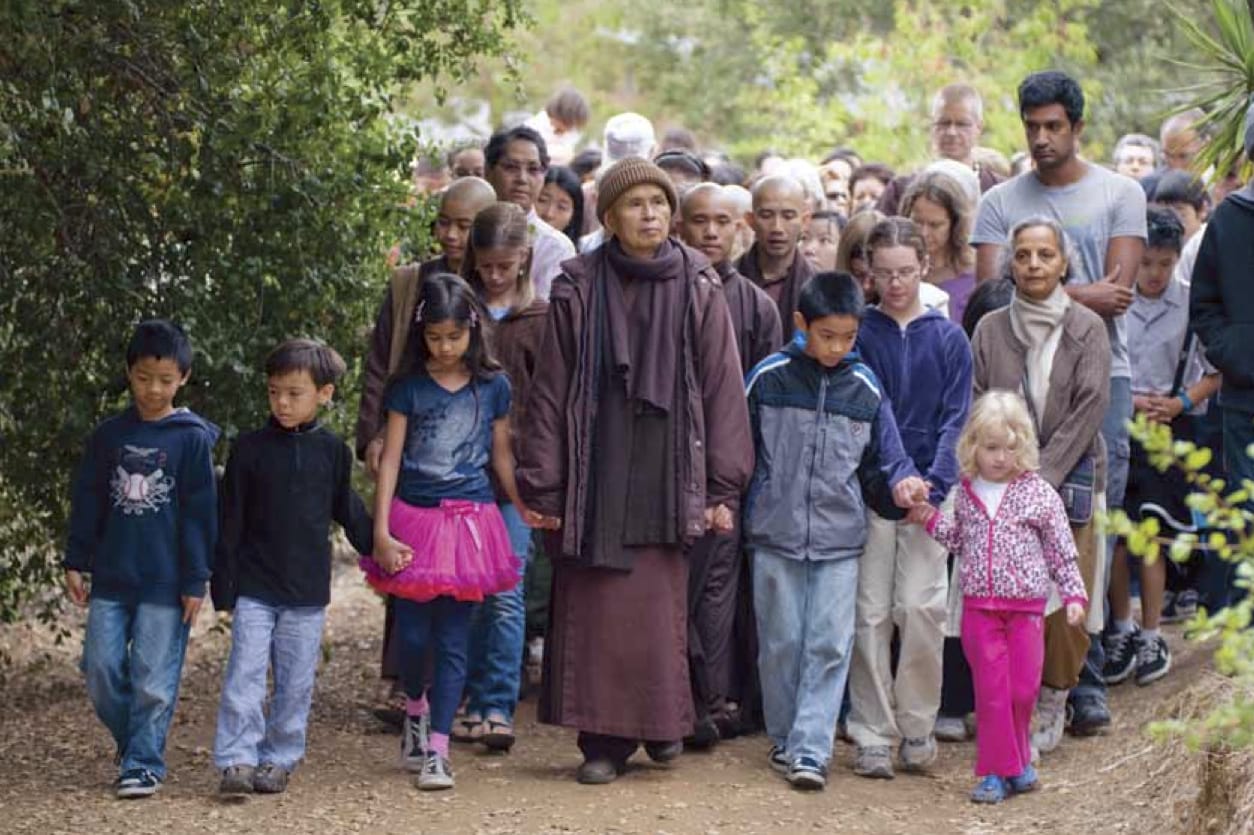
Thich Nhat Hanh walking with a crowd

Walking meditation with Thich Nhat Hanh during a Day of Mindfulness at Deer Park Monastery. Photo by Don Farber.

Many of us walk for the sole purpose of getting from one place to another. Now suppose we are walking to a sacred place. We would walk quietly and take each gentle step with reverence. I propose that we walk this way every time we walk on the earth. The earth is sacred and we touch her with each step. We should be very respectful, because we are walking on our mother. If we walk like that, then every step will be grounding, every step will be nourishing.

We can train ourselves to walk with reverence. Wherever we walk, whether it’s the railway station or the supermarket, we are walking on the earth and so we are in a holy sanctuary. If we remember to walk like that, we can be nourished and find solidity with each step.

To walk in this way, we have to notice each step. Each step made in mindfulness can bring us back to the here and the now. Go slowly. Mindfulness lights our way. We don’t rush. With each breath we may take just one step. We may have run all our life, but now we don’t have to run anymore. This is the time to stop running. To be grounded in the earth is to feel its solidity with each step and know that we are right where we are supposed to be.

Each mindful breath, each mindful step, reminds us that we are alive on this beautiful planet. We don’t need anything else. It is wonderful enough just to be alive, to breathe in, and to make one step. We have arrived at where real life is available—the present moment. If we breathe and walk in this way, we become as solid as a mountain.

There are those of us who have a comfortable house, but we don’t feel that we are at home. We don’t want for anything, and yet we don’t feel at home. All of us are looking for our solid ground, our true home. The earth is our true home and it is always there, beneath us and around us. Breathe, take a mindful step, and arrive. We are already at home.

Uniting Body and Mind

We can’t be grounded in our body if our mind is somewhere else. We each have a body that has been given us by the earth. This body is a wonder. In our daily lives, we may spend many hours forgetting the body. We get lost in our computer or in our worries, fear, or busyness. Walking meditation makes us whole again. Only when we are connected with our body are we truly alive. Healing is not possible without that connection. So walk and breathe in such a way that you can connect with your body deeply.

Walking meditation unites our body and our mind. We combine our breathing with our steps. When we breathe in, we may take two or three steps. When we breathe out, we may take three, four, or five steps. We pay attention to what is comfortable for our body.

Our breathing has the function of helping our body and mind to calm down. As we walk, we can say, Breathing in, I calm my body. Breathing out, I bring peace into my body. Calming the breath calms the body and reduces any pain and tension.

Walking meditation is first and foremost a practice to bring body and mind together peacefully.

When we walk like this, with our breath, we bring our body and our mind back together. Our body and our mind are two aspects of the same reality. If we remove our mind from our body, our body is dead. If we take our body out of our mind, our mind is dead. Don’t think that one can be if the other is not.

Walking meditation is first and foremost a practice to bring body and mind together peacefully. No matter what we do, the place to start is to calm down, because when our mind and our body have calmed down, we see more clearly. When we see our anger or sadness clearly, it dissipates. We begin to feel more compassion for ourselves and others. We can only feel this when body and mind are united.

Walking meditation should not be work. It is very pleasant, especially in the early morning when the air is still very fresh. When we walk mindfully, we see the beauty and the wonder of the earth around us, and we wake up. We see that we are living a very wonderful moment. If our mind is caught and preoccupied with our worries and suffering, we miss these things. We can value each step we take, and each step brings us happiness. When we look again at the earth and the sky, we see that the earth is a wonderful reality.

We Are Not Separate From the Earth

We think that the earth is the earth and we are something outside of the earth. But in fact we are inside of the earth. Imagine that the earth is the tree and we are a leaf. The earth is not the environment, something outside of us that we need to care for. The earth is us. Just as your parents, ancestors, and teachers are inside you, the earth is in you. Taking care of the earth, we take care of ourselves.

When we see that the earth is not just the environment, that the earth is in us, at that moment you can have real communion with the earth. But if we see the earth as only the environment, with ourselves in the center, then we only want to do something for the earth in order for us to survive. But that is not enough. That is a dualistic way of seeing.

We have to practice looking at our planet not just as matter, but as a living and sentient being. The universe, the sun, and the stars have contributed many elements to the earth, and when we look into the earth we see that it’s a very beautiful flower containing the presence of the whole universe. When we look into our own bodily formation, we are made of the same elements as the planet. It has made us. The earth and the universe are inside of us.

When we take mindful steps on the earth, our body and mind unite, and we unite with the earth. The earth gave birth to us and the earth will receive us again. Nothing is lost. Nothing is born. Nothing dies. We don’t need to wait until after our body has disintegrated to go back to Mother Earth. We are going back to Mother Earth at every moment. Whenever we breathe, whenever we step, we are returning to the earth. Even when we scratch ourselves, skin cells will fall and return to the earth.

Breathing in, I know Mother Earth is in me. Breathing out, I know Mother Earth is in me.

Earth includes the life sphere and the atmosphere. So you don’t have to wait until you die to go back to Mother Earth, because you are already in Mother Earth. We have to return to take refuge in our beautiful planet. I know that earth is my home. I don’t need to die in order to go back to Mother Earth. I am in Mother Earth right now, and Mother Earth is in me.

You may like to try this exercise while you walk: Breathing in, I know Mother Earth is in me. Breathing out, I know Mother Earth is in me.

Paul Tillich, the German theologian, said, “God is not a person but not less than a person.” This is true of the earth as well. It is more than a person. It has given birth to millions of species, including human beings. Many ancient cultures believed there was a deity that inhabited the sun, and they worshiped the sun. But when I do walking meditation and touching the earth, I do not have that kind of dualistic view. I am not worshiping the earth as a separate deity outside of myself.

I think of the earth as a bodhisattva, a great and compassionate being. A bodhisattva is a being who has awakening, understanding, and love. Any living being who has awakening, peace, understanding, and love can be called a bodhisattva, but a bodhisattva doesn’t have to be a human being. When we look into a tree, we see the tree is fresh, it nourishes life, and it offers shade and beauty. It’s a place of refuge for so many birds and other creatures. A bodhisattva is not something that is up in the clouds far away from us. Bodhisattvas are all around us. A young person who has love, who has freshness, who has understanding, who offers us a lot of happiness, is a bodhisattva. The pine standing in the garden gives us joy, offers us oxygen, and makes life more beautiful.

When we say that earth is a beautiful bodhisattva, this is not our imagination. It is a fact that the earth is giving life and she is very beautiful. The bodhisattva is not a separate spirit inhabiting the earth; we should transcend that idea. There are not two separate things—the earth, which is a material thing, and the spirit of the earth, a nonmaterial thing that inhabits the earth.

Our planet earth is itself a true, great bodhisattva. It embodies so many great virtues. The earth is solid—it can carry so many things. It is patient—it takes its time moving glaciers and carving rocks. The earth doesn’t discriminate. We can throw fragrant flowers on the earth, or we can throw urine and excrement on the earth, and the earth purifies it. The earth has a great capacity to endure, and it offers so much to nourish us—water, shelter, food, and air to breathe.

When we recognize the virtues, the talent, the beauty of the earth bodhisattva, love is born. You love the earth and the earth loves you. You would do anything for the well-being of the earth. And the earth will do anything for your well-being. That is the natural outcome of the real loving relationship. The earth is not just your environment, to be taken care of or worshiped; you are each other. Every mindful step can manifest that love.

With each step the earth heals us, and with each step we heal the earth.

Part of love is responsibility. In Buddhism, we speak of meditation as an act of awakening. To awaken is to be awake to something. We need to be awake to the fact that the earth is in danger and living species on earth are also in danger. When we walk mindfully, each step reminds us of our responsibility. We have to protect the earth with the same commitment we have to protect our family and ourselves. The earth can nourish and heal us but it suffers as well. With each step the earth heals us, and with each step we heal the earth.

When we walk mindfully on the face of the earth, we are grounded in her generosity and we cannot help but be grateful. All of the earth’s qualities of patience, stability, creativity, love, and nondiscrimination are available to us when we walk reverently, aware of our connection.

Let the Buddha Walk

I have a student named Sister Tri Hai who spent a long time in prison. She was a peace activist I knew since she was in middle school. She came to the United States to study English literature before going back to Vietnam and becoming a nun. When she was out in the streets advocating for peaceful change, she was arrested and put in prison.

During the day, the prison guards didn’t like her to sit in meditation. When they see someone sitting in a prison cell solidly and stably, it feels a bit threatening. So she waited until the lights had gone out, and she would sit like a person who has freedom. In outer appearance she was caught in the prison. But inside she was completely free. When you sit like that, the walls are not there. You’re in touch with the whole universe. You have more freedom than people outside who are imprisoning themselves in their agitation.

Sister Tri Hai also practiced walking meditation in her prison cell. It was very small—after seven steps she had to turn around and come back. Sitting and walking mindfully gave her space inside. She taught other prisoners in her cell how to sit and how to breathe so they would suffer less. They were in a cold cell, but through their walking meditation, they were grounded in the solid beauty of the earth.

Those of us who can walk on the earth, who can walk in freedom, should do it. If we rush from one place to another, without practicing walking meditation, it is such a waste. What is walking for? Walking is for nothing. It’s just for walking. That is our ultimate aim—walking in the spring breeze. We have to walk so that we have happiness, so that we can be a free person. We have to let go of everything, and not seek or long or search for anything. There is enough for us to be happy.

All the Buddhist stories tell us that the Buddha had a lot of happiness when he sat, when he walked, when he ate. We have some experience of this. We know there are moments when we’re walking or sitting that we are so happy. We also know that there are times, because of illness or physical disability or because our mind is caught elsewhere, when we cannot walk freely like the Buddha. There are those of us who do not have the use of our legs. There are those of us who are in prison, like Sister Tri Hai, and only have a few feet of space. But we can all invite the Buddha to walk for us. When we have difficulty, we can leave that difficulty behind and let the Buddha walk for us. In a while the solidity of the earth can help us return to ourselves.

If we sit mindfully, if we walk mindfully and reverently on the earth, we will generate the energies of mindfulness, of peace, and of compassion in both body and mind.

We are made of body and mind. Our body can radiate the energy of peace and compassion. Our mind also has energy. The energy of the mind can be powerful. If the energy of the mind is filled with fear and anger, it can be very destructive. But if we sit mindfully, if we walk mindfully and reverently on the earth, we will generate the energies of mindfulness, of peace, and of compassion in both body and mind. This kind of energy can heal and transform.

If you walk reverently on the earth with two other people, soaking in the earth’s solidity, you will all three radiate and benefit from the energy of peace and compassion. If three hundred people sit or walk like this, each one generates the energy of mindfulness, peace, and compassion, and everyone in the group receives that healing energy. The energy of peace and mindfulness does not come from elsewhere. It comes from us. It comes from our capacity to breathe, to walk, to sit mindfully and recognize the wonders of life.

When you walk reverently and solidly on this earth and I do the same, we send out waves of compassion and peace. It is this compassion that will heal ourselves, each other, and this beautiful green earth.

Meditation: Walking on the Earth

Walk slowly, in a relaxed way. When you practice this way, your steps are those of the most secure person on earth. Feel the gravity that makes every step attach to the earth. With each step, you are grounded on the earth.

One way to practice walking meditation is to breathe in and take one step, and focus all your attention on the sole of your foot. If you have not arrived fully, 100 percent in the here and the now, don’t take the next step. I’m sure you can take a step like that because there is buddhanature in you. Buddhanature is the capacity of being aware of what is going on. It is what allows you to recognize what you are doing in the current moment and to say to yourself, I am alive, I am taking a step. Anyone can do this. There is a buddha in every one of us, and we should allow the buddha to walk.

While walking, practice conscious breathing by counting steps. Notice each breath and the number of steps you take as you breathe in and as you breathe out. Don’t try to control your breathing. Allow your lungs as much time and air as they need, and simply notice how many steps you take as your lungs fill up and how many you take as they empty, mindful of both your breath and your steps. The link is the counting.

When you walk uphill or downhill, the number of steps per breath will change. Always follow the needs of your lungs. You may notice that your exhalation is longer than your inhalation. You might find that you take three steps during your in-breath and four steps during your out-breath, or two steps, then three steps. If this is comfortable for you, please enjoy practicing this way. You can also try making the in-breath and the out-breath the same length, so that you take three steps with your in-breath and three with your out-breath. Keep walking and you will find the natural connection between your breath and your steps.

Don’t forget to practice smiling. Your half-smile will bring calm and delight to your steps and your breath, and help sustain your attention. After practicing for half an hour or an hour, you will find that your breath, your steps, your counting, and your half-smile all blend together in a marvelous balance of mindfulness. Each step grounds us in the solidity of the earth. With each step we fully arrive in the present moment.

Walking Meditation Poem

I take refuge in Mother Earth.
Every breath, every step
manifests our love.
Every breath brings happiness.
Every step brings happiness.
I see the whole cosmos in the earth.