Showing posts with label breathing. Show all posts

Tuesday, July 15, 2025

Who Is the Boss?


https://plumvillage.org/articles/blog/monastic/who-is-the-boss


Excerpt:

Aimlessness, Busi-less-ness
Aimlessness doesn’t mean we are just roaming or floating about like a boat on the ocean without a rudder, being thrown hither and thither. No, we bring our mind home to our body, we are fully present with what we are doing, for the sheer joy of doing it. When we are fully present while doing something, it is joyful, it is nourishing. We are our most beautiful self. We’ll have a result. We may even say, “I want to go in this direction.” But while we are doing it, we are not lost in “I want to get there, I want to get there, I want to get there.” With that kind of state of mind, we are not truly in the present moment; we are trying to be in the future, which is not possible. The only moment we can be in is the present moment.  To be present, to practice aimlessness, is being our most beautiful self.

Saturday, April 19, 2025

David Wagoner, LOST & Hugh Byrne: Lost in Thought

Live Session Summary, Sunday, April 13, 2025: 

It was good to be with you for our live session today. The focus of the session was on working skillfully with our thoughts, rather than being lost in them. 

Here are some of the main themes, poems, and quotes from today’s Live session:

A focus of today’s talk was on how we work with mental proliferation—getting caught up in thoughts and mental narratives and suffering as a result. The term in the Pali language for this kind of ‘lost in thought’ mind is papanca and it is a lack of awareness wherein we are being led along by our thoughts.

The Buddha said, ‘What you frequently think about and ponder on becomes the inclination of your mind.’ So, when we get swept up in angry, fearful, or judgmental thoughts, this becomes the tendency or inclination of the mind when repeated often enough. 

A saying attributed to Ralph Waldo Emerson states, ‘Sow a thought, reap an action; sow an action, reap a habit; sow a habit, reap a character; sow a character, reap a destiny.’ Repeated often enough, certain ways of thinking—and acting—become a default for us and we ‘become’ an angry or fearful person and we tend to create our destiny through what we repeatedly think and do. 

It is not that we are inherently or inevitably an angry or fearful person, but rather that we have formed that character through repetition over time—we have trained our mind in these unhelpful habits and they become the inclination of our mind.

The way of turning these habits around and moving towards freedom is to simply observe the thoughts without judgment, and to choose not to follow them wherever they lead. In meditation we can come back to the breath and the body and open to what is present here and now—and when we become aware that the mind has moved into thought we return kindly and gently to the breath and body and begin again.

In these turbulent times we are living in it is easy to get swept up in worried, anxious, and fearful thoughts—What will happen if…? We can create fearful scenarios that cause us suffering but bear little connection with what is happening right here and now—they are usually tied to the future and things that ‘could’ or ‘might’ happen. A wise response is to notice this proliferation of thinking and to choose not to fuel it, not to follow the thoughts wherever they go, but to break the cycle by opening to what is alive and present here and now in the body, heart, and mind. 

Viktor Frankl spoke of finding a space between stimulus and response and the freedom that comes from choosing our response wisely: ‘Between stimulus and response lies a space. In that space lies our ability to choose. In our ability to choose lies our growth and freedom.’ Connecting with that ‘space’ or gap we can consciously choose our response—and in choosing our response we have an opportunity to choose a response that leads to greater freedom and happiness rather than leading to more suffering. 

I shared Dorothy Hunt’s lines: ‘Peace is this moment without judgment // This moment in the heartspace where everything that is is welcome’; The poem ‘Lost’, which is based on an American Indian elder story and rendered into English by David Waggoner; and Muhyiddin Ibn al-‘Arabi’s poem ‘There was a time when I would reject those who were not of my religion.’

Wishing you a good week ahead and I look forward to seeing you next Sunday, April 20 at 9am eastern for our next live session. Warmly, Hugh πŸ™πŸ» πŸ’œ 🌻

——————-

Analysis of David Wagoner’s poem ‘Lost’

https://open.substack.com/pub/youarehere/p/place-poem-lost-by-david-wagoner?r=iabwa&utm_medium=ios

Friday, October 4, 2024

Thich Nhat Hanh - ‘Belly breathing to ride the storm' from Thich Nhat Hanh's 'The Art of Living'

⽊  πŸŽ‹  ⽊  πŸŽ‹  

p117
Internet Archive

'The Art of Living' by Thich Nhat Hanh

"It is possible to use our breathing to embrace our strong emotions and experience relief. We are so vast, and our emotions are just one part of us; we are much more than our emotions. A strong emotion is like a storm that comes, stays a while, and passes. Everyone must learn to survive a storm. The practice of belly breathing is essential. Every time a strong emotion like anger, fear, sadness, or despair comes up, we should go back to our breathing right away so we can take care of the storm raging within us. We are like a tree in a storm. The top branches of the tree may be blowing wildly in the wind, but the trunk and roots are stable and firm. With belly breathing we bring our mind down to our trunk, our abdomen, where it is calm and stable. We should not stay high up in the branches, where we are blown about.

Internet Archive.org

'No Mud, No Lotus' - Page 50


When you look at a tree in a storm, if you focus your attention on the top of the tree, you’ll see the leaves and branches blowing wildly in the wind, and the tree will look so vulnerable, as though it could be broken at any time. But when you direct your attention down to the trunk of the tree, there is not so much movement. You see the stability of the tree, and you see that the tree is deeply rooted in the soil and can with stand the storm. When we experience a strong emotion, the mind is agitated like the top of the tree. We have to bring our mind down to the trunk, to the abdomen, and focus all our attention on the rise and fall of the abdomen.

from query to ChatGPT: on Oct 4

Thich Nhat Hanh frequently offers metaphors to illustrate how the breath can serve as a refuge in the midst of overwhelming emotions. One of the most well-known instances of this metaphor is found in his book Peace Is Every Step, where he describes the breath as an anchor that helps us remain grounded, especially when we feel emotionally swept away. He also discusses similar ideas in The Art of Living and No Mud, No Lotus. In these works, Hanh emphasizes the importance of mindful breathing to stay connected to the present moment and to cultivate inner calm.

The metaphor you mention, comparing emotions to the violent swaying of branches while the trunk remains steady, reflects Thich Nhat Hanh's teaching that mindful breathing helps us return to our core stability, much like the rooted trunk of a tree. The storm of emotions is natural and inevitable, but the breath is our refuge, allowing us to ride through turbulent experiences without being overwhelmed by them.

Bringing in Guanyin, the bodhisattva of compassion, offers a deepened perspective on this metaphor. Guanyin embodies both compassion and the power of deep listening. Her practice involves truly hearing and responding to the cries of the world. If we apply Guanyin's insight to Thich Nhat Hanh's metaphor, we can view our breath as not only a source of grounding but also an expression of self-compassion. By returning to our breath, we are, in essence, practicing deep listening to ourselves—tuning into our emotions without judgment or resistance. Just as Guanyin listens with boundless compassion, we too can listen to our inner storm with kindness, allowing the breath to calm and soothe, much like her presence would comfort those in distress.

This insight encourages a dual process: using the breath to stay rooted, and applying the spirit of compassionate listening to our inner emotional life, just as Guanyin would listen to the suffering of others. It is both a practical and compassionate approach to working with strong emotions.

Like a mountain: ε±± 

Wednesday, July 26, 2023

Wednesday, May 3, 2023

Joe Reilly - tune

 https://www.youtube.com/watch?v=ggMMLZZDFKc&ab_channel=NathanMeadows

by Joe Reilly

Full lyrics here for non-native English speakers ____________
Breathing in I am alive right here Breathing out My mind is clear Breathing in My body is at ease Breathing out I am at peace Breathing Empty out your pockets, no enlightenment here, just a pair of brown eyes and some meditation ear. It's clear, we are something much more than what's sold on TV, or bought in the store, we are stores of seeds, deep and wise We are all of the oceans, just look in your eyes See the vastness of the sea, all the elements that be flowing through you and me Let go and be free And breath Breathing in, I am alive right here Breathing out My mind is clear Breathing in My body is at ease Breathing out I am at peace We're freak of our perceptions so many misconceptions and wrong notions Didn't you hear we are all of the oceans The waves the rocks and the clouds we are the water dropped gently falling down and returning to the sky I am learning to ask why We are yearning to try to breathe Breathing in, I am alive right here Breathing out My mind is clear Breathing in My body is at ease Breathing out I am at peace. There are so many reasons to be happy There are so many reasons to give thanks There are so many reasons to be happy, to give prays. I'm sitting in my room. I'm sweeping with my broom. I’m dancing with the moon. I will be dreaming soon. but for now, I'm wide awake. Sitting still like the lake with some wild rice growing is really nice knowing Who I really am who we really are. Sometimes I can forget when I'm driving in my car it's time to pull over didn't go very far try walking on the earth in my face that sounds bizarre I think it’s rather funny to let go of my money and be one with the energy that flows in me and around me, and so I just surround me with flowers and poetry beautiful verses So when my mind disperses I remember we’ve reheard this To not get caught in the cycle of birth and death. I really don’t know about that so I just follow the breath. Follow my breath Follow your breath with me. Breathing in I am alive right here Breathing out My mind is clear Breathing in My body is at ease Breathing out I am at peace Breathing There are so many reasons to be happy There are so many reasons to give thanks There are so many reasons to be happy, to give prays.

Friday, December 16, 2022

Reciprocity and my breath

 You reading This, Be Ready 

by William Stafford

Starting here, what do you want to remember?
How sunlight creeps along a shining floor?
What scent of old wood hovers, what softened
sound from outside fills the air?

Will you ever bring a better gift for the world
than the breathing respect that you carry
wherever you go right now? Are you waiting
for time to show you some better thoughts?

When you turn around, starting here, lift this 
new glimpse that you found; carry into evening
all that you want from this day. This interval you spent
reading or hearing this, keep it for life –

What can anyone give you greater than now,
starting here, right in this room, when you turn around?

by William Stafford


Saturday, July 30, 2022

Gathas: How to


How to Do Gatha Practice

By reciting the short verses known as gathas, says Zachiah Murray, we transform any activity into an opportunity to awaken to our true nature. Illustrations by Carole HΓ©naff.

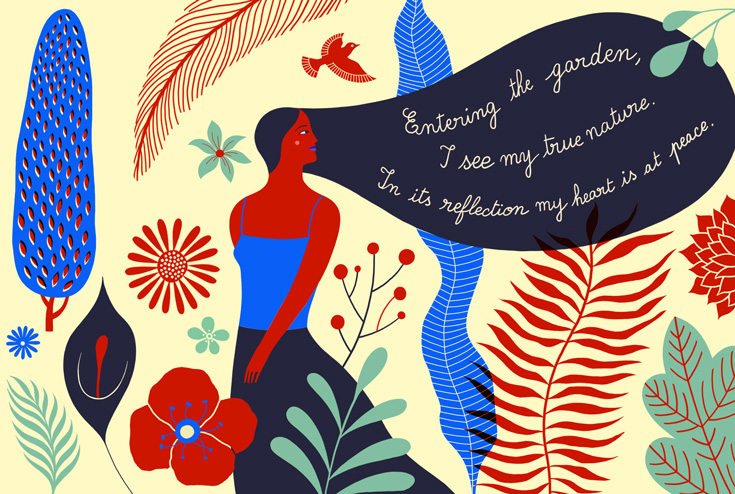
Illustration of woman walking in garden, "entering the garden, I see my true nature. In it's reflection my heart is at peace."
Gathas are short verses that call us to the present moment. Reciting gathas is a good way to meditate while engaged in any activity, be it sacred or mundane. Joining the breath, the mind, and the activity of the body, the practice invites us into a deep, direct experience of our environment and our self. Dwelling in the present moment in this way, deeply aware of the action we are engaged in, we can develop greater understanding and love.

The word gatha is related to the Sanskrit term for “song” or “verse.” Gathas originated around 1300 BCE as metrical forms of Indo-Iranian religious poetry. Written by the Iranian poet and prophet Zoroaster, a text of hymns called Gathas was placed at the center of Zoroastrian scripture and tradition as a form of reflective spiritual practice. Scholars believe that as Buddhism spread eastward from India, it was influenced by Zoroastrian traditions, and gathas developed in various streams of Buddhism.

Gathas invite us into greater understanding and love through their practice.

The contemporary recitation of gathas has been popularized by Zen teacher Thich Nhat Hanh. In his tradition, a gatha is a verse recited, usually mentally, not aloud, in rhythm with the breath. This is a mindfulness practice we can perform in daily life, or as a part of formal meditation or meditative study. Rich with wordplay and intentional ambiguities, these gathas are intended to awaken the innate inner wisdom of the practitioner, spurring her toward enlightenment.

As a meditative tool, gathas have a close and parallel relative—mantra. A mantra is a sacred word or sound—usually in Sanskrit—that’s repeated, either aloud or in silence, to deepen one’s concentration in meditation. As such, a single mantra may be used while performing many different activities or as a form of meditation itself. Gathas distinguish themselves from mantras in that each gatha is deeply intertwined with a single activity, drawing the practitioner deeply into the flow and feel of the specific action being performed. Ultimately, both gathas and mantras invite us into greater understanding and love through their practice.

If we bring our sincere attention to it, any activity can cultivate awakening to our true nature, our basic goodness. That’s why gathas, which help us bring attention to the present moment, can be used when performing any type of activity—waking up in the morning, brushing our teeth, taking out the garbage, entering the meditation hall, or inviting the bell.

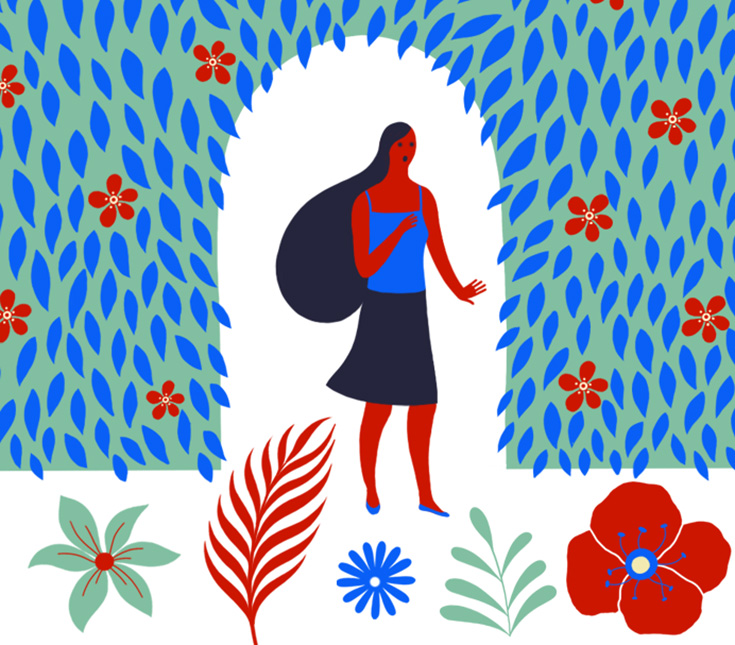
No matter what activity we’re engaging in, or the particular words of the gatha we’re reciting, the practice is always similar. To serve as an example, here’s how we can practice with a gatha for entering a garden—for the moment we cross the threshold from “inside” to “outside.” The crossing of this threshold gives us just enough space to come back to ourselves. We arrive.

Woman walking in garden

Step One: Recite the Gatha

We stop at the threshold of the garden, becoming aware of the in-breath and the out-breath. We observe the beauty of the environment around us and create an internal pause by reciting—silently or out loud—the entire gatha:

Entering the garden,

I see my true nature.

In its reflection

My heart is at peace.

We allow the meaning to touch our awareness.
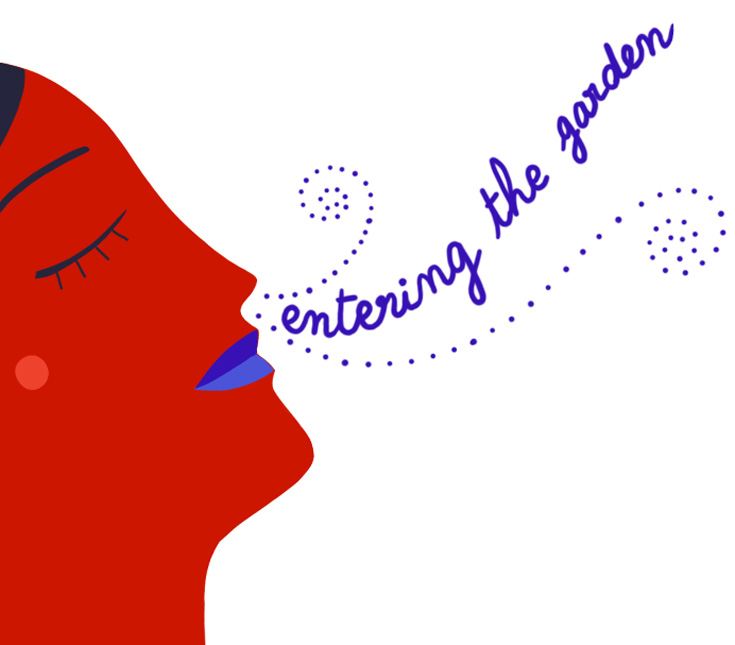
Woman inhaling, "entering the garden"

Step Two: Synchronize with the Breath

A gatha is intended to be practiced in alignment with the breath. Once we have a feel for the gatha, we can correlate each line with an in-breath or an out-breath.

As we say or think, “Entering the garden,” we breathe in, bringing our full awareness to the moment of our arrival.

Next, we say or think, “I see my true nature,” while we breathe out, entering a direct communion with all of nature and inviting a deeper understanding of our true self.

Then we say or think, “In its reflection,” as we breathe in, seeing the beauty and magnificence of nature as a mirror of our own beauty and connection with all of life.

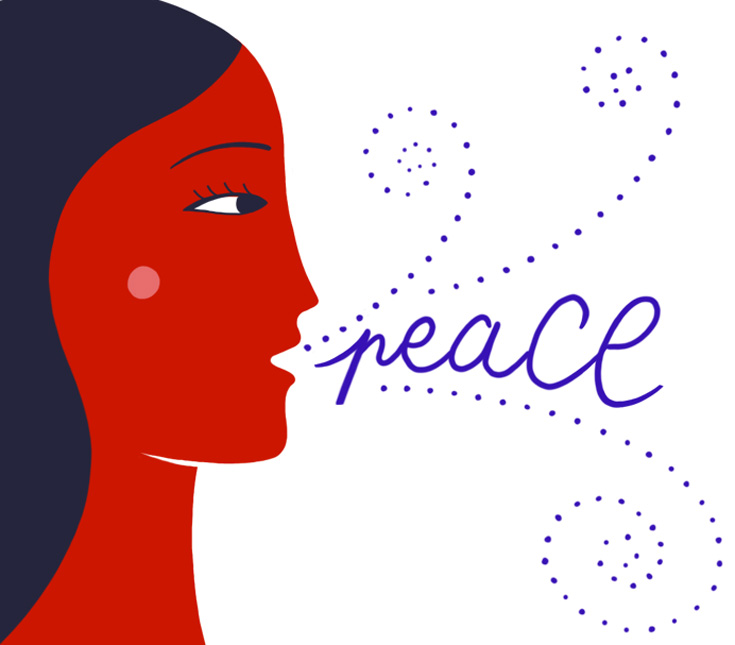
Finally, as we say or think, “My heart is at peace,” we breathe out, peaceful and alive in the present moment.

Woman exhaling, "peace"

Step Three: Shorten the Gatha

After we have practiced with the gatha a number of times and have internalized it, we can shorten it. For example, breathing in, we say or think, “Entering.” Breathing out, we say or think, “Nature.” Breathing in, we say or think, “Reflection,” and lastly, breathing out, we say or think, “Peace.” When we have truly internalized a gatha, just a few words will be enough to remind us of the whole.

Many wonderful gathas have been created by Buddhist teachers, and we can benefit from their wisdom. Thich Nhat Hanh’s gatha for greeting someone is “A lotus for you, a Buddha-to-be.” His gatha for washing our hands is “Water flows over these hands. May I use them skillfully to preserve our precious planet.” More gathas by Thich Nhat Hanh can be found in his book Chanting from the Heart: Buddhist Ceremonies and Daily Practices.

Touching what’s real and alive in each moment ultimately returns us to our authentic self.

To personalize our practice with gathas and nourish the expression of our true nature, we can compose our own gathas inspired by our daily experiences and observations. To do this, we choose an activity that we regularly perform, create and memorize a gatha for it, and recite the gatha each time we do that particular activity. The personal nature of gathas created from our own insights deepens our practice and has the potential not only to develop our mindfulness and compassion, but also to water the seeds of compassion and love in those with whom we come into contact.

As meditation in motion, gathas loosen the tangle of our thoughts, opening us to experience the present moment. They help us deepen our understanding of our connection and belonging with all of life as we mindfully engage in the activity before us. When the mind drops into the heart and joins in communion with the breath and our actions, we see life as it is and ourselves as an integral part of it. Touching what’s real and alive in each moment ultimately returns us to our authentic self. Grounded in our essential nature, we can offer our joy, peace, and love to all beings around us. This gift, the gift of our self when expressed in this way, is perhaps the greatest gift ever.

Thursday, July 14, 2022

Tuesday, August 17, 2021

always available… | The Metta Garden

always available… | The Metta Garden


it’s so simple, feels almost too simple really. to just sit and breathe. to do so without goal. to come back to something so natural, sitting and breathing. in our habits and patterns of being busy, of getting lost in or avoiding, we can forget to just allow stillness, to allow the opportunity for relaxation and natural ease and calm.

it is also something that we can have some joy in doing. it doesn’t have to be some epic journey to enlightenment. the simple pleasure of just sitting and breathing, of feeling our body rooted and held by the earth, feeling the calming coolness of air coming into our bodies, the release and freedom of air leaving. this can be quite enjoyable and peaceful.

there’s no reason we shouldn’t have this joy, this peace, this simple pleasure, which is always available. and with practice we can even tap into, settle into this feeling in all kinds of environments. it can be our anchor as Thich Nhat Hanh shares in this quote.

~j

#JustBreathe #JustSit #mindfulness #meditation #path #practice #ThichNhatHanhQuotes #ThichNhatHanh #Zen #EngagedBuddhism #JinpaLhaga


Saturday, January 30, 2021

Christina Feldman - Receiving the Breath: Meditation Q & A

When I try to bring awareness to my breath, I feel instead like I’m interfering with its natural flow. What should I do?

This is not an unusual experience. Throughout our lives, we breathe without effort; then the moment we try to breathe consciously, our breathing suddenly feels blocked, shortened, or constricted. Our bodies know how to breathe without instruction, yet it can feel as if we are having to learn how to breathe all over again.

One reason for this is that you have suddenly become the breather. Your mindfulness of breathing has taken on something extra, a layer of self-consciousness, which brings with it tension and uncertainty. You may be trying too hard. Self-consciousness disguised as mindfulness often manifests as an effort to control the breath. Observe this. There is insight to be gained in seeing how we transfer life patterns of control, anxiety, or self-consciousness into our meditation practice. Learning to undo some of these patterns within our practice is a meaningful step in learning how to release their grip on the rest of our lives.

It is important to remember that there is no “right” breath. If you carry with you the idea that your breath should be deep and full when in reality it is shallow, you immediately get into trouble. At times the breath is deep, at times shallow, at times freely flowing, and at other times it can feel blocked. Your practice is to be with your breath as it is, learning to let go of how you think things “should be.” Mindfulness of breathing is a practice of learning to harmonize your attention with what is, in this moment. Short, long, deep, shallow are all fine breaths. Trust your body; it knows what is needed.

Some people come into meditation with a history of breathing difficulties such as asthma. The moment they consciously bring their attention to their breath, the emotional history associated with breathing comes to the forefront of their consciousness. They find themselves struggling with the breath in meditation practice just as they have in life. The fear of not having enough breath to sustain life serves to make each breath an increasingly arduous process. Your meditation should be founded in ease and relaxation. If you have historical associations with the breath that hinder its free flowing, it may be helpful to adopt for a time another object of attention, such as listening. Bear in mind that it is the development of attention that is of primary significance; the object of attention is secondary.

As we begin to practice mindfulness of breathing, we often see ourselves, initially, as the breather, apart and separate from the breath itself. The direction and development of the practice is eventually to bridge this separation until our attention is absorbed fully into the breath. The breath breathes itself, and we experience a place of deep calmness, concentration, and ease. When we breathe, we just breathe. As our practice develops, we learn to let go of much of the emotional and psychological baggage that surrounds so much of what we “do” in life. Essentially, we learn to let go of the “doer.” It is important to be patient with this process. Mindfulness of breathing is a practice of patient intimacy, learning to come closer and closer to the simple process of just breathing.

Without becoming overly strategic or feeling that this is a problem you are required to fix, there are a couple of ways to experiment with letting go of the tension that surrounds your breath. You might experiment with simply focusing your attention in the area of your upper lip and nostrils. Just notice the sensation of your breath entering and leaving your body. Let go of any expectation that your breath should be deeper than it is. Be aware just of the coolness of your incoming breath and the warmth of your outgoing breath. If you notice that there is still tension within your breathing, take your attention just to listening for a few moments. Again, don’t look for sounds, just be receptive to the sounds near and far that come to you. Then return your attention to your breathing once more. See if that same quality of receptivity that you brought to listening can be brought into your awareness of breathing. Sense if it is possible just to receive your breath. Your body is breathing; trust it, let it be just as it is.

Sunday, December 20, 2020

Walk Slowly by Danna Faulds

 WALK SLOWLY by Danna Faulds 


WALK SLOWING

It only takes a reminder to breathe, 
a moment to be still, and just like that, 
something in me settles, softens, 
makes space for imperfection. The harsh voice 
of judgment drops to a whisper and I 
remember again that life isn’t a relay 
race; that we will all cross the finish 
line; that waking up to life is what we 
were born for. As many times as I 
forget, catch myself charging forward 
without even knowing where I’m going, 
that many times I can make the choice 
to stop, to breathe, and be, and walk 
slowly into the mystery.

Sunday, February 14, 2016

Fill your paper with the breathings of your heart. ~ William Wordsworth

Tuesday, January 5, 2016

@thichnhathanh: Feelings come and go like clouds in a windy sky. Conscious breathing is my anchor.

Monday, October 19, 2015

Breathing and Non-self


What we call 'I' is just a swinging door which moves when we inhale and exhale. ~ Shunryu Suzuki

Thursday, August 6, 2015

You cannot take a future or a past breath. The breath is definitively always in the present. ~ Rabia Hayek

Tuesday, April 1, 2014

Degreasing

Allow for Space

Tsoknyi Rinpoche

The difficulty most of us face is that we’re afraid of our humanity. We don’t know how to give our humanity space. We don’t know how to give it love. We don’t know how to offer our appreciation. We seize upon whatever difficult emotions or painful thoughts arise—in large part because we’ve been taught from a very young age that life is a serious business. We’re taught that we have to accomplish so many things and excel at so many things because we have to compete for a limited amount of resources. We develop such high expectations for ourselves and others, and we develop high expectations of life. Such a competitive, goal-oriented approach to life makes us very speedy inside. We become so tight physically, mentally, and emotionally as we rush through each day, each moment, that many of us forget—often quite literally—to breathe.

When we allow space into our meditation practice, however, something quite wonderful begins to happen. That solidity, that seriousness begins to break down. We begin to relax a bit more and experience some of the fluidity we enjoyed as very young children. We begin to dance with our experience: “Haaa ... I’m so upset … I’m so good … I’m happy … I’m a human being ... I might be upset, but I’m alive … If I were dead, I might not have emotion … but, wow, I’m alive.”

We also gradually cut through the habit of identifying with each emotional wave that passes through our awareness. We can be angry, jealous, or scared without having to act on those emotions or let them take over our lives. We can experience joy or love without becoming attached to the object that we think is the cause of our joy.

All too often, the emotions we experience, along with the thoughts and behaviors that accompany them, become part of our internal and social story lines. Anger, anxiety, jealousy, fear, and other emotions become part of who we believe we are, creating what I would call a “greasy” residue, like the oily stuff left on a plate after eating greasy food. If that residue is left on the plate, eventually everything served on that plate starts to taste alike; bits of food start to accumulate too, stuck to layers and layers of greasy residue. All in all, a very unhealthy situation!

When we allow space into our practice, though, we begin to see the impermanent nature of the thoughts and feelings that arise within our experience—as well as of the conditions, over many of which we have no control. That greasy residue doesn’t build up, because there’s no “plate” for it to cling to. If we can allow some space within our awareness and rest there, we can respect our troubling thoughts and emotions, allow them to come, and let them go. Our lives may be complicated on the outside, but we remain simple, easy, and open on the inside.

From Solid Ground by Sylvia Boorstein, Norman Fischer, and Tsoknyi Rinpoche, © 2011. Reprinted with permission of Parallax Press.

Thursday, September 20, 2012

A lamp inside us.

@thichnhathanh: We have a lamp inside us. The oil of that lamp is our breathing, our steps, and our peaceful smile. Our practice is to light up the lamp.

Monday, August 2, 2010

The Art of Doing Nothing

Larry Rosenberg is the founder of the Cambridge Insight Meditation Center (CIMC) and a guiding teacher of Insight Meditation Society (IMS) in Barre, Massachusetts. His new book, Breath by Breath, was recently published by Shambhala. Born to Russian-Jewish immigrants in 1932, Rosenberg grew up in Brooklyn; his father, who had Marxist leanings, came from fourteen generations of rabbis, but thought “that only an idiot goes into religion.”
Rosenberg went to Brooklyn College, and received his Ph.D. in social psychology from the University of Chicago. A highly coveted job in the Department of Psychiatry at Harvard Medical School followed. But this turned out to be a “staggering” disappointment and he returned to the University of Chicago, where he began to experiment with hallucinogens. During a trip to Mexico in the 1960s, he met a cowboy turned holy man who told him, “Don’t waste your time with drugs; you should start meditating.”
Thirty-five years later, Rosenberg is sitting in a wing chair in CIMC, talking toTricycle’s contributing editor Amy Gross about the evolution of his own practice.
Tricycle: Who was your first teacher?
Rosenberg: Krishnamurti. I met him in 1968 while I was teaching at Brandeis University. Brandeis had this program where they’d invite a person to give talks for a week. I didn’t know who Krishnamurti was, but fortunately for me, no one else did either so we started taking walks and talking. I’d never met anyone so awake. I’d never been listened to so totally and I found it quite unnerving at first. Then, as I got to know him, I just felt so at home with him. I told him that I was a professor, but the whole academic thing was dying out from under me. I’d been extremely ambitious—on fire to get a Ph.D. and a good job—but now I thought the old clichΓ© “publish or perish” should really be “publish and perish.”
Before Krishnamurti I’d never verbalized how I felt because I didn’t have the confidence. What he did that was invaluable was, he confirmed my perception. He said, “Just go on teaching and start paying attention to yourself. Start noticing how you actually live.” That’s a phrase he’d say over and over—“how you actually live.”
Tricycle: Where did you go from there?
Rosenberg: I started doing everything. Krishnamurti. Vedanta. I was on my way to India for a Sanskrit-Vedanta training program when a friend of mine introduced me to Seung Sahn, a Zen Master from Korea. I went on a retreat, and after that, there was no reason to go to India. I thought, “Boy, I’ve accomplished more in four days of meditation than in all the years of talking about texts.”
Tricycle: How did you know what you were trying to accomplish?
Rosenberg: I’d had a taste on drugs of a pristine clarity and a feeling of tremendous joy and peace and love. And once or twice I had it doing a primitive kind of meditation, the best I could do based on books and what Krishnamurti had said.
And that was the beginning of the end of my academic career. What I’d learned at Harvard was that I was looking for happiness in the wrong place, because if I couldn’t be happy at Harvard, where could I? And finally, the last two years or so at Brandeis I knew that I had to drop out of the university and go into this full-time.
Tricycle: How did you live after you dropped out?
Rosenberg: For about a year-and-a-half I just crashed in different places, including Asia. Somehow I always had a place. For a while I lived at Seung Sahn’s center near Providence, Rhode Island, wore the robes, and studied with him. He was grooming me to teach and I traveled with him as his aide.
Tricycle: What was your practice then?
Rosenberg: Mostly koans. And after three or four years he suggested that I spend a year at his monastery in Korea, which I did.
Tricycle: What led you from Korean Zen to vipassana?
Rosenberg: After Korea, I went back to the Zen Center, where there was a huge amount of ritual—chanting twice a day, bowing, robes, a stylized way of eating, so many ceremonies it seemed we were celebrating something every other week.
Then my close friend Jon Kabat-Zinn—we’ve gone through all these things together for thirty-five years—went on a vipassana retreat, and he pretty much grabbed me and said, “Larry, I found what you’ve been looking for.” Because I’d always say, “If we could only get rid of all this ceremony, all this stuff.” But I said, “Look, Jon, Zen is fine for me; I just want to stay here.” He said, “If I have to tie you up and throw you into my pickup truck, I’m going to take you on the next retreat.” So for my birthday he gave me a present of a retreat—it was led by Jack Kornfield.
Tricycle: And was it just what you were looking for?
Rosenberg: It was love at first sight. The retreat was basically sit-and-walk until you’re blue in the face. Breathing was the main method, and making mental notes. There was no chanting. There was no special way to eat except mindfully. Oh my God, what a relief! I didn’t realize how much I didn’t want to carry around all that Asian form and custom and just be an American guy who wanted to do this stuff.
The heart of the whole thing is understanding. Not intellectual understanding, although that’s a way to begin. It’s deeply seeing into yourself. And that to me is different from concentration, which can of course facilitate such clear seeing. Many things help you with concentration, like chanting or bowing, so they can be useful parts of practice. But finally, there is no substitute for insightful seeing or for understanding how you create suffering for yourself; and in the process—in seeing into and through it - how to let go of it. It’s a life of awareness. That’s my passion. Now, there’s a school of Zen that emphasizes just-awareness of what is, and I could easily have gone in that direction. That’s Soto Zen, and a practice called shikan-taza—just sitting—and when that ripens, that to me is mature practice. It’s nothing. You sit and you’re just totally attentive to what’s there. What I teach, anapanasati, leads to that, to more and more simplicity until finally we don’t need techniques and methods, even the breath. [Anapanasati is where breathing is used as an exclusive object of attention to develop concentrated focus; then awareness grounded in the breathing is used to see clearly into the impermenant and empty nature of all formations. Letting go into freedom emerges into insight. - LR] I don’t impose it on people. I let them come to it naturally. But for me, I’ve always been much more drawn to just awareness of the way things are. Krishnamurti - whose teaching is a brilliant modern commentary on the fundamental teaching of mindfulness—started me that way, and I’ve always come back to it.
Tricycle: It’s a hard way to start, don’t you think?
Rosenberg: I won’t say it’s impossible, but yes, I agree, it’s a hard way to start.
[Image: Larry Rosenberg giving a dharma talk on the Anapanasati Sutra in Shravasti, India, 1992. © Dorothea Bowen]

page 2

The Art of Doing Nothing

Larry Rosenberg is the founder of the Cambridge Insight Meditation Center (CIMC) and a guiding teacher of Insight Meditation Society (IMS) in Barre, Massachusetts. His new book, Breath by Breath, was recently published by Shambhala. Born to Russian-Jewish immigrants in 1932, Rosenberg grew up in Brooklyn; his father, who had Marxist leanings, came from fourteen generations of rabbis, but thought “that only an idiot goes into religion.”
Rosenberg went to Brooklyn College, and received his Ph.D. in social psychology from the University of Chicago. A highly coveted job in the Department of Psychiatry at Harvard Medical School followed. But this turned out to be a “staggering” disappointment and he returned to the University of Chicago, where he began to experiment with hallucinogens. During a trip to Mexico in the 1960s, he met a cowboy turned holy man who told him, “Don’t waste your time with drugs; you should start meditating.”
Thirty-five years later, Rosenberg is sitting in a wing chair in CIMC, talking toTricycle’s contributing editor Amy Gross about the evolution of his own practice.
Tricycle: Why did you open the Cambridge Insight Meditation Center?
Larry Rosenberg in KoreaRosenberg: I’d been teaching at a bookstore two nights a week. And a lot of people started coming. And then they started saying we needed a center. I wasn’t thrilled with that. I had avoided certain kinds of responsibilities my whole life. But after a few years it became obvious that it would really be great if there was some place - IMS plus this urban place - because people were coming back from their long retreats at IMS and there was no place to practice. Also I was evolving a way of teaching that took daily life very seriously.
Tricycle: You mean in contrast to retreat time?
Rosenberg: Yes. The idea was that people could go off and do retreats and we’d keep the sitting practice alive and also encourage them to go back to their families, school, job, and then tell us about it. And we would respond not like therapists but from a dharma point of view. Could the practice be helpful to the work and the marriage and school, etc.? It's quite a challenge, one I welcome: What do these teachings have to offer in terms of how people can live in the world?
Tricycle: How did that differ from your own studies?
Rosenberg: Most of our teachers had been celibate monks from Asia. They had very little direct experience with women, some of them had never had a job or touched money, etc. - and they were giving us advice. To me, some of their advice seemed limited. Their advice to men about women - I’m making a bit of a joke about it, but it was sort of like: “Take care of the wife and kids so they’re adequately fed and housed and get some schooling, so they’re not a problem.” Basically it’s so that you can get on with the real thing, which is to sit. It isn’t seeing marriage itself or children or work as dynamic situations that have a lot of energy in them, that are quite challenging, and that if looked at in a certain way are not inferior to sitting as a way of growing spiritually.
Tricycle: That view westernizes the dharma, doesn’t it?
Rosenberg: Yes, I think Westerners lack respect for their own spiritual maturity. It’s as though Asia owns spirituality, and we’re these barbarians, beseeching, “Oh, Bhante, please come over and tell us how to live.” But I’ve been to Asia, and they’re just as screwed up as we are. And there’s some real wisdom in our culture; the West has a tradition, too, of compassion and wisdom. And some people who aren’t even religious have it. When I was in Asia I totally did whatever an Asian lay person would do - I have the deepest respect for this tradition - but Asia does not have a monopoly on kindness. In Asia, being a lay person is - from the point of view of meditational practice - considered second-class. I personally think that the monastic life does optimize your possibilities for breaking through to awakening. But it’s by no means a guarantee. Most monasteries are hardly crammed full of enlightened people.
But we need a teaching that addresses the lives we actually live. We do need to handle money. We are in relationships. We do need to eat more than once a day. The problem isn’t eating or sex or money; it’s that we don’t know how to use these energies. The monastic strategy is: Don’t touch it; it’s dangerous. So the monks don’t handle money, etc. To me that’s not in-and-of-itself particularly holy. It’s a strategy - a monastic strategy to get free. I’m all for it - if you’re going to be a monastic.
Tricycle: And for lay practitioners?
Rosenberg: Our challenge is to learn how to use money and food and relationship correctly and not to look at these realms as tainted. And I didn’t see fully adequate help coming from Asians. What I’ve learned, I’ve learned from the Buddha’s teaching of the Four Noble Truths and my own pain, from not knowing how to do these things.
Tricycle: Could you describe how your own practice has changed over the years?
Rosenberg: Throughout all sorts of different schools and practices, two things have survived. One is an abiding interest in the breath. And the other is just ordinary mind power, just awareness itself. That’s what I got from Krishnamurti, and it’s in all the Buddha’s teachings. It’s just to be attentive to the way things are. In Pali, the word for mindfulness is sati and one of the definitions of it is “that which sets things right.” I don’t know if you’ve seen this in the practice, but when mindfulness touches things, they’re less problematic or not a problem at all. It’s magical. What I learned from anapanasati was that the breath is not simply to calm yourself or steady yourself or develop concentration; it can nourish awareness throughout. You use the breath the way everyone else does—to calm down—but it stays with you as you investigate the body, feelings, and all the different mind states, and begin to see that they’re impermenant and lack an enduring core; they’re not self.
Tricycle: So the breath is like background music or—
Rosenberg: It helps keep you on target. It can sustain and strengthen the awareness. It can cut down unnecessary thinking and even eliminate thinking, for periods of time anyway. It’s particularly helpful with difficult emotions that are hard to observe. It’s like a soothing friend holding your hand as you walk into fear or loneliness or anger, encouraging you to stay with it. And if you feel like running away, observe that. And the breath is always there, in-out, in-out. In the communities I’m used to teaching in—highly educated, intellectual people who live complex lives, whose work involves coordinating many activities, the use of computers, social relations... their minds have become very, very complicated. Too complicated. For those people, the breath is a relief. It’s like, “Phew!”
Tricycle: What happens to you now when you sit?
Rosenberg: The breath is still there. But my practice now for the most part is doing nothing. I just sit there. I know it sounds dopey [laughs]. Typically I’ll start off with the breathing, but sometimes not. I get calm and clear pretty quickly. Sometimes I’ll just spend a whole sitting really deeply in samadhi, which is very useful, especially if I'm tired—tremendous energy comes from it. So I’m not investigating it; it’s not vipassana at all. I give exclusive attention to the in-and-out breathing. And it strengthens the mind. It’s like a sanctuary that you can drop into to get away from everything for a while. Even five minutes of conscious breathing, and I’m ready to do what has to be done in terms of people and work. So typically, I start off with the breath. And sometimes that’s all I’ll do. But ninety-nine per cent of the time, I just open the field of attention. If I had to put it into words, it’s learning the art of doing absolutely nothing. So you’re sitting there, attentive; and enjoying the show.
[Image: "If I couldn't be happy at Harvard, then where?": Rosenberg at Su Dok Sak, Seung Sahn's monastery in Korea. Courtesy Larry Rosenberg]
Page 3

The Art of Doing Nothing

Larry Rosenberg is the founder of the Cambridge Insight Meditation Center (CIMC) and a guiding teacher of Insight Meditation Society (IMS) in Barre, Massachusetts. His new book, Breath by Breath, was recently published by Shambhala. Born to Russian-Jewish immigrants in 1932, Rosenberg grew up in Brooklyn; his father, who had Marxist leanings, came from fourteen generations of rabbis, but thought “that only an idiot goes into religion.”
Rosenberg went to Brooklyn College, and received his Ph.D. in social psychology from the University of Chicago. A highly coveted job in the Department of Psychiatry at Harvard Medical School followed. But this turned out to be a “staggering” disappointment and he returned to the University of Chicago, where he began to experiment with hallucinogens. During a trip to Mexico in the 1960s, he met a cowboy turned holy man who told him, “Don’t waste your time with drugs; you should start meditating.”
Thirty-five years later, Rosenberg is sitting in a wing chair in CIMC, talking toTricycle’s contributing editor Amy Gross about the evolution of his own practice.
Larry Rosenberg with Zen master Seung SahnTricycle: What’s “the show?”
Rosenberg: Whatever comes up. A thought. A sound. A sensation. You don’t reach out for anything. You just let life bring stuff to you. Or there’s silence. Many people have some ambivalence about silence; they fear it, or don’t value it. Because we only know ourselves through thinking and speaking and acting. But once the mind gets silent, the range of what’s possible is immeasurable. So first you taste the silence. Then you realize that it’s not a vacuum or dead space. It’s not an absence of the real stuff; it’s not that the real stuff is the doing, the talking, and all that. You get comfortable in it and you learn that it’s highly charged with life. It’s a very refined and subtle kind of energy. And when you come out of it, somehow you’re kinder, more intelligent. It’s not something that you manufacture—it’s an integral part of being alive. And it’s vast. We’ve enclosed ourselves in a relatively small space by thinking. It binds us in, and we’re not aware that we’re living in a tiny, cluttered room. With practice, it’s as if the walls of this room were torn down, and you realize there’s a sky out there.
Tricycle: Have your reasons for practicing changed over the years?
Rosenberg: I’d say that what got me into this doesn’t bear a lot of resemblance to why I do it now. The original motives were immature and romantic, having to do, at first, with wanting to get a natural organic high without the side effects of drugs. But after a while, getting high from meditation is beside the point. The point is getting free. That’s not only of benefit to you—I say this to people who think the practice is very self-centered: The greatest gift you can give to others is to become less of a problem through understanding yourself. We don’t know how to live together as human beings. To me, practice is not an act of ideology; it’s an act of intelligence or wisdom.
Tricycle: Is getting free the same as getting enlightened?
Rosenberg: If you say, “Am I practicing in order to get enlightened?” the answer is yes. But that sounds stupid to me. The process of liberation is right now. Anyone who has practiced for a while knows there are dramatic openings - that “Wow!” where you see things very clearly. It helps a lot when you have that. But throughout any ordinary day there are so many small ways where, if you pay attention, you can see how you’re suffering unnecessarily. Awareness sees it and in the seeing of it, there’s letting go and you’ve liberated yourself. So liberation isn’t just a goal. It’s actually a practice. You are liberating yourself in this moment—and that’s all we’ll ever have, these moments. If you have even a little glimpse of clear mind, or that in us which is untouched by any kind of cultural conditioning, it’s hard to settle for anything less. And terms like "enlightenment" or "awakening"—which I prefer—are important because sometimes people forget what this practice is really about. It's finally about enlightenment, about awakening, about liberation. It's not about making yourself happier. It's not liberation of the self, it's liberation from the self.
Tricycle: As we evolve an American Buddhism, do we need an alternative to the phrase “not-self?” We’re raised to develop an independent, strong self. I don’t know if Asians have an easier time with the idea of the end of ego.
Rosenberg: Ego is a universal thing. Egomania is wherever you look. It’s hard for everybody to understand this “not-self” stuff. I say, Are you willing to look at your mind and learn? See what happens when you’re an egomaniac. If you find that it’s not a skillful way to live, that you’re getting hurt over and over, this is why. But you have to see that yourself. It’s not a new ideology to adopt: “I believe in not-self.” So what? Beliefs are so easy to come by. That isn’t what the Buddha is saying. The Buddha is saying, “Investigate what you call your own personal identity, and find out what that really is.”
Tricycle: Are you different from when you started?
Rosenberg: I think there’s been improvement in behavioral qualities, personality. But what practice is about is something that is beyond measure, and if you practice, you will taste that. And it doesn’t mean that you will have a perfect personality if you taste awakening. People think that’s true. But you have to express yourself through the vehicle that you have. Maybe my packaging has improved, and I don’t think that’s trivial - I’m probably easier on the people in my life. But in another sense, I don’t want to overestimate it. There’s a story that I like very much. The Zen master Sawaki Roshi was walking with a disciple who described himself as a shy, awkward person. Sawaki Roshi was a very confident, charismatic person. So they were walking and the disciple said, “If I keep practicing with you for the next thirty years, will a weak person like me become stronger?” And his teacher said, “No. Meditation is useless. I was just born this way.” He was trying to make it not a means-end kind of thing. When people would ask Sawaki Roshi about the value of meditation, he sometimes says, “Oh, this sitting? It’s absolutely useless. But if you don’t do this useless thing wholeheartedly, your life will be useless.” Figure that one out. In a certain way you just practice. Don’t worry about “Am I getting better?” and the rest of it. Just practice dharma for its own sake and let things take care of themselves.
Tricycle: You’re suggesting that the changes wrought by practice are very subtle, but in your case, practice redirected your life.
Rosenberg: I think one of the things practice does is bring you to your own unique way of flowering. Some people are afraid, “If I meditate, will I have to quit my university life or end my marriage?” I don’t know. I think it shows you what’s true for you, and then it’s up to you to live that or betray it. You don’t have to leave the world. It’s not about being in or out of the world. You can be a monk and be ruled by ego.
Tricycle: Can you be a CEO and not ruled by ego?
Rosenberg: Why not? I think Buddha was a great CEO. Jesus was an amazing CEO. They were incredible in the way they mobilized people and orchestrated things, got a lot done in just one short life. I’m not saying that it’s easy but in principle, why not? The suffering isn’t in functioning as a CEO; it’s that you think you are a CEO. Dharma ultimately is about finding out that you’re absolutely no one. What a relief. When you’re no one, finally you’re real. I mean, you’re living from full presence rather than from all these representations of the self that you identify with: I’m a CEO! I’m a great editor! You’re more alive than you’ve ever been. And when you practice, you don’t have to wait a long time. We all have our moments of clarity, even now.
[Image: Rosenberg studied with Zen master Seung Sahn at the Cambridge Zen Center in the 1970s. Courtesy Larry Rosenberg]

page 4

The Art of Doing Nothing

Larry Rosenberg is the founder of the Cambridge Insight Meditation Center (CIMC) and a guiding teacher of Insight Meditation Society (IMS) in Barre, Massachusetts. His new book, Breath by Breath, was recently published by Shambhala. Born to Russian-Jewish immigrants in 1932, Rosenberg grew up in Brooklyn; his father, who had Marxist leanings, came from fourteen generations of rabbis, but thought “that only an idiot goes into religion.”
Rosenberg went to Brooklyn College, and received his Ph.D. in social psychology from the University of Chicago. A highly coveted job in the Department of Psychiatry at Harvard Medical School followed. But this turned out to be a “staggering” disappointment and he returned to the University of Chicago, where he began to experiment with hallucinogens. During a trip to Mexico in the 1960s, he met a cowboy turned holy man who told him, “Don’t waste your time with drugs; you should start meditating.”
Thirty-five years later, Rosenberg is sitting in a wing chair in CIMC, talking toTricycle’s contributing editor Amy Gross about the evolution of his own practice.
How Breathing Really Is
It is important to emphasize, in discussing the art of meditation (and the practice as you continue it becomes an art, with many subtle nuances), that you shouldn’t start out with some idea of gaining. This is the deepest paradox in all of meditation: we want to get somewhere - we wouldn’t have taken up the practice if we didn’t—but the way to get there is just to be fully here. The way to get from point A to point B is really to be at A. When we follow the breathing in the hope of becoming something better, we are compromising our connection to the present, which is all we ever have. If your breatihng is shallow, your mind and body restless, let them be that way, for as long as they need to. Just watch them.
The first law of Buddhism is that everything is constantly changing. No one is saying that the breathing should be some particular way all the time. If you find yourself disappointed with your meditation, there’s a good chance that some idea of gaining is present. See that, and let it go. However your practice seems to you, cherish it just the way it is. You may think that you want it to change, but that act of acceptence is in itself a major change.
One place where ideas of gaining typically come in, where people get obsessive about the practice, is in the task of staying with the breathing. We take a simple instruction and create a drama of success and failure around it: we’re succeeding when we’re with the breath, failing when we’re not. Actually, the whole process is meditation: being with the breathing, drifting away, seeing that we’ve drifted away, gently coming back. It is extremely important to come back without blame, without judgment, without a feeling of failure. If you have to come back a thousand times in a five-minute period of sitting, just do it. It’s not a problem unless you make it into one.
Each instance of seeing that you’ve been away is, after all, a moment of mindfulness, as well as a seed that increases the likelihood of such moments in the future. Best of all is to go beyond the whole mentality of success and failure, to understand that our lives are a series of alternations between various states. If you already had some kind of laser-like attention that never wavered, you wouldn’t need to practice meditation at all. The object of these two contemplations isn’t to make your breathing perfect. It’s to see how your breathing really is.
Excerpted with permission from Breath by Breath: The Liberating Practice of Insight Meditation (Shambhala)