Showing posts with label desire. Show all posts

Sunday, May 30, 2021

John O'Donohue: "A Morning Offering"


John O'Donohue: "A Morning Offering"


I bless the night that nourished my heart
To set the ghosts of longing free
Into the flow and figure of dream
That went to harvest from the dark
Bread for the hunger no one sees.

All that is eternal in me
Welcomes the wonder of this day,
The field of brightness it creates
Offering time for each thing
To arise and illuminate.

I place on the altar of dawn:
The quiet loyalty of breath,
The tent of thought where I shelter,
Waves of desire I am shore to
And all beauty drawn to the eye.

May my mind come alive today
To the invisible geography
That invites me to new frontiers,
To break the dead shell of yesterdays,
To risk being disturbed and changed.

May I have the courage today
To live the life that I would love,
To postpone my dream no longer
But do at last what I came here for
And waste my heart on fear no more.


"A Morning Offering" by John O'Donohue. Text as published in To Bless the Space Between Us: A Book of Blessings (Doubleday, 2008).

Friday, May 28, 2021

Mind Wanting More - Holly Hughes


Mind Wanting More

Only a beige slat of sun
above the horizon, like a shade
pulled not quite down. Otherwise,
clouds. Sea rippled here and
there. Birds reluctant to fly.
The mind wants a shaft of sun to
stir the grey porridge of clouds,
an osprey to stitch sea to sky
with its barred wings, some dramatic
music: a symphony, perhaps
a Chinese gong.
 
But the mind always
wants more than it has—
one more bright day of sun,
one more clear night in bed
with the moon; one more hour
to get the words right; one
more chance for the heart in hiding
to emerge from its thicket
in dried grasses—as if this quiet day
with its tentative light weren't enough,
as if joy weren't strewn all around.

~ offered by Hugh Byrne, May, 2021, and again on Sunday, Aug 29, 2021

Wednesday, December 23, 2020

Fundamental Dharma - Sylvia Boorstein


If you pay attention for 
just five minutes, you know some very fundamental dharma: things change, nothing stays comfortable, sensations come and go quite impersonally, according to conditions, but not because of anything that you do or think you do. Changes come and go quite by themselves. In the first five minutes of paying attention, you learn that pleasant sensations lead to the desire that these sensations will stay and that unpleasant sensations lead to the hope that they will go away. And both the attraction and the aversion amount to tension in the mind. Both are uncomfortable. So in the first minutes, you get a big lesson about suffering: wanting things to be other than they are. Such a tremendous amount of truth to be learned just closing your eyes and paying attention to bodily sensations.


--Sylvia Boorstein

Monday, March 30, 2020

Before we set our hearts too much up... La Rochefoucauld

Before we set our hearts too much upon anything, let us examine how happy those are who already possess it. ~ Francois de La Rochefoucauld

Tuesday, February 11, 2020

Deep in the mountains

At night, deep in the mountains
I sit in meditation.

The affairs of men never reach here.
Everything is quiet and empty.

All the incense has been swallowed up by the endless night.
My robe has become a garment of dew.

Unable to sleep, I walked out into the woods.
Suddenly, above the highest peak,
The full moon appears.

-- Ryokan (?)

Sunday, December 22, 2019

Playthings


Playthings

Child, how happy you are sitting in the dust, playing with a broken twig all the morning.
I smile at your play with that little bit of a broken twig.
I am busy with my accounts, adding up figures by the hour.
Perhaps you glance at me and think, "What a stupid game to spoil your morning with!"
Child, I have forgotten the art of being absorbed in sticks and mud-pies.
I seek out costly playthings, and gather lumps of gold and silver.
With whatever you find you create your glad games, I spend both my time and my strength over things I never can obtain.
In my frail canoe I struggle to cross the sea of desire, and forget that I too am playing a game.

https://www.poetryfoundation.org/poems/45671/playthings

Friday, October 11, 2019

Signlessness & Happiness & Looking Deeply


Happiness in Every Breath


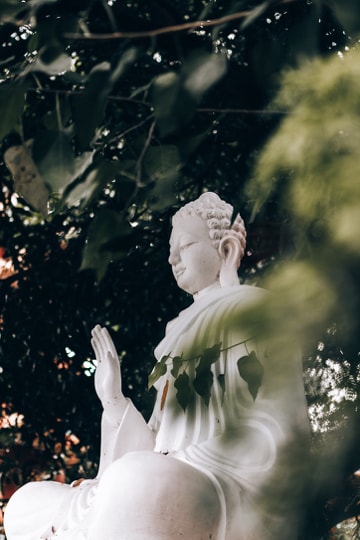
Buddha statue with leaves.
Photo by Hombre.

When we stop feeding our cravings, says Thich Nhat Hanh, we discover that we already have everything we need to be happy.

The human mind is always searching for possessions and never feels fulfilled. This causes impure actions ever to increase. Bodhisattvas, however, always remember the principle of having few desires. They live a simple life in peace in order to practice the Way and consider the realization of perfect understanding as their only career.
The Sutra on the Eight Realizations of the Great Beings
The Buddha said that craving is like holding a torch against the wind; the fire will burn you. When someone is thirsty and drinks only salty water, the more he drinks, the thirstier he becomes. If we run after money, for example, we think that a certain amount of money will make us happy. But once we have that amount, it’s not enough; we think we need more. There are people who have a lot of money, but they are not happy at all. The Buddha said that the object of our craving is like a bone without flesh. A dog can chew and chew on that bone and never feel satisfied.
We all experience moments when we feel lonely, sad, empty, frustrated, or afraid. We fill up our feelings with a movie or a sandwich. We buy things to suppress our pain, despair, anger, and depression. We find a way to consume, in the hopes that it will obliterate the feelings. Even if a TV show isn’t interesting, we still watch it. We think anything is better than experiencing the malaise, the ill-being in us. We have lost sight of the reality that we already have all the conditions we need for our own happiness.
Each of us has our own idea of happiness. It’s because of this idea that we run after objects we desire. We sacrifice our time and, to a certain extent, destroy our bodies and our minds. According to the Buddha, happiness is simple—if we go home to the present moment, we realize that we have more than enough to be happy right here and now. All the wonders of life are in us and around us. This realization can help us release our craving, anger, and fear.
The more we consume, the more we bring in the toxins that feed our craving, anger, and ignorance. We need to do two things to return to mindful awareness. First, we can look deeply into the nutriment that is feeding our craving, examining the source. No animal or plant can survive without food. Our craving, just like our love or our suffering, also needs food to survive. If our craving refuses to go away, it’s because we keep feeding it daily. Once we have identified what feeds our craving, we can cut off this source of nutriment, and our craving will wither.
The second practice is mindful consumption. When we end our consumption of things that feed our craving, ignorance, and wrong perceptions, we can be nourished by the many wonderful things around us. Understanding and compassion are born. Joy in the present moment becomes possible. We have a chance to transform our own suffering.

The Four Nutriments

The Buddha spoke of four kinds of nutriments, the four kinds of foods that we consume every day. Our happiness and suffering depend very much on whether what we consume is wholesome or unwholesome.

THE FIRST NUTRIMENT: EDIBLE FOOD

The first kind of nutriment is edible food—what we put into our mouth and chew, swallow, or drink. Most of us instinctively know what food is healthy for our bodies and what food isn’t, but we often choose not to think about it. Before eating, we can look at the food on the table and breathe in and out to see whether we are eating food that is making us healthy or making us sick. When we are away from home, whether we are eating a snack on the go, dining at an event, or grazing on something while at work, we can pause and decide to eat only the most nourishing food. This is mindful eating.
Mindful eating can begin with mindful shopping. When we go grocery shopping, we can choose to buy only food that feeds our well-being. We can use the cooking of this food as an occasion to practice mindfulness. At the table, we can be silent for a moment. We can practice breathing in and out and give thanks for the healthy food in front of us.

 THE SECOND NUTRIMENT: SENSORY IMPRESSIONS

Sensory impressions are what we consume with our eyes, ears, nose, body, and mind. Television programs, books, movies, music, and topics of conversation are all items of consumption. They may be healthy or toxic. When we talk with a good friend or listen to a dharma talk, the seeds of compassion, understanding, and forgiveness are watered in us, and we are nourished. But an advertisement or film can touch the seed of craving in us and make us lose our peace and joy.
When we drive through the city, we consume, whether we want to or not. We are assaulted twenty-four hours a day by sensory impressions on billboards, on the radio, and all around us. Without mindfulness, we are vulnerable. With mindfulness, we can be aware of what we are seeing, hearing, smelling, and touching. Our mindful awareness can help us change the focus of our attention and be nourished by the positive things around us. The blue sky, the sounds of birds, the presence of a friend—all of these things feed our compassion and joy.

 THE THIRD NUTRIMENT: VOLITION

The third kind of nutriment, volition, is also called aspiration or desire. Every one of us has a deep desire, and we are nourished by that desire. Without desire, we wouldn’t have the energy to live. That deepest desire can be wholesome or unwholesome. When Siddhartha left the palace to follow a spiritual path, he had a desire to practice and to become enlightened in order to help people suffer less. That desire was wholesome, because it gave him the energy to practice, to overcome difficulties, and succeed. But the desire to punish another person, to acquire wealth, or to succeed at the expense of others, is an unwholesome desire that brings suffering to everyone.
Each of us can look deeply to recognize our deepest desire, to see whether it is wholesome. The desire to help fight pollution and preserve our planet is something wonderful. But our craving for money, power, sex, fame, or to punish others only leads to ill-being. That kind of desire pulls us in the direction of death. If we find this kind of volition rising up in us, we need to stop and look deeply. What is behind this desire? Is there a feeling of sadness or loneliness we are trying to cover up?

 THE FOURTH NUTRIMENT: CONSCIOUSNESS

Consciousness here means collective consciousness. We are influenced by the way of thinking and the views of other people in many ways. Individual consciousness is made of collective consciousness, and collective consciousness is made of individual consciousness.
It is our collective consciousness that determines how we live in the world. If we aren’t mindful and we live in an environment where people around us are very angry, violent, or cruel, then sooner or later we’ll become angry and cruel as well. Even if we intend to be compassionate and kind, we can’t help but be influenced by the collective consciousness. If everyone else around us is consuming material things and giving in to craving, it is more difficult to maintain our mindful awareness. This is especially true for our children. When we put our children in an environment, they may be as influenced by that environment as they are by our parenting.
Most of us don’t live in an environment where people are always peaceful, compassionate, and open. But we can be mindful of creating a community around us that fosters these qualities. Even if it is only our house or our block or our small community, we need to surround ourselves with compassionate people.
The Buddha said, “If you know how to look deeply into the nature of your craving and identify the source of nutriments that have brought it in to you, you are already at the beginning of transformation and healing.” Every kind of ill-being has been brought to us by one or more nutriments. Looking into the nature of ill-being in terms of the four nutriments can lead us onto the path of mindful consumption, which is the path to well-being.

 Mindful Consumption

More than two thousand years ago, the Buddha offered guidelines called the Five Wonderful Precepts to his lay students to help them live peaceful, wholesome, and happy lives.
I have translated these precepts for modern times as the Five Mindfulness Trainings, because mindfulness is at the foundation of each of them. The First Mindfulness Training focuses on reverence for life; the second on generosity and right livelihood; the third on true love and sexual responsibility; the fourth on deep listening and right speech.
The Fifth Mindfulness Training, focusing on health and healing through mindful consumption, says: “Aware that true happiness is rooted in peace, solidity, freedom, and compassion, and not in wealth or fame, we are determined not to take as the aim of our life fame, profit, wealth, or sensual pleasure, nor to accumulate wealth while millions are hungry and dying. We are committed to living simply and sharing our time, energy, and material resources with those in need. We will practice mindful consuming, not using alcohol, drugs, or any other products that bring toxins into our own and the collective body and consciousness.”
We can make a decision to follow this training and commit to not consuming anything that brings toxins into our body and mind. Mindful consumption is the way out of craving, not only for us as individuals, but also for the whole world. The only sustainable way for human life to continue is if we consume less and become content with fewer possessions. Once we are able to live simply and happily, we are better able to help others. We have more time and energy to share.
Mindful consumption means looking deeply into your desire to consume, as it arises, staying with that desire until you have some insight into its origins and the intention at its base. When we perceive something, anything at all, we create a sign of it in our mind. A sign is the object of our perception. When we look at a friend, for example, we first see her appearance. We see a self. But if we look deeply into the appearance of our friend, we see elements in her that are not her. We see the air and water, the earth and the sun in her. We see her ancestors in her. So we are not caught in thinking her appearance, her sign, is all she is.
Wherever there is a sign, a mark, an appearance, there is deception. Signs trick and deceive us. But we can break through the veil of signs, and see the nature of things as they are. Seeing the nature of reality is not the fruit of twenty years of meditation; it is our daily practice. We can do it at home, at work, or wherever we are. When we look deeply, we can discover the true nature of a person or a thing; we see the characteristics of interdependence and interconnection. We touch reality as we eat, as we drink. We see the piece of bread as the reality it is; we see our brother, our sister, our partner, our children, and our colleagues at work as they truly are. We can look deeply into the nature of money or material possessions and see that they will not bring us any more happiness than is already available to us. The more we look deeply, the more clearly we see, and reality reveals itself to us bit by bit. When we see reality as it is, there is no craving, no anger, and no fear.
Running after our cravings has brought us a lot of suffering and despair. Committing to mindful consumption is committing to our own happiness. It is a conscious decision to make space for the happiness that is available in each step and each breath. Every breath and every step can be nourishing and healing. As we breathe in and breathe out, or as we take a mindful step, we can recite this mantra: “This is a moment of happiness.” It doesn’t cost anything at all. This is why I say that mindful consumption is the way out of suffering. The teaching is simple, and the practice is not difficult.

Monday, August 7, 2017

Doing, Being and the Great In-Between

Doing, Being and the Great In-Between
by Christina Feldman (published in Tricycle Magazine)

We all want our lives to have meaning—but sometimes we’re unsure what that is. This question of meaning has many significant threads: it’s a question that touches upon our sense of identity and worthiness, and asks us to explore what we’re committed to in this life. George Eliot once wrote, “It seems to me that we can never give up longing and wishing while we are alive. There are certain things we feel to be beautiful and good and we must hunger for them.”

I would suggest that it is the beautiful and the good that we aspire to and value above all else. In the midst of the beautiful and the good, we feel most alive, most awake, and most present. The Buddha’s teachings are about cultivating the beautiful and the good, the seeds of possibility that live in every human heart: generosity, kindness, and compassion. These qualities ennoble our hearts and leave no residue of regret in our minds.

A few weeks ago I was in a conversation with a woman I mentor, a woman who has achieved many things. She develops mindfulness treatments for cancer patients, writes books, and teaches. She lives an incredibly worthy life by any standard. She talked about being of an age at which it is time for her to pull back and to give up some of that activity, but she found herself questioning how much meaning her life would have as she retreated from her essential work. It became apparent how complex the word meaning is—how that longing to live a meaningful, creative, fulfilling life is such a powerful aspiration.

In our culture, the idea of meaning is weighty. We ask children what they’re going to do when they grow up rather than who they’ll be. Early in our lives, the seeds are planted to imagine that the meaning of our lives is going to be defined by what we do or by how we are perceived by others.

I’ve met so many people who, when they wake up without a plan or project for the day, feel that this renders their life meaningless. At the same time I’m increasingly aware of how we live in a culture of exhausted people. This includes dharma teachers! I’m embarrassed when we get together and everybody reports how tired they are. Some of you may sense this when you go on retreat. It feels as if the reservoir is empty. You spend the first two days of retreat simply recovering from life. Thomas Merton spoke about the contemporary violence of our times: being answerable to too many people, saying yes to too many things, taking on too much. But in our culture even the exhaustion can seem admirable because we’re so needed. For some the luxury of waking up to a “don’t-know” day, a day empty of projects, is a distant memory. (I do appreciate that for those who are prone to low moods, “don’t-know” days can feel very bleak and depressing.)

In the Buddha’s teaching, desire is a very interesting word. In fact, it’s not one word alone; there are a number of words in Pali that might be translated as “desire.” The Buddha teaches that there are many wholesome desires: the desire to serve, the desire to give, the desire to be free, the desire to cultivate qualities of heart that ennoble our lives and lead us to connect with others. It’s desire that causes us to seek depth and understanding. It is desire that brings about wholesome social change and justice. Our desires are catalysts for all change and transformation, both outwardly and inwardly. They are at the root of skillful effort.

Yet there are also desires that aren’t so noble. These are the insatiable appetites that create stress. One of the subtlest of these desires is called bhavatanha, which may be translated as “the craving to become.” This is the endless desire to become the kind of person who only has pleasant experiences, who is admired and applauded and loved. It’s a desire to become the kind of person who is secure and safe; a person without blemish or imperfection; a person who never fails, who’s never criticized, who’s never judged. Often we’re barely aware of how powerful and compulsive this craving to become is, the degree to which it organizes our world, our relationships, and our choices. It makes us really busy. In order to become this person, we have to engage in many activities and rearrange the conditions of our lives. The pursuit of this desire is equated with success. It’s about finding an identity, which in turn is about worthiness. If I become a person who has only good meditations, who gets only positive feedback, who is successful, and who manages to defend against the unpleasant, then I’ve reached a state of worthiness. I believe my life will have meaning.

If we look at bhavatanha from a reasonable point of view, we might ask, “Is it possible?” From a rational perspective, we would say “No.” None of us has the power to control and re-arrange the conditions of our lives so that we have only pleasant experiences. The Buddha suggested that bhavatanha, the eternal quest for perfection and the ideal self, is the source of the greatest suffering in our lives. But we may find ourselves wondering: What would we do without bhavatanha? What would motivate us? What would give meaning to our lives if we weren’t always striving to become?

From the angle of contemplative practice, it’s really helpful to release the word “meaning” as we usually understand it and to explore the word “meaningfulness.” There’s a vast difference between these two. Meaningfulness is not about great achievement or success; it’s not about grand identities or roles. It’s about how we live our moments. It’s about how we attend to the details of our lives. As I was sitting in conversation with my mentee, the thought came to me: “Why isn’t it considered meaningful to look out my window and appreciate the camellia blooming? Why isn’t this as meaningful as finishing a grand project or becoming someone?” It was clear to me in that moment that if I attended to the camellia wholeheartedly, the moment filled with appreciation and beauty. Right then, there was no sense of lack and no need to improve upon the moment. There was no need to be anyone. The camellia didn’t affirm a “me,” but by observing it with my whole being it affirmed a capacity for stillness, receptivity, and appreciation. It didn’t mean that I was going to sit in that chair forever. I wasn’t going to tell my publisher that my book would never be finished or my children that I’d retired as a mother. But it pointed to the way we dichotomize doing and being.

“It’s a desire to become the kind of person who is secure and safe; a person without blemish or imperfection; a person who never fails, who’s never criticized, who’s never judged.”
What do I mean by being? In the exhaustion of our busyness, the thought of “just being” sounds attractive. I hear people say, “I don’t want to expend any more effort to settle my mind, to be mindful, to be awake. I just want to be.” I understand why this sentiment arises, but we need to be careful. The Buddha’s teaching is a profoundly aspirational one. It points to the deep and transformational possibilities that live in every human heart. The Buddha pointed out that the seeds of liberative understanding and clarity, of kindness and compassion, lie within each of us. And the path to their fruition lies in our commitment. These intentions translate into an embodied way of being. It’s said that the whole of this path rests upon the head of the pin of intention, but “effort” is one of the most frequently used words in the Pali canon. Effort sets us on a path to awakening.

And yet in our practice, we discover how our intentions can slide into becoming another project. So often, I hear the word “work” mentioned these days. Everybody’s working on something! Is this what the practice is about? Be aware of how we translate this desire “to become” into our practice. Have you ever wondered where the end of that work is? If the core sense of self remains unquestioned, it’s always going to find something new to work on. We arrive on retreat with a project of what we have to work on and find ourselves engaged in another quest for identity, worthiness, and meaning with a capital M. We want to be a good meditator. We want a perfectly collected mind and to be eternally mindful, compassionate, and kind. When it’s elusive, we tell ourselves to sit more. But just sitting won’t bring aspiration to embodiment and fulfillment—only understanding and commitment can do that. This includes the commitment to relinquish the endless search for becoming that governs our lives. When that desire “to become” remains empty and unfulfilled, we think, “Maybe it’s just not possible for me.” When we collapse into that exhaustion, then “just being” suddenly looks good.

But we need to be aware of this ideology of “just being,” too. With an attachment to “just being,” how easy it is to yield our hunger for the beautiful and the good. “Just being” can be a yielding to doubt. The toxic companion of the craving to become is the craving for non-becoming. This is when we push away everything that delivers an identity we don’t want: difficult thoughts, bodily experiences, events, and even challenging meditations. We try to annihilate the identity we don’t want, annihilating our sense of aspiration in the process. We flounder and despair, convincing ourselves of impossibility and meaninglessness.

It’s difficult to find an equivalent word for being in Pali. Instead, there are phrases that point to a way of being present and inhabiting this life. One phrase the Buddha uses is “calm abiding” [shamatha]. Another is “equanimity” [upekkha]. He uses the word stillness [passaddhi]. as a way of being present within all moments when there is de-centering of “me,” of self, of identity. These phrases are worthy of deep contemplation and exploration.

When I looked at the camellia, for example, a door opened. I saw what it meant to rest in a quality of profound easefulness where I’m alive and dynamic. There’s a clear sense of not-wanting and sufficiency. The meaningfulness is not in the object—the meaningfulness is in the seeing. Buddhist practice is constantly inviting us to explore that calm abiding. In this way, we may discover that doing and being aren’t so polarized. They work in unison, cooperating to allow a wakeful presence in all the moments and details of our lives. This presence is responsive and creative, a way of being that isn’t born of wanting or not wanting, but of stillness.

Craving “to become” is an impulse that makes us lean forward, away from here, into a better moment, a better self. When we do so, we separate that idealized moment from the actuality of what is just here. It’s only when we learn to end the separation of the possible and the actual that we also learn to end this dichotomy between doing and being. Calm abiding is a present-tense phrase, a way of being in the midst of our lives. We learn to calmly abide in the body, in the mind, in the midst of reactivity. Nothing has to go away. It’s the camellia blooming outside the window again. It’s the shift from the object orientation to the seeing orientation. All of our likes and all of our dislikes, our wanting and not wanting, are born of object orientation. This object orientation—defining identity by objects (including the contents of our consciousness)—limits us. We’ll always have a sense of unease within it.

[IMAGE] The Meaning Between Doing and Being
Beyond the View, No. 2, 2009. © Helen Sear, courtesy Klompching Gallery, New York.


We find ourselves feeling that praise will make me a better self and blame will make me a worse self. A good meditation, whatever that is, says something important about who I am. And a so-called bad meditation really is that: just affirming a sense of unworthiness or failure in capacity. We see how easily we define ourselves by the contents of experience and our minds. In the search for this idealized self, we look at the world through self-referential eyes: “What does this mean to me?” If it means something positive based on the past, my life somehow becomes meaningful. If I look at the world and receive something that challenges or shakes my identity, life becomes impossible and bleak.

Calm abiding is something different. It’s a deep knowing of the ways in which events come and go, both unlovely and lovely. It’s knowing that we can’t control or define ourselves by those events. It’s learning to rest in a non-preferential, non-reactive relationship that is sensitive, receptive, and free from the demand that things go one way or another. Calm abiding is established through intention and commitment. It limits the tide of events and experience. As the Buddha put it, it is knowing “This does not belong to me. This is not who I am. This is not me.”

As we learn to rest in that state of calm abiding amid the river of events and experience, we learn to attend to the details. Leonard Cohen once said, “There is a crack in everything / That’s how the light comes in.” By learning to rest in this caring, sensitive, friendly seeing, we get a taste of upekkha, equanimity, which the Buddha uses interchangeably with nibbana, or liberation, in the Udana Sutta. In the Pali canon there is discourse in praise of equanimity where the Buddha says, “For one who clings, motion exists, but for one who does not cling, there is no motion. Where no motion is, there is stillness. Where stillness is, there no craving is, there is neither coming nor going. Where no coming or going is, there is no arising or passing away. There is neither this world, nor a world beyond, nor a state between. This verily is the end of suffering.”

When we rest, we begin to see the interwoven nature of how events and identity bind together through misperception and clinging to create suffering. We learn to unbind from that perpetual contractedness through awareness. We are less prone to launch ourselves into the compulsive and agitated activities of doing and fixing, getting rid of, in the endless search for the ideal self. We learn to befriend not-knowing, to be still and learn responsiveness, and to foster an intention to bring to each moment just what is needed. It doesn’t mean that there are no objects or events, but that we explore the landscape of meaningfulness. Meaningfulness is found not only in the dramatic and the intense but also in the small moments, illuminated by a curious awareness. We discover that meaningfulness is in our being present. We don’t need to seek meaning, but to understand our capacity to be present in this responsive, still way. It’s in how our foot touches the ground, how we meet another person, how we meet ourselves. The camellia is actually enough. There’s nothing as impoverished as the deeply unawakened heart; and nothing enriches us more, and brings more life and meaningfulness, than the awakened heart.

THREE KINDS OF DESIRE

THREE KINDS OF DESIRE

Powerful explication of 'desire' .... navigated after reading Christina Feldman's article on 'Being, Doing, and the Great In-Between' in Tricycle mag.

Tuesday, May 30, 2017


I count him braver who overcomes his desires than him who overcomes his enemies. ~ Aristotle

Friday, December 30, 2016


We always strive after what is forbidden, and desire the things refused us. ~ Ovid

Sunday, March 22, 2015

Bravery

I count him braver who overcomes his desires than him who overcomes his enemies. ~ Aristotle

Tuesday, March 10, 2015

Practice

He who reigns within himself and rules his passions, desires, and fears is more than a king. ~ John Milton