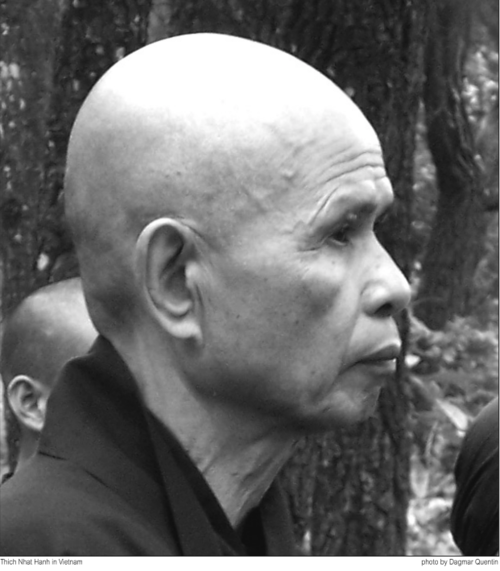
From CHIBS OKEREKE - Transcribed from Insighttimer on Jan 25, 2026
In this short [descriptive] practice [and guide]we'll be noticing when the mind runs ahead of reality.
And then we're going to gently invite ourselves back to what's true right now. Let's allow the body to arrive before the mind tries to sprint off into the rest of the day.
You can close your eyes if that feels comfortable. Or simply soften your gaze with the eyes open. And let's begin by feeling the support beneath you. The chair. The bed, the floor. Holding you safely.
See if you can allow the shoulders to drop a little. Maybe unclenching the jaw. Softening the belly. And now let's take a slow comfortable breath in through the nose. And a soft, easy breath out, through the nose or the mouth. Breathing in through the nose. And out through the nose or the mouth. One last breath in. And a slow breath out. And now allowing the breath to return to its natural rhythm.
And now I invite you to bring your attention to the simple reality of this moment. Perhaps you can feel the feet on the ground, body breathing.
Maybe you can hear some sounds in the room. Just taking a moment to notice that you're here.
Now, the mind will want to run ahead into what ifs. Worst case scenarios. Conversations that haven't happened yet. problems that haven't arrived. That's just your nervous system, trying to prepare and protect you.
Today we're practicing something different. We're noticing the moment that our thoughts start to sprint into the future. And we're choosing not to feed the frenzy. So as we breathe in, Feeling the breath moving low into the belly. And as we breathe out. Letting the exhale be just a little longer than the inhale. A slightly longer out breath, tells the nervous system. "You're safe."
--> And if a thought pops up about something we said or something we're worried might happen. Just seeing if we can notice it. In the same way that we'd notice a cloud passing across the sky. A thought like to predict. But the body knows what's real. Presence is where clarity lives.
This is an excerpt of a talk at the Sandy Beach Hotel in Da Nang on April 10, 2007. Thay spoke in Vietnamese to an audience of intellectuals and answered some fascinating questions from the audience.
Most of us think that happiness is made of fame, power, money. Every one of us wants to have more power. We want to have more fame and money, because fame and money give us more power. We keep believing that when we have more money, fame, and power we’ll be happy. I have met a lot of people with great power, with a lot of money and fame, but their suffering is deep. They are so lonely.
William Ford, the Chairman of Ford Motor Company in America, is the fourth generation of the billionaire Ford family. He came to practice with us in our practice center in Vermont. I offered him the gift of a bell, and I taught him how to invite the bell each day. He told me stories of millionaires and billionaires in America who have a lot of fear, sadness, and despair.
Who has more power than the President of the United States? But if we look into the person of President Bush we see he’s not a happy person. Even President Bush doesn’t have enough power to take care of all the problems that confront him. He’s so powerful — he has a great army, a great amount of money — but he cannot solve the problems in Iraq. He can’t spit it out and he can’t swallow it. You’re very lucky that you’re not the President of the United States! If you were the President of the United States you would not sleep all night long. How can you sleep when you know that in Iraq your young people die every day and every night. The number of American young people who have died there has gone up to more than three thousand. In Iraq — in that country that you want to liberate — nearly a million have died. The situation in Iraq is desperate.
The writer Jean-Jacques Rousseau said that the people with the most power feel that they never have enough power, and this is true. We believe that if we have power, we will be able to do what we want and buy what we want. We can buy a position, buy our enemies, buy anything. If we have power in our hands, we can do anything we want. We have to re-examine that belief, because in reality, I have met people who have great power and money and fame, and who suffer extremely.
The Power of the Spiritual Dimension
In Buddhism we also talk about power. But power in Buddhism is very different; it is a kind of energy that can bring us a lot of happiness and bring a lot of happiness to others.
In Eastern philosophy and literature, we talk about the spiritual path. Each one of us has to have a spiritual direction in our lives. Whether we are business people, politicians, educators, or scholars, we should have a spiritual dimension in our daily lives. If we do not have that spiritual dimension, we cannot take care of tension and despair, or the contradictions in our mind. We can never establish good communication with our co-workers, our family, our community. Each one of us must have the power of the true spiritual path.
In Buddhism, we talk about the three powers that we can generate through our practice: cutting off afflictions, insight, and the capacity to forgive and to love.
The first one is the power to cut off our afflictions — to sever our passions, hatred, and despair. If we cannot cut off passion and hatred, we cannot ever have happiness. We can learn concrete practices to do this. Once we sever the ties of passion and hatred that bind us, we become light and free and spacious. If we have passion and hatred we suffer — both men and women, you have experience with this. We cannot eat, we cannot sleep; that is hell. So the first power is the capacity to cut off afflictions.
The second power is the power of insight — in Buddhism it is called prajna. It is not knowledge that we have accumulated from reading books or learning in school. Knowledge can be beneficial, but it can also become an obstacle. In Buddhism we say that the only career of a practitioner is insight. The insight of the Buddha and the bodhisattvas — what we call enlightenment — has the capacity to cut off afflictions and to generate the noble sentiments of compassion, loving kindness, altruistic joy, and equanimity. That’s our only career, to give rise to insight. Once we have insight we can unravel our afflictions and help others to take care of their difficulties very quickly, just like a medical doctor. You only need to listen to the symptoms and you’ll be able to make a diagnosis and give the appropriate treatment.
The third power in Buddhism is the capacity to forgive. When we have the capacity to accept and to love, we do not have reproach or enmity. That love manifests in the way we look, in the way we speak. When we look with the eye of compassion and loving kindness, when we speak loving words, we are the ones who benefit first of all. In the Lotus Sutra, the bodhisattva Avalokiteshvara looks at all beings with compassion. Looking at all beings with the eye of compassion is a wonderful way of behaving like the bodhisattva — without reproach, without hatred. And the person that we are looking at in this way feels forgiven and loved. We can help others to be liberated from ignorance and from the traps they are caught in.
Wealth as a Spiritual Tool
When we have these three powers — the power to cut off afflictions, the power of insight, and the power to accept, love, and forgive — then fame, money, and power become wonderful tools. It is then that the more money we have the better, the more power the better, because they become means to help people, to enhance life. Buddhism does not accuse or judge people who want to become rich or successful in politics or business, but while you’re pursuing these things you should have a spiritual dimension. We must behave on a foundation of love, insight, and wisdom.
In the time of the Buddha, Anathapindika was an example of this kind of businessman. If you are a business person or a politician and you have love and compassion, then you become a bodhisattva. You have the capacity to cut off your passions and your hatred; you have insight to help resolve problems at your work; you have the capacity to accept and forgive people’s mistakes. You have a lot of power — spiritual power.
As Buddhist teachers we should not abuse our power. It is not because you are the abbot of a temple or the eldest in a temple that you have power. It is because you have the capacity to cut off afflictions, to forgive, and to love. It’s not because you are the abbess or the teacher that people listen to you, it’s because of your love and compassion.
In the political or business arena, the power of the owner or the leader has to be based on the power to cut off afflictions, the power of insight, and the power to love and forgive. Then you use your position skillfully and the things you do will not cause dissension. If you do not generate these three virtuous powers, power and money will corrupt everything, including the life of the owner or the leader. That is why spiritual direction is very important.
The Greatest Success
The Buddha taught that we do not have to hurry towards the future to have happiness; we can be happy right now and right here. The greatest success is to live with love right in the present moment. We have the time to take care of ourselves. If we have pain, tension, irritation, and agitation, we suffer and naturally we cause others to suffer, including our loved ones. That is why we have to have time for ourselves. Then we’ll have time for our family and our community.
Come back to the present moment, do not allow the future to occupy all your energy and time. That is a very important principle from Buddhism. To come back is not easy, because we have the habit energy of running towards the future. Stopping that momentum, coming back to each step, to each breath — that is the basic practice. By living each moment of daily life, living in a way that is deep and free, we can be in touch with the wonders of life.
In a practice center, the basic practice is to use the breath and the steps to bring us back to the present moment. For example, when you listen to a bell you stop all your thinking and speaking and you come back to your breath. You breathe and you bring the mind back to the body, you are truly present in the present moment. In our daily life there are a lot of times our body is here but our mind is wandering in the past and the future. Our minds are not truly present in the body and we’re not present for ourselves. How can we be present for our loved ones, for our wives and husbands? These practices are very practical and clear, and they’re not difficult if we have the chance to begin.
I would like to leave the rest of the time so that you can pose questions related to the topic that we discussed today. Thank you for listening.
Question: Bringing Buddhism to the West
Man from audience: First, I’m very surprised when your disciples still keep their religion. For example, if they are priests or pastors or ministers, do they keep their religion? Second, I know that besides being a monk, you are also a scholar. I have read a few of your writings, and I see that you have done work to spread and explain Vietnamese Buddhism to the world, just like Master Van Hanh (1). How have you contributed to the development of Vietnamese Buddhism as a scholar?
Thay: Back when Christian missionaries came to Vietnam, they often tried to convert the Vietnamese people and force them to give up their tradition to embrace the new religion. This caused a lot of suffering.
When we had boat people dwelling in refugee camps in Thailand or in other countries, there were also missionaries. They wanted to help those boat people and also tried to lure them to follow their religions. It’s a great pity to force somebody to lose their roots. That is why when we bring Buddhism to Westerners, we tell them, “Do not give up your religion; you can study Buddhist practices to help you take care of your difficulties of body and mind and to learn great love and compassion. You do not have to lose your root religion, because we don’t think that’s the best way.”
In the West, there is a great number of young people who leave their Christian religion because that tradition does not provide the practices that people need today. A lot of people give up their religion and many of them come to practice with us. I have told them, “Once you practice with us, you can go back to help renew your own tradition and religion.” If a country does not have a spiritual foundation, that nation will not endure. So the Westerners see that Buddhism is very inclusive, accepting all and embracing all without denying other traditions.
In Buddhism, we call that spirit of inclusiveness equanimity or non-discrimination. It means that we embrace all. If we say that you have to leave your religion so that you can take refuge in the Three Jewels — that’s not very Buddhist. Buddhism is very open. That is why we have been able to help the pastors and ministers. In their hearts they still love their religion, but they practice wholeheartedly because in Buddhism we have very concrete practices to help them take care of their tension and stress, and help them to help people. If we hold that only our religion has the right view, and other religions do not have absolute truth, this will cause war. Buddhism does not do that.
When we organize retreats or have public talks in the West, many thousands of people come to listen to me, but they’re not Buddhists. Most of them come from a Christian or Jewish background. Sometimes I give a teaching in a church and more people come than at Christmas time, because they see that Buddhism is very noble, very open. It is inclusive and non-discriminative. Moreover, now scientists find inspiration in Buddhism because they see interdependence and emptiness; these teachings attract a lot of scientists to Buddhism.
The second question addresses the issue of learning. In truth, each time we have a new retreat designed for a specific group of people, for example a retreat for police officers or Congress people or business people or environmentalists or war veterans, I have to do research. I have to study beforehand to understand their difficulties and suffering so I can offer appropriate practices. That’s why during all my years in the West I have learned a lot. If you do not understand the teachings and practices of the Jewish or Christian traditions, you cannot help those people. If you do not see the suffering of business people, you can never teach them to practice so they can take care of their tension and stress.
You do not need to become a scholar. As a monastic, we do not aim to become scholars, but we have to know enough in these areas to speak their language, to bring people into the practice. When you say that I’m a scholar and I spread Vietnamese Buddhism, that is not quite correct. When I taught at Sorbonne University [in Paris] about history or Vietnamese history or Vietnamese Buddhism, I had to do research. Just for that occasion I read books on the history of Vietnamese Buddhism. I had to use the pen name Nguyen Lang because I was not allowed to publish under my name Thich Nhat Hanh. The government said that I called for peace and that I was a friend with the Communists, so they didn’t allow my books to be published. My aim was not to become a scholar or a historian, but the truth is I had to teach in the university. And I just wrote it down, so that younger generations could benefit.
The meditation that I share in the West has its roots in Vietnam of the third century. We had a very famous Zen master, Master Tang Hoi, whose father was a soldier from India and whose mother was a young Vietnamese woman. When his parents passed away, the child Tang Hoi went to a temple in northern Vietnam to become a monastic. He translated commentaries on the sutras in that temple in Vietnam, then went to China where he became the first Zen master teaching meditation in China — three hundred years before Bodhidharma. I wrote a book about Zen Master Tang Hoi, and I said that Vietnamese Buddhists should worship this Zen master as our first Zen master of Vietnam. An artist drew his picture for me so we could have it on the altars at our different centers.
In Vietnam we have the Mahayana tradition and the Hinayana tradition. I was lucky that when I was trained in the Mahayana tradition I also had time to research the stream of original Buddhism. I discovered that Zen Master Tang Hoi had used the original Buddhist sutras with a very open view of the Mahayana tradition. That is why when we organize retreats in Europe or North America, many people come from different traditions and they feel very comfortable. Our practice combines both Mahayana and Hinayana traditions and the basic sutras we use in meditation are present in all different schools — in the Pali, Chinese, Sanskrit, Korean, and Tibetan Canons of Buddhist scriptures. I have translated and written commentaries on sutras about meditation like Learning the Better Way to Live Alone and The Mindfulness of Breathing. Even though I didn’t talk about them tonight, the spirit of my talk was based on the insight of these sutras.
Our true aim is not to spread Vietnamese culture in the world, but I want to help people to relieve their suffering by sharing with them the methods of practice. That’s why they know about meditation and practices that have Vietnamese roots. I say this so that you see clearly that when I go to the West it’s not to spread Vietnamese culture to other countries. I just want to help people.
When I went to the West to call for peace, I only asked to go for three months. The chief of the police station asked me, “What do you plan to do there? Whatever you do is okay, just don’t call for peace, okay?” And I did not reply. Because my aim was to call for peace, for the world to end the war, I just stayed quiet. Then I went to the United States and called for peace — how can we end the Vietnam war? So they didn’t allow me to come back to Vietnam. That’s why we cannot say that I left Vietnam to spread Vietnamese culture in the West. I only wanted to go for three months. Who would have suspected that I would stay forty years! The truth is that during the time I was in exile in the West, as a monk I had to do something to help people. If I couldn’t help my own people, then I could help Westerners. It seems like I had this aim to spread Vietnamese culture, but it happened naturally.
Question: Renewing Buddhism in Da Nang
Man from audience: On this trip you came to Da Nang. How do you think we can help develop our city, including the Buddhist practice in Da Nang? And do you plan to have a monastery in Da Nang, where we have monastics and lay people, and where scholars in Da Nang can participate?
Thay: Da Nang is already very beautiful. It’s developing very quickly, very well. But we know that economic and technological development comes in tandem with social evils, such as gangs, suicide, and prostitution. If we know that, we should work to prevent it. The scholars and humanitarians, the monks and nuns, you have to sit down together and make a very concrete plan to prevent these social evils. That is something I can share.
The second issue has to do with our Buddhist path. Even though Buddhism has been in our country for many years, we have to renew it. If we do not, it does not have enough strength and it cannot carry out its mission. Our learning is still too theoretical, and mostly we still practice by worshipping or praying. That’s very important, but Buddhism is not just a devotional religion. If we can break through the shell of religious ritual, we can touch the deep source of insight. With that insight we can contribute a path for our nation that will bring true civilization, true culture. It will bring harmony, prosperity, auspiciousness. In the time of the kingdoms of the Ly and Tran dynasties (2) they also praticed with koans; they did not just worship and make offerings. Those were very auspicious eras, with love and understanding between the king and the people.
If Buddhism played such a role in the past, helping the country to be powerful and to dispel invaders, it can contribute to the country in the same way now and in the future. To that end we have to renew Buddhism in the way we study, teach, and practice. It is very necessary to establish monasteries, training new Dharma teachers and lay people to help young people with their problems in their families.
We think that Plum Village can contribute in this area. If the great venerables, the high venerables here in your Buddhist Institute want to stop these young people from getting corrupted, you need to establish monasteries. You can train five hundred or a thousand monks and nuns so that they can help people in society. They can help people in their districts and bring balance to those areas. They can help re-establish communication in the family so that young people do not go out to look for some sort of relief and then fall into the traps of prostitution, suicide, and drug addiction. That is the mission of Buddhism in this modern age. We can send Dharma teachers to you to help you train a generation of new monks and nuns. I think that our country is waiting for this rising up — to “uncloak the old robe” — and to renew Buddhism.
Question: Thinking About the Future
Man from audience: Respected Zen Master, from the beginning of this talk I listened to your teaching about meditation. My understanding — I don’t know if it’s correct or not — is that meditation is only for people who have suffering or misfortune, or people who have a lot of extra time. People who work, study, or have normal activities, they need to think about the past so that they can do certain things that are good for the present, but in meditation you talk about liberating yourself from the past. And they need to look to the future — only you know your dreams, how to be successful in your career— but in meditation you cut off thinking about the future. So the people who need to think about life, about society, about themselves for the future, should they practice meditation?
[Translator: Thay is smiling.]
Thay: We can learn a lot from the past. We have to reexamine the past and learn from it. But that does not mean that we are imprisoned by the past. Those two things have nothing to do with each other.
While we are looking into the past, we can still establish our body and mind stably in the present moment. It is because we establish our body and mind stably in the present moment that we have the capacity to learn from the past. Otherwise we just dream about the past, or we are haunted by the past. The future is the same way. If we sit there and worry about the future, we only spoil the future. We have the right to design projects, to plan for the future. But this does not mean that you are frightened and worried about the future. These two things are completely different.
The future is made up of only one substance, and that is the present. If you know how to take care of the present with all your heart, you are doing everything you can for the future. Thinking and dreaming about the future does not take a long time — you don’t need twenty-four hours to dream about it! You only need one or two minutes, and that’s fine.
What is meditation? Meditation is not something you can imagine. Meditation first of all means you have to be present in the present moment. Earlier I brought up an image that the body is here but the mind is wandering elsewhere. In that moment you’re not present. You’re not present for yourself. You’re not present for your husband, your wife, your children, your brothers or sisters, your nation, or your people. That is the opposite of meditation.
In the present moment there are needs; for example, you have certain pains and difficulties. Your loved one has certain pains and difficulties. If you cannot be present in the present moment, how can you help yourself and the other person? That is why meditation, first of all, is to be present in the present moment. Being present in the present moment means you are not imprisoned by the past and your soul is not sucked up by the future. Meditation is not thinking, not something abstract.
Sitting meditation, first of all, is to be present, to sit still. Once we have that stillness, we’ll be able to see the truth. We can have projects and take actions that are appropriate to the truth in order to take care of a situation. That is why dwelling peacefully, happily in the present moment, is so important. You come back to the present moment to be nourished, to be healed, and also to manage the problems and issues in the present. If we can take care of the issues in the present, then we’ll have a future.
Dreaming about the future and planning about the future are two different things; one is a scientific way, the other one is running away. For example, perhaps there is sadness in the present and we want to run away. Dreaming about the future is a kind of calming medicine, like barbiturates, that can help you temporarily forget about the present.
We have to practice. Taking steps in freedom, with ease, is something that you have to practice. Once you have joy and happiness in the present moment, you know that these moments of happiness are the foundation of the future.
Please remember this for me: If you don’t have happiness in the present moment, there is no way to have happiness in the future.
To the friends practicing Pure Land tradition I say that the Pure Land is a land of peace, of happiness. There are those among us who think that the Pure Land is in the west and in the future. The west is not about Europe or North America — the western direction! Those who practice Pure Land, especially beginners, believe that the Pure Land is in the future. They think that only when we die we go there, and then we go in a western direction, the direction of extreme happiness.
People who have practiced Pure Land for a long time go more deeply. The Pure Land is not in the west or in the east, but right in our mind. When we practice meditation, and we practice properly, we practice in the Pure Land. Each breath, each step, each smile, each look can bring us happiness in the present moment.
The Buddha, wherever he went, never left the Pure Land. If now we can live in the Pure Land with each step, each breath, each smile, everything can give rise to the Pure Land; with certainty the Pure Land is something in our hand. But if we suffer day and night, and we think when we die we’ll go to the Pure Land, that something is not so sure.
That’s why I want to remind you once again: If you have no capacity to live happily right in the present moment, in no way can you have happiness in the future
The sangha has just completed the French Retreat and we return here to a regular day of mindfulness in Plum Village. This talk is from the New Hamlet and is dated Thursday, April 17, 2014. The talk is in English.
0:00 Chanting 9:22 Hearing the Call of Mother Earth 23:25 The Sound of Silence 35:48 Types of Sound in Lotus Sutra 50:00 Impermanence of Sound 1:02:56 Establishing Silence 1:15:43 Consumption of Sound
The beauty of Mother Earth is a bell of mindfulness. It’s spring now and we can easily see how beautiful the earth is. If we can see this then happiness will available right away. Is anything blocking you from seeing this? Is your mind full of things? Can you hear the call of Mother Earth? Are you being pulled away by the past or anxious, fearful about the future? Even in the present moment we can be distracted. But if we look, we can see that life is full of wonders. We can pay attention to our breathing to help stop the thinking of the past, the future, and the projects of the present. I am here. I am free.
In Plum Village we have the practice of noble silence. Thay shares about the recent French Retreat where the community sat together in silence for a meal and after the sound of the bell. What is the benefits of silence? What is the sound of silence?
In the 25th chapter of the Lotus Sutra there is the bodhisattva Avalokite?vara – the one who listens to the sound of the world. Five kinds of sound are mentioned in this chapter. Thay teaches on these sounds. Sound of wonder. The one observes the sound of the world. The brahma sound. Sound of the rising tide. The one that transcends all worldly sounds.
In Buddhism we speak of two kinds of phenomenon. Conditioned and unconditioned. Sound is considered impermanent. It’s nature is to be created; to be made. And anything that is created is impermanent. Another early Mahayana Sutra is mentioned (chapter 40) speaks about the voice of the Buddha. The word of the Buddha is something easy to understand. The sound of the Buddha is not to loud. Silent thunder. We can hear the voice of the Buddha anytime and anywhere.
When we have been able to establish silence the we can hear what is inside ourselves. What our heart is saying. We are often concerned with our daily concerns. We worry about material comforts and affective concerns. But there is also the ultimate concern. Do we have the time to answer the ultimate concern? Hear the deepest call of your life. And that we are a continuation of our ancestors. Meditation can help cultivate the silence.
Four Kinds of Nutriments and consumption. Consuming the sound. The sound of wonders. We don’t have to run anymore.
The good news they do not print. The good news we do print. We have a special edition every moment that we need you to read. The good news is that you are alive and the linden tree is still there standing firm in the harsh winter. The good news is that you have wonderful eyes to touch the blue sky. The good news is that your child is there before you, and your arms are available. Hugging is possible.
They print only what is wrong. Look at each of our special editions. We always offer the things that are not wrong. We want you to benefit from them and help protect them. The dandelion is there by the sidewalk, smiling its wondrous smile, singing the song of eternity. Lo! You have ears capable of hearing it. Bow your head. Listen to her. Leave behind your world of sorrow and preoccupation and get free. The latest good news is that you can do it.
In the Plum Village tradition of Zen Buddhism, the practice of returning to the breath is both foundational and transformative. Thich Nhat Hanh often emphasized the quality of this return, suggesting that how you come back to the present moment is just as important as the act itself. Below are insights and commentaries on this practice:
1. The Quality of the Return
Thich Nhat Hanh taught that the return to the breath should be gentle, nonjudgmental, and infused with kindness. When you notice you’ve been carried away by thoughts or grasping, it’s essential to avoid frustration or self-criticism. Instead, recognize the act of noticing as a moment of mindfulness itself—a bell of awareness.
•Gentleness: Return to your breath as if greeting an old friend. This cultivates a sense of ease and trust in yourself.
•Nonjudgmental Awareness: Simply acknowledge, “Ah, I’ve been distracted,” without labeling it as good or bad.
•Kindness: Smile inwardly to your distraction, viewing it as an opportunity to practice.
Thich Nhat Hanh once said:
“The miracle is not that you walk on water, but that you walk on the Earth. Each mindful breath is a step toward freedom.”
By prioritizing gentleness in your return, you make the act itself a moment of liberation.
2. Awareness of the Body
Thich Nhat Hanh highlighted the body as a refuge. When returning to the breath, allow awareness to embrace your whole body. Use the breath as a bridge to come back to the present moment not only mentally but also physically.
•Reconnect with Sensations: Feel the rise and fall of your belly, the contact of your feet with the ground, or the warmth of your hands.
•Relaxation as a Gateway: Upon returning, let your out-breath carry relaxation throughout your body. Thich Nhat Hanh offered this gatha to embody this process:
Breathing in, I know I am breathing in.
Breathing out, I know I am breathing out.
Breathing in, I calm my body.
Breathing out, I smile.
This practice anchors you in the here and now, offering a sense of embodied presence.
3. The Intention Behind the Practice
Setting an intention for this practice involves cultivating curiosity and compassion rather than striving for perfection or quick solutions. It also invites a recognition of the habitual nature of distraction without succumbing to the “gaining idea” of trying to achieve a specific state.
•Curiosity: Be interested in the process of returning itself. Ask, “What is happening now as I return?”
•Compassion: Acknowledge that distraction is part of being human. Treat it as a friend reminding you to practice mindfulness.
Brother Phap Hai, a senior Plum Village teacher, has written about approaching mindfulness as a “dance” rather than a rigid discipline. He encourages practitioners to “play with returning,” allowing lightness to guide their intention.
4. Commentary on Discomfort
When the inclination arises to avoid discomfort, the breath can become a compassionate container for holding what is difficult. Thich Nhat Hanh offered the image of a mother holding a crying baby: your in-breath and out-breath are the mother, and your discomfort is the baby. The quality of your return involves embracing discomfort with tenderness and without the need to fix it.
•Softening Resistance: On your in-breath, silently say, “It’s okay to feel this.” On your out-breath, release any tension.
•Staying Present: The return is not an escape from discomfort but a turning toward it with awareness.
5. Practical Exercises
•Anchor in Gratitude: As you return to the breath, silently express gratitude for this moment of mindfulness.
“Thank you, breath, for bringing me back.”
•Use Gathas: Recite simple phrases to support the quality of your return:
Breathing in, I return to my true home.
Breathing out, I smile with my whole being.
6. Summary of What’s Important
1.Gentleness: Make your return a celebration, not a task.
2.Embodiment: Use the breath to anchor yourself in the body.
3.Curiosity: Approach the process with an open and inquisitive mind.
4.Compassion: Treat distractions as opportunities for practice, not failures.
5.Consistency: Let the act of returning become a source of joy and renewal.
As Thich Nhat Hanh reminded us:
“Each breath is a chance to start anew.”
The quality of your return, imbued with mindfulness and loving presence, transforms this simple act into a profound spiritual practice.
So coming back to embrace ourselves, to start the process of healing, to touch the positive elements does not seem to be a difficult practice. You only need a Sangha where there are people who are doing that and who enjoy just doing that. When you come to the Meditation Hall and sit down holding your plate of food, you may do it with a lot of pleasure. Don’t think of it as a hard practice. Yes, we don’t talk during the whole meal, you sit quiet in an erect position during the whole meal. Yes, we do that. But many of us enjoy doing that. We don’t have to talk, we don’t have to think, we don’t have to do anything: we just realize complete rest during the whole meal. To be able to share a meal with a Sangha in mindfulness, not to have to do anything at all, to just enjoy every morsel of your food, touching your food deeply without any thinking, without making any project in your mind is the practice, the practice of stopping and resting.
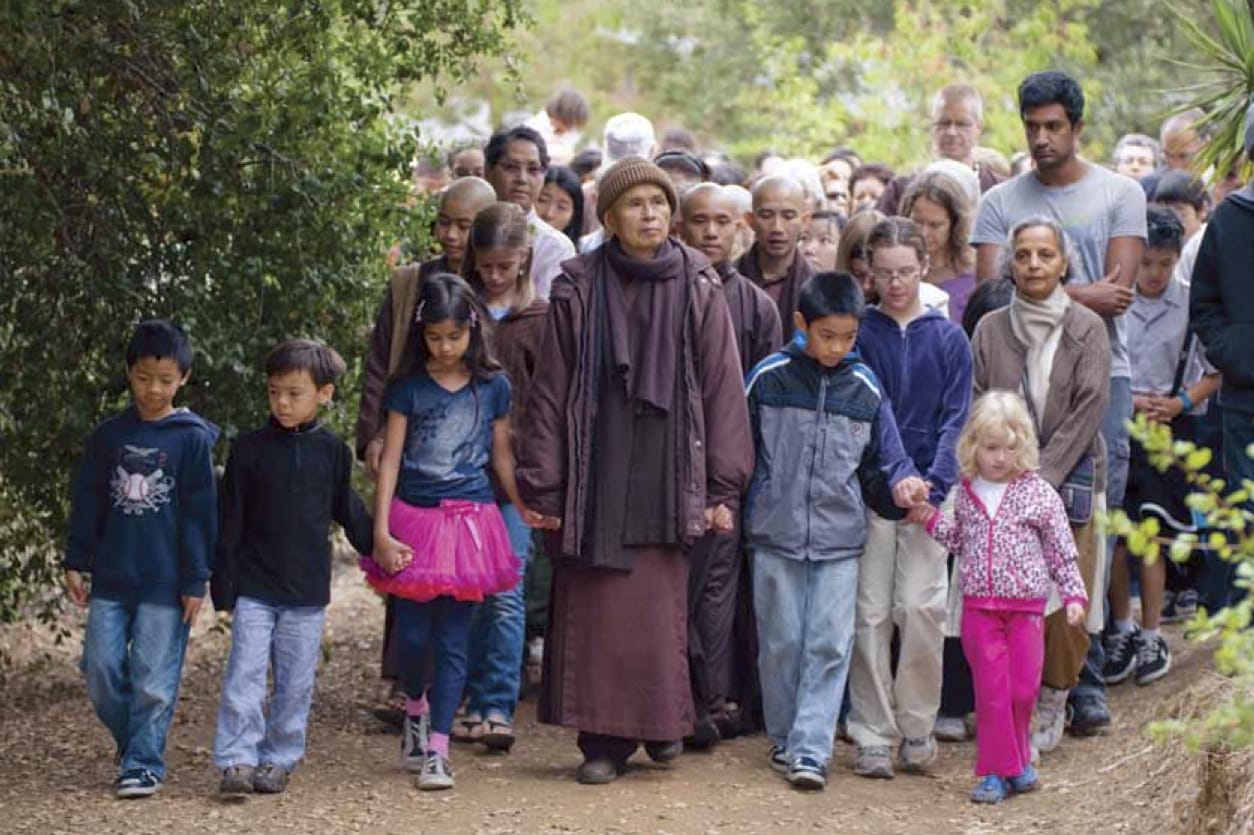
The late Thich Nhat Hanh emphasized the practice of mindful walking as a profound way to deepen our connection with our body and the earth. Read on and learn how to breathe, take a mindful step, and come back to your true home.
Walking meditation with Thich Nhat Hanh during a Day of Mindfulness at Deer Park Monastery. Photo by Don Farber.
Many of us walk for the sole purpose of getting from one place to another. Now suppose we are walking to a sacred place. We would walk quietly and take each gentle step with reverence. I propose that we walk this way every time we walk on the earth. The earth is sacred and we touch her with each step. We should be very respectful, because we are walking on our mother. If we walk like that, then every step will be grounding, every step will be nourishing.
We can train ourselves to walk with reverence. Wherever we walk, whether it’s the railway station or the supermarket, we are walking on the earth and so we are in a holy sanctuary. If we remember to walk like that, we can be nourished and find solidity with each step.
To walk in this way, we have to notice each step. Each step made in mindfulness can bring us back to the here and the now. Go slowly. Mindfulness lights our way. We don’t rush. With each breath we may take just one step. We may have run all our life, but now we don’t have to run anymore. This is the time to stop running. To be grounded in the earth is to feel its solidity with each step and know that we are right where we are supposed to be.
Each mindful breath, each mindful step, reminds us that we are alive on this beautiful planet. We don’t need anything else. It is wonderful enough just to be alive, to breathe in, and to make one step. We have arrived at where real life is available—the present moment. If we breathe and walk in this way, we become as solid as a mountain.
There are those of us who have a comfortable house, but we don’t feel that we are at home. We don’t want for anything, and yet we don’t feel at home. All of us are looking for our solid ground, our true home. The earth is our true home and it is always there, beneath us and around us. Breathe, take a mindful step, and arrive. We are already at home.
Uniting Body and Mind
We can’t be grounded in our body if our mind is somewhere else. We each have a body that has been given us by the earth. This body is a wonder. In our daily lives, we may spend many hours forgetting the body. We get lost in our computer or in our worries, fear, or busyness. Walking meditation makes us whole again. Only when we are connected with our body are we truly alive. Healing is not possible without that connection. So walk and breathe in such a way that you can connect with your body deeply.
Walking meditation unites our body and our mind. We combine our breathing with our steps. When we breathe in, we may take two or three steps. When we breathe out, we may take three, four, or five steps. We pay attention to what is comfortable for our body.
Our breathing has the function of helping our body and mind to calm down. As we walk, we can say, Breathing in, I calm my body. Breathing out, I bring peace into my body. Calming the breath calms the body and reduces any pain and tension.
Walking meditation is first and foremost a practice to bring body and mind together peacefully.
When we walk like this, with our breath, we bring our body and our mind back together. Our body and our mind are two aspects of the same reality. If we remove our mind from our body, our body is dead. If we take our body out of our mind, our mind is dead. Don’t think that one can be if the other is not.
Walking meditation is first and foremost a practice to bring body and mind together peacefully. No matter what we do, the place to start is to calm down, because when our mind and our body have calmed down, we see more clearly. When we see our anger or sadness clearly, it dissipates. We begin to feel more compassion for ourselves and others. We can only feel this when body and mind are united.
Walking meditation should not be work. It is very pleasant, especially in the early morning when the air is still very fresh. When we walk mindfully, we see the beauty and the wonder of the earth around us, and we wake up. We see that we are living a very wonderful moment. If our mind is caught and preoccupied with our worries and suffering, we miss these things. We can value each step we take, and each step brings us happiness. When we look again at the earth and the sky, we see that the earth is a wonderful reality.
We Are Not Separate From the Earth
We think that the earth is the earth and we are something outside of the earth. But in fact we are inside of the earth. Imagine that the earth is the tree and we are a leaf. The earth is not the environment, something outside of us that we need to care for. The earth is us. Just as your parents, ancestors, and teachers are inside you, the earth is in you. Taking care of the earth, we take care of ourselves.
When we see that the earth is not just the environment, that the earth is in us, at that moment you can have real communion with the earth. But if we see the earth as only the environment, with ourselves in the center, then we only want to do something for the earth in order for us to survive. But that is not enough. That is a dualistic way of seeing.
We have to practice looking at our planet not just as matter, but as a living and sentient being. The universe, the sun, and the stars have contributed many elements to the earth, and when we look into the earth we see that it’s a very beautiful flower containing the presence of the whole universe. When we look into our own bodily formation, we are made of the same elements as the planet. It has made us. The earth and the universe are inside of us.
When we take mindful steps on the earth, our body and mind unite, and we unite with the earth. The earth gave birth to us and the earth will receive us again. Nothing is lost. Nothing is born. Nothing dies. We don’t need to wait until after our body has disintegrated to go back to Mother Earth. We are going back to Mother Earth at every moment. Whenever we breathe, whenever we step, we are returning to the earth. Even when we scratch ourselves, skin cells will fall and return to the earth.
Breathing in, I know Mother Earth is in me. Breathing out, I know Mother Earth is in me.
Earth includes the life sphere and the atmosphere. So you don’t have to wait until you die to go back to Mother Earth, because you are already in Mother Earth. We have to return to take refuge in our beautiful planet. I know that earth is my home. I don’t need to die in order to go back to Mother Earth. I am in Mother Earth right now, and Mother Earth is in me.
You may like to try this exercise while you walk: Breathing in, I know Mother Earth is in me. Breathing out, I know Mother Earth is in me.
Paul Tillich, the German theologian, said, “God is not a person but not less than a person.” This is true of the earth as well. It is more than a person. It has given birth to millions of species, including human beings. Many ancient cultures believed there was a deity that inhabited the sun, and they worshiped the sun. But when I do walking meditation and touching the earth, I do not have that kind of dualistic view. I am not worshiping the earth as a separate deity outside of myself.
I think of the earth as a bodhisattva, a great and compassionate being. A bodhisattva is a being who has awakening, understanding, and love. Any living being who has awakening, peace, understanding, and love can be called a bodhisattva, but a bodhisattva doesn’t have to be a human being. When we look into a tree, we see the tree is fresh, it nourishes life, and it offers shade and beauty. It’s a place of refuge for so many birds and other creatures. A bodhisattva is not something that is up in the clouds far away from us. Bodhisattvas are all around us. A young person who has love, who has freshness, who has understanding, who offers us a lot of happiness, is a bodhisattva. The pine standing in the garden gives us joy, offers us oxygen, and makes life more beautiful.
When we say that earth is a beautiful bodhisattva, this is not our imagination. It is a fact that the earth is giving life and she is very beautiful. The bodhisattva is not a separate spirit inhabiting the earth; we should transcend that idea. There are not two separate things—the earth, which is a material thing, and the spirit of the earth, a nonmaterial thing that inhabits the earth.
Our planet earth is itself a true, great bodhisattva. It embodies so many great virtues. The earth is solid—it can carry so many things. It is patient—it takes its time moving glaciers and carving rocks. The earth doesn’t discriminate. We can throw fragrant flowers on the earth, or we can throw urine and excrement on the earth, and the earth purifies it. The earth has a great capacity to endure, and it offers so much to nourish us—water, shelter, food, and air to breathe.
When we recognize the virtues, the talent, the beauty of the earth bodhisattva, love is born. You love the earth and the earth loves you. You would do anything for the well-being of the earth. And the earth will do anything for your well-being. That is the natural outcome of the real loving relationship. The earth is not just your environment, to be taken care of or worshiped; you are each other. Every mindful step can manifest that love.
With each step the earth heals us, and with each step we heal the earth.
Part of love is responsibility. In Buddhism, we speak of meditation as an act of awakening. To awaken is to be awake to something. We need to be awake to the fact that the earth is in danger and living species on earth are also in danger. When we walk mindfully, each step reminds us of our responsibility. We have to protect the earth with the same commitment we have to protect our family and ourselves. The earth can nourish and heal us but it suffers as well. With each step the earth heals us, and with each step we heal the earth.
When we walk mindfully on the face of the earth, we are grounded in her generosity and we cannot help but be grateful. All of the earth’s qualities of patience, stability, creativity, love, and nondiscrimination are available to us when we walk reverently, aware of our connection.
Let the Buddha Walk
I have a student named Sister Tri Hai who spent a long time in prison. She was a peace activist I knew since she was in middle school. She came to the United States to study English literature before going back to Vietnam and becoming a nun. When she was out in the streets advocating for peaceful change, she was arrested and put in prison.
During the day, the prison guards didn’t like her to sit in meditation. When they see someone sitting in a prison cell solidly and stably, it feels a bit threatening. So she waited until the lights had gone out, and she would sit like a person who has freedom. In outer appearance she was caught in the prison. But inside she was completely free. When you sit like that, the walls are not there. You’re in touch with the whole universe. You have more freedom than people outside who are imprisoning themselves in their agitation.
Sister Tri Hai also practiced walking meditation in her prison cell. It was very small—after seven steps she had to turn around and come back. Sitting and walking mindfully gave her space inside. She taught other prisoners in her cell how to sit and how to breathe so they would suffer less. They were in a cold cell, but through their walking meditation, they were grounded in the solid beauty of the earth.
Those of us who can walk on the earth, who can walk in freedom, should do it. If we rush from one place to another, without practicing walking meditation, it is such a waste. What is walking for? Walking is for nothing. It’s just for walking. That is our ultimate aim—walking in the spring breeze. We have to walk so that we have happiness, so that we can be a free person. We have to let go of everything, and not seek or long or search for anything. There is enough for us to be happy.
All the Buddhist stories tell us that the Buddha had a lot of happiness when he sat, when he walked, when he ate. We have some experience of this. We know there are moments when we’re walking or sitting that we are so happy. We also know that there are times, because of illness or physical disability or because our mind is caught elsewhere, when we cannot walk freely like the Buddha. There are those of us who do not have the use of our legs. There are those of us who are in prison, like Sister Tri Hai, and only have a few feet of space. But we can all invite the Buddha to walk for us. When we have difficulty, we can leave that difficulty behind and let the Buddha walk for us. In a while the solidity of the earth can help us return to ourselves.
If we sit mindfully, if we walk mindfully and reverently on the earth, we will generate the energies of mindfulness, of peace, and of compassion in both body and mind.
We are made of body and mind. Our body can radiate the energy of peace and compassion. Our mind also has energy. The energy of the mind can be powerful. If the energy of the mind is filled with fear and anger, it can be very destructive. But if we sit mindfully, if we walk mindfully and reverently on the earth, we will generate the energies of mindfulness, of peace, and of compassion in both body and mind. This kind of energy can heal and transform.
If you walk reverently on the earth with two other people, soaking in the earth’s solidity, you will all three radiate and benefit from the energy of peace and compassion. If three hundred people sit or walk like this, each one generates the energy of mindfulness, peace, and compassion, and everyone in the group receives that healing energy. The energy of peace and mindfulness does not come from elsewhere. It comes from us. It comes from our capacity to breathe, to walk, to sit mindfully and recognize the wonders of life.
When you walk reverently and solidly on this earth and I do the same, we send out waves of compassion and peace. It is this compassion that will heal ourselves, each other, and this beautiful green earth.
Meditation: Walking on the Earth
Walk slowly, in a relaxed way. When you practice this way, your steps are those of the most secure person on earth. Feel the gravity that makes every step attach to the earth. With each step, you are grounded on the earth.
One way to practice walking meditation is to breathe in and take one step, and focus all your attention on the sole of your foot. If you have not arrived fully, 100 percent in the here and the now, don’t take the next step. I’m sure you can take a step like that because there is buddhanature in you. Buddhanature is the capacity of being aware of what is going on. It is what allows you to recognize what you are doing in the current moment and to say to yourself, I am alive, I am taking a step. Anyone can do this. There is a buddha in every one of us, and we should allow the buddha to walk.
While walking, practice conscious breathing by counting steps. Notice each breath and the number of steps you take as you breathe in and as you breathe out. Don’t try to control your breathing. Allow your lungs as much time and air as they need, and simply notice how many steps you take as your lungs fill up and how many you take as they empty, mindful of both your breath and your steps. The link is the counting.
When you walk uphill or downhill, the number of steps per breath will change. Always follow the needs of your lungs. You may notice that your exhalation is longer than your inhalation. You might find that you take three steps during your in-breath and four steps during your out-breath, or two steps, then three steps. If this is comfortable for you, please enjoy practicing this way. You can also try making the in-breath and the out-breath the same length, so that you take three steps with your in-breath and three with your out-breath. Keep walking and you will find the natural connection between your breath and your steps.
Don’t forget to practice smiling. Your half-smile will bring calm and delight to your steps and your breath, and help sustain your attention. After practicing for half an hour or an hour, you will find that your breath, your steps, your counting, and your half-smile all blend together in a marvelous balance of mindfulness. Each step grounds us in the solidity of the earth. With each step we fully arrive in the present moment.
Walking Meditation Poem
I take refuge in Mother Earth. Every breath, every step manifests our love. Every breath brings happiness. Every step brings happiness. I see the whole cosmos in the earth.