Showing posts with label ego delusion. Show all posts

Saturday, May 2, 2020

What If Our Delusions Aren’t a Barrier to Enlightenment?


What If Our Delusions Aren’t a Barrier to Enlightenment?


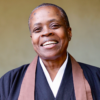
“What if our deluded minds aren’t a barrier to enlightenment at all?” asks Zenju Earthlyn Manuel. “What if they are the very path to it?”


Photo via Unsplash.
If your inability to cut off ceaseless thought has ever left you feeling hopeless or inadequate, you’re not alone. Anyone who has practiced earnestly for any length of time has likely wrestled with the thinking mind, motivated by a desire to evolve away from delusion and toward awakening or enlightenment. We may wonder what we’re missing, always searching for the secret code we believe will unlock the door to enlightenment. We read endless dharma books, which might lead us to that door but ultimately leave us standing outside, desperate to get in. Perhaps we even take our deluded selves to a Buddhist teacher or center to receive guidance, hoping to fix whatever it is that prevents us from seeing the light.
But what if our deluded minds aren’t a barrier to enlightenment at all? What if they are the very path to it? Several years ago, I stumbled upon the term shinzo, or “ever-intimate,” used by Dogen Zenji. Perhaps due to the lack of intimacy I so often felt in my personal life, I felt an immediate connection with the phrase in my own practice. So, I made an effort to learn more about Dogen’s teachings on shinzo. In his book Dogen on Meditation and Thinking: A Reflection on His View of Zen, Buddhist scholar Hee-Jin Kim wrote that Dogen used the term to address the intimate and dynamic relationship between enlightenment and delusion:
The ultimate paradox of Zen liberation is said to lie in the fact that one attains enlightenment only in and through delusion itself, never apart from it… Enlightenment consists not so much in replacing as in dealing with or “negotiating” delusion.

In essence, Dogen was saying that mind—or body-mind, as he referred to it—must be brought into the inherent intimacy between what is illuminated in our lives and what is darkened, that we must fully participate in the dance of these two, continually twirling together and trading places.
I was already well acquainted with this dance, in which two parts of a whole each strive to overcome the other until, eventually, companionship develops and the struggle resolves. There is mutuality, and the gifts each brings are acknowledged.

But isn’t the whole point of Buddhist practice to overcome delusion? Why would we ever want to entertain delusion as a guest? Most of us view enlightenment as a superior way of being. This view comes from ancient Vedic traditions, in which the goal was to negate the deluded mind, to negate thinking, but that is not the goal of Zen practice as taught by Dogen. And this is what I love about Dogen’s radical teachings. With respect to thinking and non-thinking, he taught that it doesn’t matter if we have discriminating, deluded thoughts. What matters is how we use those thoughts.

When we become intimate with our own thinking, delusions become the earth upon which the moon of enlightenment shines.
In Hotsu Mujoshin (“On Giving Rise to the Unsurpassed Mind”), Dogen wrote, “Thinking is the mystery of the practice by which we become intimate with ourselves and the universe.” In other words, when we become intimate with our own thinking, delusions become the earth upon which the moon of enlightenment shines. We may long to be the light itself, the moon glowing upon the earth, yet we feel tethered to our emotions and the thoughts that bring them to the surface. In Dogen’s vision, the relationship between delusion and enlightenment within our lives is necessary. Whether we are angry, even enraged, aggrieved, or content, we are right where we should be. No part of our humanity needs to be tossed away. We need all that we were born with to navigate life, and that includes delusions.
This tension is apparent in the second of the four bodhisattva vows, which Soto Zen practitioners regularly chant: “Delusions are inexhaustible. I vow to end them.” Many a Zen student has chuckled at the absurdity of vowing to end something that is inexhaustible. How could we ever meet this vow? Instead of declaring endless war on our delusions, though, we can simply stop trying to banish them from the path of enlightenment. We can end the separation and lack of intimacy with our thinking minds, and through that encounter with delusion we can come to know the enlightenment that previously seemed as distant as the morning star.

We may fear, deny, ignore, or refuse to accept this marriage of enlightenment and delusion, longing to hold company with our favorite friend, enlightenment. After all, the intimacy of delusion with enlightenment can be difficult to fathom. Enlightenment doesn’t negate delusion, yet a willingness to experience intimacy with our thoughts is crucial to attending to the suffering of our times. As the fires of suffering burn in our country and in the world, it is high time we fully examine our collective thinking in order to move toward a humanity that can truly see itself and can therefore transform its greatest ills.

Like so many others on the Buddhist path, I was waiting for my life to be the way I wanted it to be and wasn’t fully engaging with the way it actually was. Over time, through the practice of zazen, I began to see how this mixed-up dream had separated me from the life I was living every day, every moment.
I saw this dance in action one day, when an aspirant who had been practicing with me for some time opened up and shared memories of being abused as a child. As she spoke, I noticed both her feet were moving, tapping, shaking. Several times she sat upright, then fell back into her seat. Her head moved up and down as she described the trauma. Seeing her agitation, I asked, “You have been learning so much. What could you teach that child right now from your practice of zazen and yoga?”
It took her a moment reply. Her eyes darted around as she considered the question. “To breathe,” she finally said.

“Then let’s do that right now,” I instructed.

We sat quietly together and breathed. After five minutes, her feet stopped shaking, her hands sat still on her lap. Suddenly, she jerked her head back and began to moan and cry. Her body stiffened. She had been using the movements, which were momentarily absent, to fend off the pain from so long ago that was still lodged in her body-mind. I asked her to continue breathing, as she had been practicing for five years.
“Show the child how the breathing is done,” I told her.
I breathed in and out with her, holding her in my heart as she dove into herself, developing the capacity to overcome her limitations by seeing the thoughts she lives with. We were not breathing into calmness but creating the inner environment through which the work of just seeing can occur. (Please keep in mind this practice may not be appropriate for everyone. Consult an experienced Buddhist teacher or a therapist when working with trauma.)

Her direct experience of her body-mind moving and settling, moving and settling, allowed her to see and know herself directly, without someone else telling her what she needed to know. Once her breathing had slowed, I asked her to bring that same earnestness to her zazen practice, to enter each path that she follows—yoga, Buddhist retreats, therapy—with the somberness of her suffering and not to see them as escapes from home or from the world. I asked her to enter the zendo from now on as if coming into a dark cave with her thoughts. As the thoughts arise, I told her, surrender to them and come to know the process as illumination taking place.

The deeper our life is illuminated within delusion, the more clearly we can see our own limitations, struggles, and suffering. This is the true intimacy of Zen practice and the mystical nature of zazen.
In Mahayana Buddhism, there is a notion that once the Buddha became enlightened, we all did. This teaching points us in the direction of not trying to acquire or gain enlightenment but rather allowing it to meet us along the way. Enlightenment is neither given nor gained, so we are bound to tango with the deluded body-mind. And what a dance it is!

In Sokushin Zebutsu (“The Very Mind is Buddha”), Dogen wrote, “Thinking is said to be exerted by the mind of the entire great earth, the mind of the trees and stones, of mountains and rivers, the sun, moon and stars and by the one mind of all dharmas…” Thinking, then, is malleable; it’s adaptable and resilient. The intimacy between the self, the universe, and our thinking is indelibly part and parcel of Dogen’s Zen. Enlightenment is “ever intimate” with, and transparent to, delusion.

When we dive deeply into the tension between enlightenment and delusion, we go beyond our mere ideas of them. Dogen wrote that, if we even think of enlightenment, there will be an aspiration for it. Thought is not an enemy to our endeavors for enlightenment. In fact, it’s impossible to dance with enlightenment without the intimate knowing that comes from opening fully to our deluded, thinking minds.

Thursday, December 31, 2015

On ego

Nobody really cares if you're miserable, so you might as well be happy. ~ Cynthia Nelms

Seems like being mired in negativity is often an unconscious choice in satisfaction of some public show.

Saturday, December 5, 2015

It's extremely difficult to stay alert and attentive instead of getting hypnotized by the constant monologue inside your own head. ~ Wallace

Tuesday, November 5, 2013

Dhamma Drunkards

Drunk on Dhamma

Venerable Ajahn Chah

So long as the mind feels pleasure and pain, it’s drunk. Even while practicing the dhamma, it’s drunk, you know. People can get drunk eating rice—there’s no need to drink alcohol. If you eat a lot of rice, you can get drunk—drunk on rice. The same with the dhamma: Don’t get drunk on it. When people are drunk on the dhamma, they don’t stop. They keep on talking. If they see anybody coming, they want to grab him by the arm and give him a sermon on the dhamma. That’s a sign that they’re drunk on dhamma. They go after everybody: “I want to teach that person; I want to do this person a favor by teaching him the dhamma”—and so they do a favor to the entire country by teaching the dhamma. That’s a sign of drunkenness. Being drunk on the dhamma is no different from being drunk on alcohol. They’re really similar. Don’t go there. You have to look carefully, again and again, for sometimes something is dhamma, but it’s drunk. That’s not right.

From Still, Flowing Water, by Venerable Ajahn Chah, trans. Thanissaro Bhikkhu © 2013. Reprinted with permission.
Illustration by Roberto La Forgia

Sunday, September 29, 2013

Rumination

Rumination....
RuMination

Thursday, May 31, 2012

Breaking Through Resistance

Breaking Through Resistance


Thinking and talking about practice are easy substitutes for the real effort that a practice life requires.   We resist facing life as it is because that would mean abandoning our views of how we think it should be. The most basic form of resistance is wanting life to be other than it is.

- Ezra Bayda, "Breaking Through"


An example of a way that the ego can delude and sidetrack me. 


Breaking Through

How to recognize and overcome three universal obstacles to practiceEzra Bayda


Detours and obstacles are a fact of practice life. Some arise out of our own psychology and conditioning: patterns of self-judgment and perfectionism, a tendency to procrastinate or seek diversions, addiction to control, and the like. Other obstacles seem to be more universal, and these are the ones that nearly every practitioner faces at one time or another. These obstacles are at the heart of practice, yet they are seldom given the emphasis they deserve. But until we can see them clearly—see how they manifest in our lives—it will be difficult, if not impossible, for our practice to move forward. 

There are three obstacles in particular that we need to address. 

Misunderstanding the depth of waking sleep 
The first obstacle to practice is not understanding the magnitude and power of waking sleep. “Waking sleep” refers to the state in which we live most of the time—identified with, or lost in, our thoughts, our emotions, and our actions. In the first place, we’re addicted to our thoughts: believing that our thoughts and opinions are the Truth is the veil through which we perceive reality. But we also have difficulty controlling our emotions; in fact, we love to indulge them. Furthermore, we can’t seem to stay in the present moment for more than a few seconds at a time; the present is the last place we want to be. Because we are so frequently lost in the obscuring confusion of our thoughts and emotions, we lack the clarity and presence that come when we are more awake. 

Buddhism teaches that we are all born with buddhanature and that our spiritual aspiration is to allow our true nature to reveal itself, just as an acorn aspires to become an oak tree. Yet emphasizing our basic goodness, as important as it is, is only part of the picture. No matter how strong our aspiration may be, if we don’t develop deep insight into the power and magnitude of waking sleep, we will be blindsided by it again and again. It’s imperative for us to understand that spiritual practice is not just something we do when we’re sitting in meditation or when we’re on retreat. Just as there is no end to the power of life means practicing at all times, with everything we encounter, not just when we’re on the cushion or when something upsets us. Failing to see everything as an opportunity for practice is a setup for frustration and disappointment, keeping us stuck where we are and limiting our possibilities for inner growth. The more we include in our practice, the more satisfying our life can be. 

Underestimating resistance 
The second obstacle we encounter in practice, closely related to the first, is underestimating the degree to which resistance is a predictable and inevitable part of a practice life. Resistance comes in many forms: not wanting to sit in meditation, not wanting to stay with our experience for more than a few seconds, spinning off into thinking about the past or the future, suppressing or avoiding emotional pain, finding fault with ourselves, finding fault with others. We can see resistance in our commitment to believing such thoughts as “This is too hard,” “I can’t do it,” or “I’m unworthy.” 

Yet another, more subtle form of resistance is thinking and talking about practice rather than actually experiencing our life. Thinking and talking about practice are easy substitutes for the real effort that a practice life requires. We resist facing life as it is because that would mean abandoning our views of how we think it should be. The most basic form of resistance is wanting life to be other than it is. 

For the most part, we don’t really want to wake up. We have to be honest about this. We want to hold on to our beliefs and even to our suffering. Afraid of the unknown, we cling to the familiar. We don’t want to give up our illusions even when they make us miserable. Resistance is the ego’s effort to maintain control. Yet no matter what form it takes, it brings us no peace. Pema Chödrön tells a story about a friend who as a child had recurring nightmares in which ferocious monsters were chasing her through a house. Whenever she closed a door behind her, the monsters would burst through the door and frighten her. Pema once asked what the monsters looked like, but her friend couldn’t tell her, because in the dream she had never turned around to see. 

At some point, however, she decided not to turn away from what she feared. The next time she had the nightmare, just as she was about to open a door to avoid being caught by the monsters, she stopped running, turned around, and looked the monsters in the eye. They were huge, with horrible features, but they didn’t attack her; they just jumped up and down. As she looked closer, the three-dimensional multicolored monsters began to shrink into two-dimensional black-and-white shapes. At that moment, the girl awoke, and she never had that nightmare again. 

It is in running away from our “monsters” that we make them seem so solid. Whatever we resist exerts a strong hold on us: in solidifying it, we empower it to stay in our mind and our life. But when we cultivate the willingness to be with life just as it is, our relationship to what we’ve avoided starts to change. Once we see through the solidity of our resistance, our lives become more fluid and workable. We’re able to move beyond where we were once stuck. Even if we don’t like our life as it is, we don’t need to wage war against it. We can start meeting our resistance squarely by noticing all of the ways in which we avoid the present moment, the ways in which we avoid practice, the ways in which we resist what is. Understanding the depth of our resistance is of major importance in furthering our practice. 

Another form of resistance arises when we hit the “dry spot.” The dry spot is the moment when we lose our connection with the aspiration that originally brought us to practice. Often we hit the dry spot when our expectations of practice are unfulfilled—when it isn’t bringing us the immediate peace, calm, or freedom from fear that we had hoped for. Disappointment leads to anger, and anger to resistance. 

It’s important to understand, however, that vacillating between aspiration and resistance is the natural rhythm of practice and that the dry spot is a natural manifestation of this cycle. But the first few times we hit the dry spot, it doesn’t seem natural at all. We may even feel as if we’re failing at practice, since the thoughts that arise in these moments seem like fixed truths. It’s hard to see them for what they are—simply automatic reactions to the inevitable ups and downs of practice life. 

Hitting the dry spot is the point at which students often leave practice. But if we can wait it out, we begin to understand the natural cycle of resistance. We even come to expect the doubting mind to arise. Doubt in itself is not the problem. The problem comes from identifying with the doubting “me” and believing that this is who we really are. But if seen for what it is, doubt can even be a positive force in practice. Provided we don’t get lost in the negative beliefs that arise with it, it can lead to a deepening of our quest. As practice takes hold, we can learn to use doubt as an opportunity to experience the grief of our unfulfilled expectations about practice. We can learn to surrender to, and reside in, the physical experience of what doubt feels like in the body, instead of following the story line of negative thoughts. Not following the story line can be difficult, because the thoughts seem so true, so solid, so compelling. But if we can stay with the visceral experience of doubt, even as the anguish of not knowing remains, the dryness is transfused with a deeper sense of aspiration. 

Thomas Merton expressed this clearly: “True love and prayer are learned in the moment when prayer has become impossible and the heart has turned to stone.” When we understand the cycles of resistance and can wait out a dry period by resting in the direct physical experience of doubt, we will gradually come to feel a renewed sense of direction and hope.

Wanting to feel a particular way 
The third major obstacle we encounter in practice is a deep-seated desire to feel a particular way, whether calm or clear or spacious or simply free of anxiety. Probably all of us share the illusion that if we practice long enough and hard enough, we’ll get what we want: enlightenment, good health, a satisfying relationship, or whatever else we’re seeking. We can tell that we’re still harboring this illusion if we believe that experiencing difficulties or distress means that something is wrong—specifically, that something is wrong with us. This persistent belief drives us to do whatever we can to alleviate our discomfort. We believe deeply that if we just practice harder, we’re sure to feel better. 

We should never underestimate the extent to which we equate feeling better with being awake. But a key point about spiritual practice is that we don’t have to feel any particular way. Nor do we have to be any particular way. All we can do is experience, and work with, whatever is arising in our life right now. No matter what is going on or how we feel about it, the essence of practice is to honestly acknowledge whatever is happening in the moment and stay present with our experience of it. In this way we can come to feel a true appreciation for life just as it is. 

There’s a famous Buddhist story about a man who was shot in the chest with an arrow. The pain was great, but the Buddha pointed out to the man how much greater the pain would be if he had been shot with a second arrow in the exact same spot. What this teaching suggests is that however painful or disappointing our experience may be, adding the second arrow of our judgmental thoughts about it will only deepen the pain and lead to greater suffering. 

If, for example, I wake up not feeling well, adding the judgment “This shouldn’t be happening to me” will only make me feel much worse. The countermeasure to judging is to move out of the mental world and our thoughts about what’s happening, and into the physical realm and what we’re actually feeling in the moment. Judgments are based on ideals or expectations, and these thought-based pictures are at least one step removed from what is real. Coming back to what is, minus our thought-based pictures, is a step toward freedom. 

When we can see through our deep-seated desire to feel a particular way and realize that we don’t have to feel different in order to be free, we can experience the equanimity that comes with staying truly present with what is. 

Fully grasping the three obstacles that we’re sure to encounter on the spiritual path—misunderstanding the depth of waking sleep, underestimating resistance, and wanting to feel a particular way—is the essential foundation for learning how to work with them effectively. And working with them, in turn, will take us to the heart of what it means to be free. 

Ezra Bayda has been practicing meditation since 1970, and currently teaches at Zen Center San Diego. He is the author of five books, including Beyond Happiness: The Zen Way to True Contentment. 

Artwork by Bill Jacobson