
I am one
who eats breakfast
gazing at morning glories
—Basho
https://aplacetobreatheblog1.blogspot.com/2011/07/everything-i-think-im-missing.html
by Danna Faulds

A morning mindfulness exercise to practice maintaining your attention on the here and now along with affirmations inspired by the words of Buddha: “Each morning we are born again. What we do today is what matters most.” Side effects may include increased presence, compassion and joy.
Transcript
Hi and welcome to the Buddha Morning Meditation.
The goal of this meditation is to help you have a beautiful day.
Start by sitting symmetrically and upright,
But without it being uncomfortable.
Close your eyes to start the journey within.
And close your mouth so that you're only breathing through your nose.
Our nostrils filter the air we breathe better than our mouths do,
And thus allow for slower,
More serene breathing.
Become entirely still.
You're completely motionless,
Except for the air coming in and out of your nostrils.
Observe your breathing.
It occurs naturally and automatically,
Without you having to do anything.
Now observe your current mood,
As if you were inspecting your emotions from the outside looking in,
As if these emotions were separate from your being.
And notice how the air coming in is colder than the air coming out of your nostrils.
If at any point during this meditation you're bothered by incoming thoughts,
It's perfectly normal,
And it's part of the practice.
When you notice these thoughts,
Simply refocus your attention on the cold air coming in and the warm air coming out.
That is to say,
On the present moment.
Without forcing anything,
And simply by observing the air coming in and out,
Slow down your breathing,
So that the flow of air gradually becomes thinner.
Imagine that this flow of air brings calm and comfort to your inner body,
As it comes in on the inhale and out on the exhale.
While still breathing slowly,
Imagine that you receive this air that enters your nostrils,
As if you had been deprived of air,
As if you were incredibly thirsty and were finally given a drink of water.
As if this flow of air were a magical substance,
Bringing you joy with every inhale.
And progressively,
The flow of air is becoming thinner and thinner.
You're breathing slower and slower.
Buddha once said,
Each morning we are born again,
What we do today is what matters most.
We are now going to focus on seven affirmations to increase our connection to the here and now throughout the day.
Pay attention to the words contained in the affirmations,
While remaining focused on your breathing.
First affirmation,
(1) I cannot change the past, but I can always do my best here and now.
Second affirmation,
(2) I do one thing at a time and pay full attention to everything I do.
Third affirmation,
(3) I cultivate silence and control the compulsion to interpret and qualify.
Fourth affirmation,
(4) Happiness is always here and now.
Fifth affirmation,
(5) Perfection is an illusion created by the mind. Instead, I just try to do my best.
Sixth affirmation,
(6) I practice kindness towards myself and others.
Seventh affirmation,
(7) I'm confident, I'm relaxed, Everything is fine.
Before we finish,
Once again feel your current mood as if you were inspecting your emotions from the outside looking in.
And when you're ready,
You can progressively come out of this meditation and start noticing the surrounding sounds.
The various parts of your body that are in contact with an outside object,
Such as the chair or floor you might be sitting on,
Or the wall you might be leaning against.
And of course,
All the colors around you.
I hope you enjoyed this meditation.
Have a great day.


Here is a short passage from The Journey to the East by Hermann Hesse that illustrates the moment of renewal and return — when the narrator, H.H., begins to understand that his despair and confusion were rooted in ego, and that recovery lies not in striving, but in surrender and openness.
“I had failed because I had always tried to use words, instead of silent acts of love, to prove my faith. I had placed too much reliance on my mind and on my language, too little on my heart and on simple deeds. I had sought out the meaning of the journey as if it were a story, a chronicle, a fixed sequence. But now I began to understand: the Journey itself is not linear. It is not something that happened in the past — it is eternal. It is always accessible. The way to it lies within.”
This moment represents H.H.'s transformation:
He recognizes that he tried to possess the truth through memory and intellect.
He shifted toward presence, humility, and a softer kind of trust.
He lets go of the idea that the League is something external that he lost, and starts to understand it as something still living within him.
This recognition — that the sacred journey never ended, and that it could be entered right now, through sincerity and openness — is one of the most healing moments in the book. It aligns powerfully with the Buddhist idea of beginning anew, and with the gentle encouragement often found in Thích Nhất Hạnh’s teachings: that the present moment is always available, no matter how far we believe we've strayed.
Would you like to continue with another scene from the book, or look at how this theme appears in one of Hesse’s other works, such as Siddhartha?
The good news
they do not print.
The good news
we do print.
We have a special edition every moment
that we need you to read.
The good news is that you are alive
and the linden tree is still there
standing firm in the harsh winter.
The good news is that you have wonderful eyes
to touch the blue sky.
The good news is that
your child is there before you,
and your arms are available.
Hugging is possible.
They print only what is wrong.
Look at each of our special editions.
We always offer the things that are not wrong.
We want you to benefit from them
and help protect them.
The dandelion is there by the sidewalk,
smiling its wondrous smile,
singing the song of eternity.
Lo! You have ears capable of hearing it.
Bow your head.
Listen to her.
Leave behind your world of sorrow
and preoccupation
and get free.
The latest good news
is that you can do it.

Ten thousand flowers in Spring,
the Moon in autumn
Ten thousand flowers in spring, the moon in autumn,
a cool breeze in summer, snow in winter.
If your mind isn't clouded by unnecessary things,
this is the best season of your life.
I learned to meditate when I was 8 years old, though I did not know it at the time. I was beset by terrible headaches, and the doctors did not know their cause. In retrospect, I think it was the glue—I was an avid model builder—but whether that was the cause or not, the result was that I would find myself on my own in my room confronted by a pain that would not be diminished by aspirin or other drugs. What I learned was how to deal with it experientially.
I would lie in my bed in the pitch-dark and the silence (the slightest sound or hint of light was deadly), often with a pillow over my head. I remember the feeling of trying to flee and the near panic that would well up when I discovered there was nowhere to run and nowhere to hide. My only option was to turn and face the experience, looking more and more closely at its details. I noticed that as I got closer to it, the pain would take on a variable texture. Some parts of it were sharp, some parts were dull. I noticed too that when I looked closely enough, it would pulse with the rhythm of my heartbeat. At first I dreaded the pounding of the blood in my head, because every surge brought with it a surge of pain.
But then I noticed that because it was pulsing, the pain diminished on the back stroke, and that in between the high points there were moments of less intense discomfort. I slowly learned to inhabit those spaces, to give my greatest attention to the instances of lesser pain. By focusing on these, I found that the surges in between were less intrusive, and I was gradually learning to “skip over” them and settle down on the softer areas. As my focus became even more acute, I would experience a single moment, really only a brief instant, when there was no pain at all. At a certain point in the cycle, there was a tiny halt before it all came rushing back again.
That narrow point of relief was so compelling that I would try to relocate it, to return to it again and again, and to focus my attention ever more precisely upon the quiet, sweet spot where there was no pain. It was there, though it was often hard to find. After a while I would find myself able to rest there for longer and longer periods of time. It was almost as if with my mind I was prying open a place of refuge in the middle of the storm. Eventually that magic moment would come when even the pulsing part of the stroke was free of pain. This would happen once at first, then again a little later, and then there would be two or even three beats of the heart with no pain. And there would eventually come a time, usually about 20 minutes after I started, when I would lie there in absolute bliss, feeling the blessing of no more pain. The headache was entirely gone.
Years later in college, in a life-altering encounter with the teachings of Chuang Tzu, I came across a good explanation of all this in the story of Cook Ting. Cook Ting was cutting up an ox for Lord Wen-hui, who was impressed with the cook’s high level of skill and asked what his secret was. Cook Ting explains that a good cook changes his knife once a year—because he cuts. A mediocre cook changes his knife once a month—because he hacks. Holding up his own knife, he says he has had it for 19 years without sharpening it. Then he says (in Burton Watson’s translation), “There are spaces between the joints, and the blade of the knife has really no thickness. If you insert what has no thickness into such spaces, then there’s plenty of room.”
Soon after, when I discovered Buddhist meditation, it felt very familiar, and I remembered Chuang Tzu’s words and how they seemed so aptly to describe my experience as a boy. I think consciousness has no thickness and can therefore be inserted between mind objects to find spaces with plenty of room.
Much of the time our mind is thick, with thoughts and emotions and cognitive content, but when focused on the breath or on some other object it narrows, gets sharper and more precise, and is increasingly capable of becoming aware of just that thin sliver of experience presenting itself in the present moment. As attention cuts into that moment, again and again with each pulse of the heart, awareness slips effortlessly between the artifacts of our mind to find the empty space of simply knowing. I would not wish upon anyone my own path of discovering this, but I would heartily recommend the peace that is to be found there.
Am I not among the early risers
and the long-distance walkers?
Have I not stood, amazed, as I consider
the perfection of the morning star
above the peaks of the houses, and the crowns of the trees
blue in the first light?
Do I not see how the trees tremble, as though
sheets of water flowed over them
though it is only wind, that common thing,
free to everyone, and everything?
Have I not thought, for years, what it would be
worthy to do, and then gone off, barefoot and with a silver pail,
to gather blueberries,
thus coming, as I think, upon a right answer?
What will ambition do for me that the fox, appearing suddenly
at the top of the field,
her eyes sharp and confident as she stared into mine,
has not already done?
What countries, what visitations,
what pomp
would satisfy me as thoroughly as Blackwater Woods
on a sun-filled morning, or, equally, in the rain?
Here is an amazement–––once I was twenty years old and in
every motion of my body there was a delicious ease,
and in every motion of the green earth there was
a hint of paradise,
and now I am sixty years old, and it is the same.
Above the modest house and the palace–––the same darkness.
Above the evil man and the just, the same stars.
Above the child who will recover and the child who will
not recover, the same energies roll forward,
from one tragedy to the next and from one foolishness to the next.
I bow down.
Have I not loved as though the beloved could vanish at any moment,
or become preoccupied, or whisper a name other than mine
in the stretched curvatures of lust, or over the dinner table?
Have I ever taken good fortune for granted?
Have I not, every spring, befriended the swarm that pours forth?
Have I not summoned the honey-man to come, to hurry,
to bring with him the white and comfortable hive?
And while I waited, have I not leaned close, to see everything?
Have I not been stung as I watched their milling and gleaming,
and stung hard?
Have I not been ready always at the iron door,
not knowing to what country it opens–––to death or to more life?
Have I ever said that the day was too hot or too cold
or the night too long and as black as oil anyway,
or the morning, washed blue and emptied entirely
of the second-rate, less than happiness
as I stepped down from the porch and set out along
the green paths of the world?
Enough. These few words are enough.
If not these words, this breath.
If not this breath, this sitting here.
This opening to life
we have refused
again and again
until now.
Until now.
David Whyte from
Where Many Rivers Meet

LOST by David Wagoner
Stand still. The trees ahead and bushes beside you
Are not lost. Wherever you are is called Here,
And you must treat it as a powerful stranger,
Must ask permission to know it and be known.
The forest breathes. Listen. It answers,
I have made this place around you.
If you leave it, you may come back again, saying Here.
No two trees are the same to Raven.
No two branches are the same to Wren.
If what a tree or a bush does is lost on you,
You are surely lost.
Stand still. The forest knows
Where you are. You must let it find you.
https://gratefulness.org/resource/lost-david-wagoner/

KEEPING QUIET
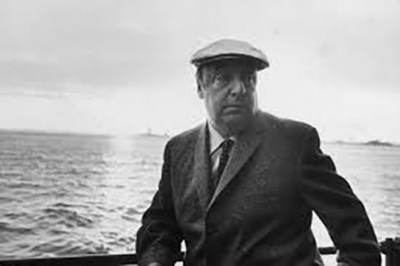
by Pablo Neruda
(English translation by Alastair Reid)
Now we will count to twelve
and we will all keep still.
For once on the face of the earth
let’s not speak in any language,
let’s stop for one second,
and not move our arms so much.
It would be an exotic moment
without rush, without engines,
we would all be together
in a sudden strangeness.
Fishermen in the cold sea
would not harm whales
and the man gathering salt
would look at his hurt hands.
Those who prepare green wars,
wars with gas, wars with fire,
victory with no survivors,
would put on clean clothes
and walk about with their brothers
in the shade, doing nothing.
What I want should not be confused
with total inactivity.
Life is what it is about;
I want no truck with death.
If we were not so single-minded
about keeping our lives moving,
and for once could do nothing,
perhaps a huge silence
might interrupt this sadness
of never understanding ourselves
and of threatening ourselves with death.
Perhaps the earth can teach us
as when everything seems dead
and later proves to be alive.
Now I’ll count up to twelve
and you keep quiet and I will go.