I love a good Target runas much as the next person. Stepping through the automatic doors of the popular superstore, it’s impossible to not feel uplifted. The lighting recalls the beckoning freedom of summer, and the colors are like a new crayon box. It’s a palpable promise of a fresh start.
One sweltering day several years ago, hearing the swoosh of the doors and feeling the relief from the sudden blast of air conditioning, I found myself drawn to an assortment of overflowing bins. “Happy Bargains!” a sign called out. “$1!” confirmed another. With my bright red cart, I eagerly approached. I mean, whowouldn’twant to go digging through bins to find a magical item that could yield joy? And at such low cost!
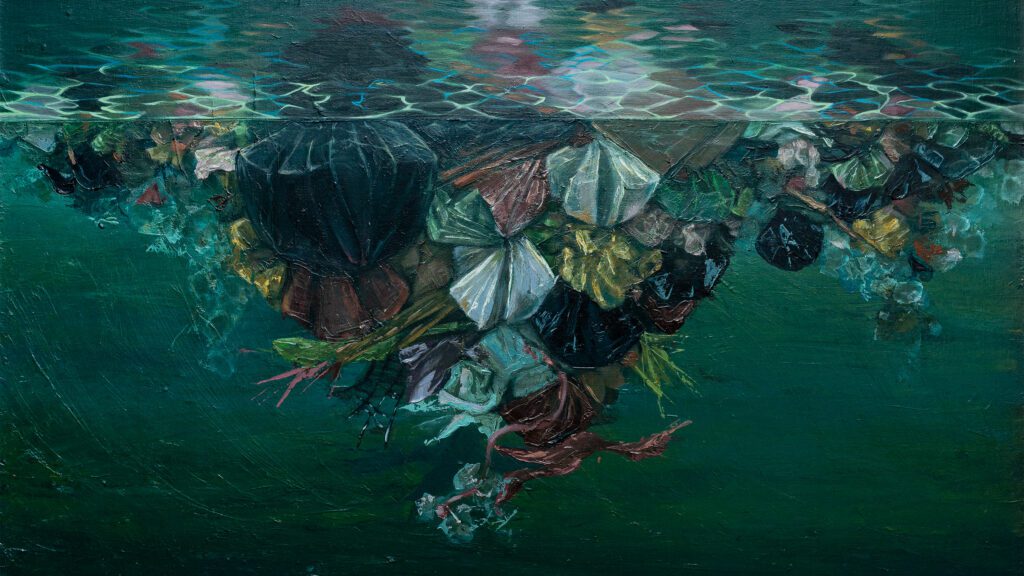
“Understanding the immensity of what’s at stake, how do we overcome the habit energy that drives us to pursue a kind of happiness that causes climate change?” I eventually picked something, but whether that item was a brightly colored notebook or a plastic cup with a sassy quip, I can’t recall what it was. However, I do remember that by the time I got home and unwrapped it on the kitchen counter, the promise of happiness had already faded. Like every other unnecessary item I’d ever purchased with the certainty that this was the thing that would finally solve the painful conundrum of being human, this thing was just more clutter. My interest in decluttering began on a family retreat with Thich Nhat Hanh. During one of his dharma talks, the Zen monk momentarily caught my eye while encouraging families to create what he called a breathing room—a space in the home for the practice of peace and compassion. A working mom of four school-aged kids, I became determined to create a breathing room for my family. I knew this meant I would need to let go of all the outgrown clothes, unused toys, and unfinished craft projects overwhelming our home. Yet when I attempted to do this, I realized that these possessions (possessions I’d purchased with the desperate hope that they could provide relief from suffering) were now causing me to suffer. Guilt, regret, worry, and anxiety about waste rose up to consume me, draining me of any real hope for change. And there, in the midst of my clutter, I bore witness to an endless cycle: Consuming emotions lead to consumer habits. Consumer habits lead to consuming emotions.“Wade” by Devan Horton www.devanhorton.comIn time, I became a professional declutterer, helping people realize that they—like me—had been caught in this cycle of consumption. I could hardly blame them for (literally) buying into the same delusion I had fallen for. The impulse to buy is remarkably human—and chasing after happiness even more so. Yet we’re not simply pursuing happiness; we’re running from our suffering toward some unfillable promise that, if we buy enough of the right things, we’ll find refuge. We know that illness, aging, and death are inextricable from our lives, and yet we still have the tendency to grab at every bauble as if it were a life preserver—an antidote to our impermanence. But our futile pursuit of a happiness that can be bought and sold is not just costing us in terms of overstuffed closets. I realized this when I transitioned unexpectedly from decluttering to the field of climate change.
When I started working in climate, I learned that for every “happy bargain” I purchase, a puff or two of carbon dioxide ascends to the atmosphere where it will remain for decades, trapping heat on the earth’s surface and warming the planet. Independently, the costs of my personal consumption are inconsequential. But multiply my habits by billions of consumers, and we begin to see the damage in millions of metric tons of daily carbon dioxide emissions.
We are pursuing individual happiness at the cost of our collective survival. We’re each attempting to outrun our suffering, and that suffering is gathering force in the atmosphere and circling back only to create more suffering. And though ultimately that suffering will touch every life on our planet, it will most gravely and unjustly impact those communities with the least economic resilience: those with the least economic capacity to run will suffer for the folly of those who have the economic resources to run the fastest. Our independent choices are no individual matter. We are careening down a dangerous path carried along by the momentum of what Thich Nhat Hanh would call our “habit energy”—energy acquired from our society that moves us along expediently without conscious thought or regard for outcome.
Understanding the immensity of what’s at stake, how do we overcome the habit energy that drives us to pursue a kind of happiness that causes climate change? One answer comes from a few lines of a gatha—a simple verse that I learned along with my children on that family retreat with Thich Nhat Hanh so many years ago:
Breathing in, I see myself as a flower. Breathing out, I feel fresh. Breathing in, I see myself as a mountain. Breathing out, I feel solid. Breathing in, I see myself as space. Breathing out, I feel free.
Here, in the midst of our steady, mindful breath, we’re reminded that the freshness and freedom we seek are not just characteristics of flowers and wide-open spaces; they’re also qualities inherent in us. We are reminded that, like mountains, we are solid and dignified; we have the sovereign capacity to be present to our suffering without being carried away by it or the urge to run from it.
So, the next time you’re standing in a superstore amidst overflowing bins wondering which bargain might offer respite from your discomfort, or your finger is hovering over the “Buy Now!” button on your phone screen, take some gentle breaths and repeat thatgatha, reminding yourself that freshness and freedom aren’t commodities, but gifts you carry. Tell yourself that you are solid as a mountain, and recall that you need not be carried away by your emotions or driven to consume as a panacea for your pain. In doing this, you won’t independently solve the problem of climate change, but you’ll resist the cycle of consumption driving it.
An equitable transition to a low-carbon economy is essential to our collective survival. We should work toward that transition with the urgency it demands. We should keep taking to the streets and calling our legislators to demand just environmental and economic policies that center the safety of the most marginalized. And as we do so, we can and should do what the Buddha proposed over two thousand years ago: stop trying to outrun suffering. Only then will we realize that happiness was never out of reach. Happiness and suffering—inevitable partners in life—dwell in the same location: precisely in the place we sit.
When the doctor sent my mother home to die, I went with her even though I didn’t know what I was supposed to do. In those days,hospice offered little support beyond a weekly nurse visit. I moved in, kept my mother clean, took care of her cat, made smoothies for her as long as she was able to swallow, and stood back when my aunt and sister came and went. I often told her I loved her.
But I made one mistake. When the nurse told me my mother would die that day and then left us alone, I laid down next to her and said that she didn’t have to be afraid, because God was waiting for her in heaven. We weren’t religious, and it rang false even then. I said it because I didn’t know what else to say.
A decade later, I left my conventional life and moved into a Zen monastery where I ordained as a priest. And a decade after that, back out in the world, I found work as a hospice chaplain. No one can teach you how to be a chaplain, so in learning what to say to dying people, and finding the courage to open my mouth and let words come out, I found my own experience to be my best teacher. I moved from wanting a person or a book to tell me exactly what to do and say, to contemplating for myself: What is this person really asking? What would I want, if I were them? What is helpful?
For some decades, death was hidden in hospitals behind closed curtains, turned over to the experts as if it were a failure, so my hospice patients were often surprised to learn that this time they weren’t going to get better. I believe that understanding what’s happening makes it easier to accept, and that acceptance is the key to grace, so I tried to talk openly with them. I used qualifiers, such as “just in case” or “if the doctors can’t find any more treatments,” to cushion the news that death was approaching.
It’s harder to listen than to talk, and my meditation practice helped me pay attention, to discern whether the information I was delivering was useful or hurtful, whether I should continue or whether I should back off and rest in platitudes. It was up to my patients. My only job was to not turn away.
I’d been a chaplain for about a year the first time I talked directly with someone about his death. By that time, I’d seen enough to have an idea of how his death was likely to go and had visited him enough times that there was trust between us. One afternoon when we were alone in his darkened hospital room, I asked whether he wanted to talk about his dying. He was eager to hear what I had to say. He was very old and worn out and had been bedridden for months, so I felt safe in telling him that watching death is like watching the lights go out gradually in a large house, one at a time, until the building is dark. I told him that his death would probably be like that, a fading away, and that he probably wouldn’t feel pain or even distress. He was grateful and, as it turned out, his wife and daughter told me that his death was indeed gentle, and my talking about it with him was the kindest thing I could have done.
Many people struggle to hold on to life. When death approaches, they grow restless and agitated. They fight. Sometimes what people need to know is that their job of waking up one more day, no matter what their circumstances are, is over. They can relax.
I found something useful to say when I told a dying woman, “You know, this is only going one way. The doctors say they’ve done all they can do, and you’re probably not going to get well this time. You have before, but not now.” Another thing I said, because that’s what I would want to hear, was “You are safe.”
What I’d tell a lot of people is that curiosity about death can replace fear. I’d say, “This is just death. You’re okay. I mean, I know that’s easy for me to say. You’re the one who’s doing it, not me, but this is the very natural thing that we all know is coming. It’s just coming soon for you.
“We’re afraid of death because we think we’re separate, and we have to keep our walls up. There’s something else going on, though, and I think you already know about it—you’re a part of the universe and will never be separate from that no matter what happens to your body. It’ll help if you can remember that you’re connected.
“And there’s something else I’ve heard about working with the fear of death. I heard this in a talk from a great American Zen master. He said his wife was dying and that she was facing it with an attitude of curiosity, asking over and over, ‘What is this?’ If you’re engaging with curiosity, there’s no room for fear.”
There were times when words weren’t possible.My patient Catherine had outlived her friends and her money, so she was living in a sad facility. She was cheerful and well-liked, and such staff as there were, were glad she had a regular visitor at last. The only time I heard her complain was when she said she’d been left in a dirty diaper for hours over the weekend. When we first met, she was nearly deaf, so I would slowly shout answers to her questions. As her hearing became worse, even that was impossible, so I’d ask her to tell me stories about her childhood and settle back and listen. We became friends. By the time death was near, when it was clear she was down to her final hours, the only way I could offer comfort was to sit by her bed and put my hand on her arm to let her know she wasn’t alone. I believe she knew I was there, and I believe it was enough.
Ira Byock, an expert on death and dying who has written many books, says we should tell dying people four things: “Please forgive me,” “I forgive you,” “Thank you,” and “I love you.”
Although those words don’t come naturally to many of us, they need to be said, either with words or actions. When patients’ families asked me what they should do, when it was clear that their loved one was going through the final hours of life, what I could tell them with confidence is that their job was to love. I’d join them in prayer if they were Christian. If they asked me to beg God for healing, I’d suggest acceptance instead. Many of my patients were not practicing Christians, yet they also wanted some spiritual reassurance. They often asked me where I thought we’d go after death, and I always said I didn’t know. “Sit with your mother and love her,” I’d say. “Let her know she’s not alone, and that her work here is finished. That’s what she needs now.”
One day when I was visiting in a large facility, I entered a long corridor and heard someone repeating, “Hello? Hello? Hello?” I saw an old lady standing in an open door, leaning on her walker and calling out. I went to her and introduced myself and soon realized that she was blind and her talking watch had been mis-set and was telling her it was time for dinner when it was only mid-afternoon. We went into her room and chatted for a bit. I was able to use my phone to find instructions for setting the watch, and I took care of that. But for me, the time and the dinner weren’t the point. The loneliness was, the calling out for help into the silence.
She was giving voice to what we all feel, what we all need: “Hello? Am I alone? Does anybody see me?” In death and in life, the one best thing there is for us to say to each other, however long we might have between this day and our death, is “I see you. You’re not alone.”
If I had my mother’s death to do over, knowing what I know now, I’d do just what I did then, except for that one thing I said at the time of her dying that I can’t take back. We had already offered and received forgiveness and gratitude. So, I’d only say I love you, again and again, letting those be the final words she would hear as she left this life.
In the great silence of these distances, I am touched by your beautiful anxiety about life, even more than I was in Paris, where everything echoes and fades away differently because of the excessive noise that makes Things tremble. Here, where I am surrounded by an enormous landscape, which the winds move across as they come from the seas, here I feel that there is no one anywhere who can answer for you those questions and feelings which, in their depths, have a life of their own; for even the most articulate people are unable to help, since what words point to is so very delicate, is almost unsayable.
But even so, I think that you will not have to remain without a solution if you trust in Things that are like the ones my eyes are now resting upon. If you trust in Nature, in the small Things that hardly anyone sees and that can so suddenly become huge, immeasurable; if you have this love for what is humble and try very simply, as someone who serves, to win the confidence of what seems poor: then everything will become easier for you, more coherent and somehow more reconciling, not in your conscious mind perhaps, which stays behind, astonished, but in your innermost awareness, awakeness, and knowledge.
You are so young, so much before all beginning, and I would like to beg you, dear Sir, as well as I can, to have patience with everything unresolved in your heart and to try to love the questions themselves as if they were locked rooms or books written in a very foreign language. Don't search for the answers, which could not be given to you now, because you would not be able to live them. And the point is, to live everything. Live the questions now. Perhaps then, someday far in the future, you will gradually, without even noticing it, live your way into the answer. Perhaps you do carry within you the possibility of creating and forming, as an especially blessed and pure way of living; train yourself for that -- but take whatever comes, with great trust, and as long as it comes out of your will, out of some need of your innermost self, then take it upon yourself.
--Rainer Maria Rilke, from "Letters to a Young Poet"
From Rainer Maria Wilke's letters to a young poet.
Dear D, you had a portion of what I boldfaced below on your refrigerator when you lived on L Avenue in SP back in the 70s, early 80s. Love from your bro, Chick
But even so, I think that you will not have to remain without a solution if you trust in Things that are like the ones my eyes are now resting upon. If you trust in Nature, in the small Things that hardly anyone sees and that can so suddenly become huge, immeasurable; if you have this love for what is humble and try very simply, as someone who serves, to win the confidence of what seems poor: then everything will become easier for you, more coherent and somehow more reconciling, not in your conscious mind perhaps, which stays behind, astonished, but in your innermost awareness, awakeness, and knowledge.
You are so young, so much before all beginning, and I would like to beg you, dear Sir, as well as I can, to have patience with everything unresolved in your heart and to try to love the questions themselves as if they were locked rooms or books written in a very foreign language. Don't search for the answers, which could not be given to you now, because you would not be able to live them. And the point is, to live everything. Live the questions now. Perhaps then, someday far in the future, you will gradually, without even noticing it, live your way into the answer. Perhaps you do carry within you the possibility of creating and forming, as an especially blessed and pure way of living; train yourself for that -- but take whatever comes, with great trust, and as long as it comes out of your will, out of some need of your innermost self, then take it upon yourself.
--Rainer Maria Rilke, from "Letters to a Young Poet"
Setting an intention is making a decision about who you want to be and how you choose to show up. Over time, those choices become change. Let's begin.
Hello, and welcome to Insight Timers' intention setting challenge. My name is Mark Epstein, and today we're exploring patience. Not as passive waiting, but as the willingness to stay with ourselves, with our own minds, while life takes the time it needs.
Often, suffering comes from the tension between our desire for change, and the pace at which change naturally happens. Especially at the start of a new year, we can feel pressure to change everything at once. But transformation rarely happens on a deadline. It happens in its own time.
We rush, push, and try to force outcomes, because the uncertainty feels uncomfortable. But when we soften around that discomfort, when we let things breathe, we discover a different kind of ease... a trust that life unfolds, whether we strain against it, or not.
To help us integrate this, the intention I'm encouraging you to carry through your day to day is, "Today, I'll let things unfold in their own time."
Let's practice together. Find a comfortable position, sitting, standing, or lying down, and allow your attention to come into your body, just feeling whatever your body is feeling, right now... as it's supported by the cushion, by the chair, by the floor. However, it's being held. Let your body feel held.
Let your breath come and go on its own. Not straining, not pushing. Not trying to make the breath something more or less than it is. Feeling the body, feeling the breath, and then, feeling the mind. Allow your mind to rest in the body, the way the body is resting in the chair, on the cushions, on the floor. And then in practicing patience, what we're really practicing is kindness to our own minds.
Notice How the body does what it does. Notice... how the breath... comes and goes in its own way. Notice how your mind does what it does outside of your control. Thoughts arise, feelings arise. The same way the sounds, or disturbances from the outside, arise. None of which we really have direct control over. All we can control is how we relate to whatever it is that is happening in our experience.
So let's pay attention to how we're relating to whatever it is that we are experiencing right now. Are we chafing at what's happening just a little bit? Are we judging what's happening? Just a little bit? Is there irritation? Is there uncertainty? Or are we... relaxed, open, impartial, accepting... unchallenging for the moment of whatever it is.... that's arising and passing away. Just pay attention to the quality of your mind, not judging it, you know?
But what is the quality of your mind right now? There's a famous Japanese haiku? The old pond, a frog jumps in, plop. The old pond is like your mind. What is it like? A frog jumping in is like a thought, a feeling, a sound, a disturbance. Plop. The ripples that it makes in your mind. Can we allow the ripples? Just to dissipate.
As we sit with open, relaxed, kind-hearted awareness. And before you move into the rest of your day, take another breath and feel the space within and around you. Notice that nothing more needs to happen right now than this. A simple moment of being here. Remember, today, and for the year ahead, today, I'll let things unfold in their own time.
On the next few screens, you'll be invited to set this intention, or your own version of it, on your insight timer home screen. The simple act of seeing your intention reflected back throughout the day is enough to create change. Thanks for being here with me today. And good luck with the rest of the challenge.
From Rainer Maria Wilke's letters to a young poet.
But even so, I think that you will not have to remain without a solution if you trust in Things that are like the ones my eyes are now resting upon. If you trust in Nature, in the small Things that hardly anyone sees and that can so suddenly become huge, immeasurable; if you have this love for what is humble and try very simply, as someone who serves, to win the confidence of what seems poor: then everything will become easier for you, more coherent and somehow more reconciling, not in your conscious mind perhaps, which stays behind, astonished, but in your innermost awareness, awakeness, and knowledge.
You are so young, so much before all beginning, and I would like to beg you, dear Sir, as well as I can, to have patience with everything unresolved in your heart and to try to love the questions themselves as if they were locked rooms or books written in a very foreign language. Don't search for the answers, which could not be given to you now, because you would not be able to live them. And the point is, to live everything. Live the questions now. Perhaps then, someday far in the future, you will gradually, without even noticing it, live your way into the answer. Perhaps you do carry within you the possibility of creating and forming, as an especially blessed and pure way of living; train yourself for that -- but take whatever comes, with great trust, and as long as it comes out of your will, out of some need of your innermost self, then take it upon yourself.
--Rainer Maria Rilke, from "Letters to a Young Poet"